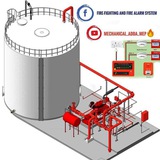
This media is not supported in the widget
VIEW IN TELEGRAM
5.Understand the pump curve at three critical points:
- Churn (zero flow)
- Rated flow
- 150% of rated flow
6. Jockey Pump
This smaller pump maintains system pressure under normal conditions, compensates for minor leakage, and starts and stops automatically based on system pressure so the main fire pump is not activated unnecessarily.
7. Driver and Control
The pump is driven by either an electric motor or a diesel engine and is controlled by a dedicated fire-pump controller (with battery charger and batteries where required).
8. Engineering Checklist
- Hydraulic demand (flow and pressure)
Available water supply
Suction conditions (NPSH, pipe size, length)
Required discharge pressure
- Pump curve (duty point and 150% flow)
Driver capacity (hp/kW)
Electrical or fuel arrangement
- Equipment listing/approval
- Installation configuration
- AHJ requirements
9. Testing & Acceptance
Installation and acceptance testing under NFPA 20 are distinct from routine inspection, testing, and maintenance under NFPA 25. Always follow the acceptance-test requirements for flow, pressure, and duration carefully.
10. Key Takeaway
A fire pump is never selected by flow rate alone. It must satisfy the full hydraulic demand while complying with the applicable NFPA requirements, adopted codes, and AHJ criteria.
❤1
Hey! Check out Fire-fighting and Fire Alarm system 's profile on Flipkart Play
https://dl.flipkart.com/dl/creator/profile?profileId=PAGOJ5LOZSWJO&profileId=PAGOJ5LOZSWJO&affid=inf_a3905193-5e59-4f39-a808-32db1ef7a2b9&_refId=&_appId=CL
https://dl.flipkart.com/dl/creator/profile?profileId=PAGOJ5LOZSWJO&profileId=PAGOJ5LOZSWJO&affid=inf_a3905193-5e59-4f39-a808-32db1ef7a2b9&_refId=&_appId=CL
This media is not supported in the widget
VIEW IN TELEGRAM
❤1
This media is not supported in the widget
VIEW IN TELEGRAM
❤1
Fire-fighting and Fire Alarm system 👷🏻🧰
Photo
🔥 ONE MEASUREMENT CAN HIDE A PROBLEM.
🔹 Redundancy → more than one measurement of the same critical variable
🔹 Voting logic → compares multiple inputs before taking defined action
🔹 Diagnostic coverage → helps identify certain sensor or signal faults
For critical functions, the design may use 2oo3, 1oo2 or other voting architectures, depending on the required safety integrity and system design.
WHY THREE SENSORS INSTEAD OF ONE?
DEEBOM ENGINEERING ACADEMY
Oil & Gas Master Class
#SafetyInstrumentation #SIS #ProcessSafety #DeebomEngineeringAcademy
Fire-fighting and Fire Alarm system 👷🏻🧰
1790648856772.pdf
MECHANICAL SEALS - DESIGN, SELECTION & RELIABILITY
1 Purpose----
Mechanical seals are critical components in rotating equipment, particularly pumps. Their primary function is to control leakage from the seal chamber and prevent air from entering the pump.
2 Essential Components-----
A mechanical seal consists of:
Primary sealing elements - rotating and stationary faces
Secondary sealing elements - dynamic and static seals
Hardware - drive, loading, and adaptive elements
Reliable sealing depends on maintaining the correct lubricating film between the sealing faces.
3 Seal Arrangements----
Mechanical seals can be classified by arrangement:
Single
Dual
Cartridge
Hydrostatic Pressure Testing - Inspection Perspective
Hydrostatic testing is a critical stage of mechanical integrity and quality assurance, used to verify the strength and leak-tightness of pressure-containing equipment and piping.
Key Inspection Points: Approved test procedure & test pack
Correct test pressure as per applicable Code/Project
Specification
Calibrated pressure gauges
Proper venting and complete air removal
Controlled pressurization and pressure holding
Visual examination for leakage at welds, joints, flanges & fittings
Recording pressure, temperature and test duration
Typical ASME Code References:
ASME B31.3- Para. 345 Leak Testing
ASME BPVC Section VIII, Div. 1- UG-99
Hydrostatic Test
ASME B31.1- Hydrostatic testing requirements for
Power Piping
The applicable Code edition, project specification and client requirements shall always govern the actual test requirements.
GoLive +1
Quality Inspection | TPI | Mechanical Integrity |
Hydrostatic Testing
#Hydrotest #Hydrostatic
❤2
### 🔧 90° Elbow vs 2 × 45° Elbows
In piping design, the way you change direction matters.
A 90° elbow creates a sharper flow direction change, while two 45° elbows can provide a smoother transition—but require more material, space, and installation work.
Good piping design = balancing pressure loss, cost, space, and installation.
#PipingEngineering #PipelineEngineering #PipeFittings #Elbow #90DegreeElbow #45DegreeElbow #PressureLoss #FluidFlow #Hydraulics #MechanicalEngineering #MEPEngineering #PipingDesign #EngineeringKnowledge #FireFighting #FireProtectionEngineering #EngineeringTips
❤3
MEP Project Manager: One Person, Many Expectations!
Managing MEP services is far more than engineering -it is the art of balancing competing priorities, tight timelines, and multiple stakeholder expectations on a single job site.
Here is a reality check on what an MEP Project
Manager balances every day:
The Multi-Directional Tug-of-War
Client: "I want it FASTER!" (Prioritizing early handovers and commissioning).
Top Management: "I want it CHEAPER!" (Focusing on value engineering and strict budget control).
MEP Design Team: "I want QUALITY!" (Ensuring engineering design standards and specifications are never compromised).
❤2
This media is not supported in the widget
VIEW IN TELEGRAM
❤1
This media is not supported in the widget
VIEW IN TELEGRAM
❤2
This media is not supported in the widget
VIEW IN TELEGRAM
❤1
Hose Reel System - A Simple but Essential
Firefighting Facility
A hose reel system is an important part of a building's fire protection arrangement, designed to provide a readily available and continuous supply of water for dealing with small fires during the early stages of an incident.
Unlike portable firefighting equipment, a hose reel is permanently connected to the building's fire-water network, allowing trained occupants or responders to access water quickly and direct it toward the fire.
❤3👍1