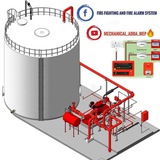
Fire-fighting and Fire Alarm system 👷🏻🧰
Photo
*Venturimeter – Short*
Device to measure flow rate of fluid in a pipe.
*Parts:*
1. Converging Cone
2. Throat (small dia)
3. Diverging Cone
*Principle:* Bernoulli's – Pressure drops at throat, velocity increases.
*Formula:* $Q = A \cdot V$
Used in water line, chiller line, pump testing.
#Venturimeter #FlowMeasurement #MEP
Device to measure flow rate of fluid in a pipe.
*Parts:*
1. Converging Cone
2. Throat (small dia)
3. Diverging Cone
*Principle:* Bernoulli's – Pressure drops at throat, velocity increases.
*Formula:* $Q = A \cdot V$
Used in water line, chiller line, pump testing.
#Venturimeter #FlowMeasurement #MEP
❤1
This media is not supported in the widget
VIEW IN TELEGRAM
❤1
Forwarded from MEP Tech Talk
QC Procedure for piping field fabrication and erection-1.pdf
1.2 MB
QC Procedure for piping field fabrication and erection-1.pdf
❤2
1790074278034.pdf
780.6 KB
PRESSURE VESSELS - THE CORE OF INDUSTRIAL SAFETY & RELIABILITY
1 What Pressure Vessels Are Used For
Pressure vessels play key roles such as:
Separators and knockout drums
* Reactors and catalyst beds
* Fractionators and distillation towers
*Heat exchangers and condensers
High-pressure storage (LPG, gas, chemicals)
1 What Pressure Vessels Are Used For
Pressure vessels play key roles such as:
Separators and knockout drums
* Reactors and catalyst beds
* Fractionators and distillation towers
*Heat exchangers and condensers
High-pressure storage (LPG, gas, chemicals)
❤3🔥1
Matching Valve Dynamics to Application
Requirements
Selecting the optimal valve type is crucial for system integrity, flow control precision, and long-term operational performance. Here is a breakdown of 8 primary valve configurations and their primary industrial applications:
1 Ball Valve: Low operating torque and tight seal; optimal for rapid quarter-turn isolation.
2 Butterfly Valve: Space-saving design with lower face-to-face dimensions, ideal for high-flow, large-diameter piping.
3 Gate Valve: Full-bore design delivering minimum fluid friction and negligible pressure drop in full-open conditions.
4 Globe Valve: Linear motion design offering accurate throttling and stable flow regulation.
5 Check Valve: Self-actuating uni-directional valve to prevent dynamic backflow and hydraulic shock.
6 Solenoid Valve: Electromechanical control for high-speed automated process switching and pilot actuation.
7 Diaphragm Valve: Isolated media pathway designed for cleanroom operations or highly aggressive
❤4