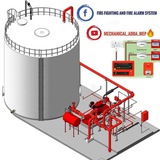
Fire-fighting and Fire Alarm system 👷🏻🧰
Photo
❓ FIRE PUMP CALCULATION:
How do you calculate Fire Pump Flow Rate?
Formula:
Total Flow =
Sprinkler Demand + Hydrant Demand
Example:
Sprinkler Flow = 1,000 L/min
Hydrant Flow = 500 L/min
Total Flow =
1,000 + 500
= 1,500 L/min
Convert to m³/hr:
1,500 × 60 ÷ 1,000
= 90 m³/hr
✅ Fire Pump Flow Rate = 90 m³/hr
Final pump flow should be determined from the applicable fire-protection standard and hydraulic calculation.
#FirePump #FirePumpCalculation #FireProtection #MEPEngineering #PumpCalculation
❤1
❓ CHILLER CALCULATION:
How do you calculate Chilled Water Flow Rate?
Formula:
Q = Cooling Capacity ÷ (ρ × Cp × ΔT)
Example:
Cooling Capacity = 350 kW
Water Density (ρ) = 1000 kg/m³
Cp = 4.186 kJ/kg·K
ΔT = 5°C
Mass Flow =
350 ÷ (4.186 × 5)
≈ 16.73 kg/s
Convert to m³/hr:
16.73 × 3.6
≈ 60.2 m³/hr
✅ Chilled Water Flow Rate ≈ 60.2 m³/hr
This calculation is useful for preliminary chiller, chilled water pump and pipe sizing.
#ChillerCalculation #HVAC #MEPEngineering #ChilledWater #HVACDesign
❤3👍2
3 Main components of the fire Hydrant System?
1 ...
2 ...
3 ...
1 ...
2 ...
3 ...
This media is not supported in your browser
VIEW IN TELEGRAM
Belt tension - tight side, slack side, and the setup tension you need before starting.
Te = Px1000/v | T₁/T₂ = e^(μθ)
P=7.5kW | v=10m/s | μ=0.35 | 0=160°=2.79rad
Te = 750N | e^(μθ) = e^0.977 = 2.657
T₁ = 750×2.657/1.657 = 1,203 N (tight side)
T₂ = 1,203-750 = 453 N (slack side)
Initial setup tension: Ti = (1,203+453)/2 = 828N per strand
Under-tension: belt slips. Over-tension: bearing loads too high, belt fatigue. Get it right and the belt lasts years.
Save this belt tension calculation reference.
Do you use a tension gauge or the deflection method to set your belt tension?
#BeltTension #BeltDrive #Mechanical Engineering
❤2
This media is not supported in the widget
VIEW IN TELEGRAM