These people evidently think that socialism calls for equalisation, for levelling the requirements and personal, everyday life of the members of society. Needless to say, such an assumption has nothing in common with Marxism, with Leninism. By equality Marxism means, not equalisation of personal requirements and everyday life, but the abolition of classes, i.e., a) the equal emancipation of all working people from exploitation after the capitalists have been overthrown and expropriated; b) the equal abolition for all of private property in the means of production after they have been converted into the property of the whole of society; c) the equal duty of all to work according to their ability, and the equal right of all working people to receive in return for this according to the work performed (socialist society); d) the equal duty of all to work according to their ability, and the equal right of all working people to receive in return for this according to their needs (communist society). Moreover, Marxism proceeds from the assumption that people's tastes and requirements are not, and cannot be, identical and equal in regard to quality or quantity, whether in the period of socialism or in the period of communism.
There you have the Marxist conception of equality.
Marxism has never recognised, and does not recognise, any other equality.
To draw from this the conclusion that socialism calls for equalisation, for the levelling of the requirements of the members of society, for the levelling of their tastes and of their personal, everyday life—that according to the Marxist plan all should wear the same clothes and eat the same dishes in the same quantity—is to utter vulgarities and to slander Marxism.
It is time it was understood that Marxism is an enemy of equalisation. Already in the Manifesto of the Communist Party Marx and Engels scourged primitive utopian socialism and termed it reactionary because it preached "universal asceticism and social levelling in its crudest form." 11 In his Anti-Duhring Engels devoted a whole chapter to a withering criticism of the "radical equalitarian socialism" put forward by Duhring in opposition to Marxist socialism.
". . . The real content of the proletarian demand for equality," said Engels, "is the demand for the abolition of classes. Any demand for equality which goes beyond that, of necessity passes into absurdity." 12
Lenin said the same thing:
"Engels was a thousand times right when he wrote that to conceive equality as meaning anything beyond the abolition of classes is a very stupid and absurd prejudice. Bourgeois professors have tried to make use of the concept of equality to accuse us of wanting to make all men equal to one another. They have tried to accuse the Socialists of this absurdity, which they themselves invented. But in their ignorance they did not know that the Socialists—and precisely the founders of modern scientific socialism, Marx and Engels—said: Equality is an empty phrase unless equality is understood to mean the abolition of classes. We want to abolish classes, and in this respect we stand for equality. But the claim that we want to make all men equal to one another is an empty phrase and a stupid invention of intellectuals" (Lenin's speech "On Deceiving the People with Slogans About Liberty and Equality," Works, Vol. XXIV, pp. 2 9 3 - 9 4 13).
Clear, one would think.
Bourgeois writers are fond of depicting Marxist socialism in the shape of the old tsarist barracks, where everything is subordinated to the "principle" of equalisation. But Marxists cannot be held responsible for the ignorance and stupidity of bourgeois writers.
J. V. Stalin
Report to the Seventeenth Party Congress on the Work of the Central Committee of the C.P.S.U.(B.)
January 26, 1934
@Communism
There you have the Marxist conception of equality.
Marxism has never recognised, and does not recognise, any other equality.
To draw from this the conclusion that socialism calls for equalisation, for the levelling of the requirements of the members of society, for the levelling of their tastes and of their personal, everyday life—that according to the Marxist plan all should wear the same clothes and eat the same dishes in the same quantity—is to utter vulgarities and to slander Marxism.
It is time it was understood that Marxism is an enemy of equalisation. Already in the Manifesto of the Communist Party Marx and Engels scourged primitive utopian socialism and termed it reactionary because it preached "universal asceticism and social levelling in its crudest form." 11 In his Anti-Duhring Engels devoted a whole chapter to a withering criticism of the "radical equalitarian socialism" put forward by Duhring in opposition to Marxist socialism.
". . . The real content of the proletarian demand for equality," said Engels, "is the demand for the abolition of classes. Any demand for equality which goes beyond that, of necessity passes into absurdity." 12
Lenin said the same thing:
"Engels was a thousand times right when he wrote that to conceive equality as meaning anything beyond the abolition of classes is a very stupid and absurd prejudice. Bourgeois professors have tried to make use of the concept of equality to accuse us of wanting to make all men equal to one another. They have tried to accuse the Socialists of this absurdity, which they themselves invented. But in their ignorance they did not know that the Socialists—and precisely the founders of modern scientific socialism, Marx and Engels—said: Equality is an empty phrase unless equality is understood to mean the abolition of classes. We want to abolish classes, and in this respect we stand for equality. But the claim that we want to make all men equal to one another is an empty phrase and a stupid invention of intellectuals" (Lenin's speech "On Deceiving the People with Slogans About Liberty and Equality," Works, Vol. XXIV, pp. 2 9 3 - 9 4 13).
Clear, one would think.
Bourgeois writers are fond of depicting Marxist socialism in the shape of the old tsarist barracks, where everything is subordinated to the "principle" of equalisation. But Marxists cannot be held responsible for the ignorance and stupidity of bourgeois writers.
J. V. Stalin
Report to the Seventeenth Party Congress on the Work of the Central Committee of the C.P.S.U.(B.)
January 26, 1934
#Stalin #Lenin #Marx #Engels #Equality
@Communism
👍7❤3🔥1
The Holy Family
or Critique of Critical Criticism.
Against Bruno Bauer and Company
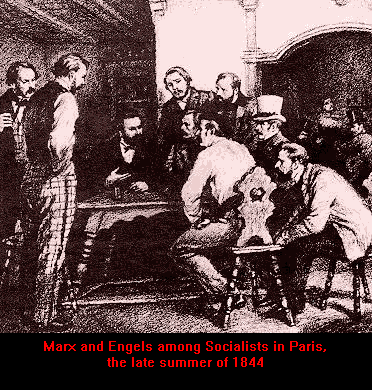
During Engels' short stay in Paris in 1844, Marx suggested the two of them should write a critique of the rage of their day, the Young Hegelians. In the doing was born the first joint writing project between the two men -- and a life-long association that would change the world.
At the end of August, 1844, Engels passed through Paris, en route to his employment in Manchester, England, from visiting his family in Barmen (Germany). During 10 days in the French capital, he met Marx (for the second time).
After talking, they began drawing up plans for a book about the Young Hegelian trend of thought very popular in academic circles. Agreeing to co-author the Foreword, they divided up the other sections. Engels finished his assigned chapters before leaving Paris. Marx had the larger share of work, and he completed it by the end of November 1844. (Marx would draw from his Economic and Philosophical Manuscripts, on which he'd been working the spring and summer of 1844.)
The foremost title line — “The Holy Family” — was added at the suggestion of the book publisher Lowenthal. It's a sarcastic reference to the Bauer brothers and their supporters.
The book made something of a splash in the newspapers. One paper noted, that it expressed socialist views since it criticised the “inadequacy of any half-measures directed at eliminating the social ailments of our time.” The conservative press immediately recognized the radical elements inherent in its many arguments. One paper wrote that, in The Holy Family, “every line preaches revolt... against the state, the church, the family, legality, religion and property.” It also noted that “prominence is given to the most radical and the most open communism, and this is all the more dangerous as Mr. Marx cannot be denied either extremely broad knowledge or the ability to make use of the polemical arsenal of Hegel’s logic, what is customarily called ‘iron logic.’
Lenin would later claim this work laid the foundations for what would develop into a scientific revolutionary materialist socialism.
Bruno Bauer attempted to rebut the book in the article “Charakteristik Ludwig Feuerbachs” — which was published in Wigand’s Vierteljahrsschrift, Leipzig 1845. Bauer essentially claimed that Marx and Engels misunderstood what he was really saying. Marx would reply to that article with his own article — published in the journal Gesellschaftsspiegel, Elberfeld, January 1846. And the matter was also discussed in chapter 2 of The German Ideology.
Source
@Communism
or Critique of Critical Criticism.
Against Bruno Bauer and Company
“When I visited Marx in Paris in the summer of 1844,
our complete agreement in all theoretical fields
became evident and our joint work dates from that time.”
Frederick Engels
During Engels' short stay in Paris in 1844, Marx suggested the two of them should write a critique of the rage of their day, the Young Hegelians. In the doing was born the first joint writing project between the two men -- and a life-long association that would change the world.
At the end of August, 1844, Engels passed through Paris, en route to his employment in Manchester, England, from visiting his family in Barmen (Germany). During 10 days in the French capital, he met Marx (for the second time).
After talking, they began drawing up plans for a book about the Young Hegelian trend of thought very popular in academic circles. Agreeing to co-author the Foreword, they divided up the other sections. Engels finished his assigned chapters before leaving Paris. Marx had the larger share of work, and he completed it by the end of November 1844. (Marx would draw from his Economic and Philosophical Manuscripts, on which he'd been working the spring and summer of 1844.)
The foremost title line — “The Holy Family” — was added at the suggestion of the book publisher Lowenthal. It's a sarcastic reference to the Bauer brothers and their supporters.
The book made something of a splash in the newspapers. One paper noted, that it expressed socialist views since it criticised the “inadequacy of any half-measures directed at eliminating the social ailments of our time.” The conservative press immediately recognized the radical elements inherent in its many arguments. One paper wrote that, in The Holy Family, “every line preaches revolt... against the state, the church, the family, legality, religion and property.” It also noted that “prominence is given to the most radical and the most open communism, and this is all the more dangerous as Mr. Marx cannot be denied either extremely broad knowledge or the ability to make use of the polemical arsenal of Hegel’s logic, what is customarily called ‘iron logic.’
Lenin would later claim this work laid the foundations for what would develop into a scientific revolutionary materialist socialism.
Bruno Bauer attempted to rebut the book in the article “Charakteristik Ludwig Feuerbachs” — which was published in Wigand’s Vierteljahrsschrift, Leipzig 1845. Bauer essentially claimed that Marx and Engels misunderstood what he was really saying. Marx would reply to that article with his own article — published in the journal Gesellschaftsspiegel, Elberfeld, January 1846. And the matter was also discussed in chapter 2 of The German Ideology.
Source
@Communism
👍7
THE HOLY FAMILY Karl Marx and Frederick Engels.pdf
13.7 MB
The Holy Family (1845) is a book written by Marx and Engels, where they criticize the young Hegelian philosophers, particularly Bruno Bauer. These philosophers focused on abstract ideas and idealism, rather than practical, material conditions. Marx and Engels argue that history and society should be understood through the lens of materialism and class struggle, not abstract theories. The book marks an early stage in their development of ideas that later became central to Marxist thought, laying the groundwork for their more famous works, like the Communist Manifesto. It's a shift from idealist philosophy to a materialist, class-based approach to understanding the world.
@Communism
#Book #PDF #KarlMarx #Marx #Engels
@Communism
👍10
Vladimir Mayakovsky 1917
Call To Account!
The drum of war thunders and thunders.
It calls: thrust iron into the living.
From every country
slave after slave
are thrown onto bayonet steel.
For the sake of what?
The earth shivers
hungry
and stripped.
Mankind is vapourised in a blood bath
only so
someone
somewhere
can get hold of Albania.
Human gangs bound in malice,
blow after blow strikes the world
only for
someone’s vessels
to pass without charge
through the Bosporus.
Soon
the world
won’t have a rib intact.
And its soul will be pulled out.
And trampled down
only for someone,
to lay
their hands on
Mesopotamia.
Why does
a boot
crush the Earth — fissured and rough?
What is above the battles’ sky -
Freedom?
God?
Money!
When will you stand to your full height,
you,
giving them your life?
When will you hurl a question to their faces:
Why are we fighting?
@Communism
Call To Account!
The drum of war thunders and thunders.
It calls: thrust iron into the living.
From every country
slave after slave
are thrown onto bayonet steel.
For the sake of what?
The earth shivers
hungry
and stripped.
Mankind is vapourised in a blood bath
only so
someone
somewhere
can get hold of Albania.
Human gangs bound in malice,
blow after blow strikes the world
only for
someone’s vessels
to pass without charge
through the Bosporus.
Soon
the world
won’t have a rib intact.
And its soul will be pulled out.
And trampled down
only for someone,
to lay
their hands on
Mesopotamia.
Why does
a boot
crush the Earth — fissured and rough?
What is above the battles’ sky -
Freedom?
God?
Money!
When will you stand to your full height,
you,
giving them your life?
When will you hurl a question to their faces:
Why are we fighting?
#Mayakovsky #Poetry #Poem
@Communism
❤10
Media is too big
VIEW IN TELEGRAM
LA’s mayor cut the fire department budget and increased the police budget. Now California is burning and the city hasn’t been able to put out any of the fires.
theredstream
theredstream
😁5😢2🤬1
🔴 The Los Angeles inferno: A historic crime of capitalism (1)
✍🏻 Niles Niemuth
California is facing what could be its most devastating wildfire in history, with fires burning uncontrolled throughout Los Angeles County. Images shared widely on social media show whole neighborhoods and city block after city block completely burned to the ground, amid reports that firefighters have been unable to even access water to extinguish the flames as their lines have run dry.
Despite the region’s immense wealth, the lack of adequate firefighting resources and decrepit infrastructure have left many communities defenseless against the flames. California, home to 186 billionaires, the most of any US state, has proven unable to protect its citizens from the ravages of climate change-fueled wildfires.
Evacuation orders have been issued for parts of Los Angeles, Orange, San Bernardino, Riverside, Ventura and Santa Barbara counties, with the scale of the disaster overwhelming emergency services. To date, 100,000 people have been ordered to leave their homes under the threat of flames, and it is estimated insured losses could reach $10 billion or more.
According to the latest reports, more than 1,000 structures, mostly homes, have been destroyed in Los Angeles County, and at least five deaths have been confirmed. Seven active fires are currently burning, with zero percent containment. Over 27,000 acres have already been scorched, and the confirmed death toll is expected to rise significantly.
Residents have shared harrowing accounts on social media, describing scenes of entire neighborhoods being consumed by the fires. Many were forced to make the agonizing decision to flee their homes as embers surrounded them, with some becoming trapped in their vehicles. Others were unable to flee as the flames bore down, becoming trapped in their homes. The lack of early evacuation orders, despite Red Flag Warnings, has exacerbated the crisis.
Another key factor contributing to the disaster is the severe shortage of firefighters. Firefighters are being flown in from neighboring states like Nevada, Oregon, and Washington, as local resources have been depleted. This shortage can be directly attributed to recent budget cuts signed by Democratic Mayor Karen Bass, with the Los Angeles Fire Department seeing a $17.6 million reduction, while the police department received a $126 million increase.
Democratic-controlled California is notorious for exploiting the labor of prison inmates to fight wildfires, paying them as little as $5.80 per day and $1 per hour when responding to a disaster, much less than the $28 per hour which is paid to an average firefighter.
Smoke from the fires has spread across the most populated county in the United States, putting up to 10 million at risk of the effects of inhaling carcinogenic particulates.
The spark for the firestorm was provided by the Santa Ana winds whipping down from inland mountain passes, bringing gusts of up to 100 miles per hour, the equivalent of a Category 2 hurricane. These same winds have spread embers up to a mile away, challenging efforts to confront the flames.
The tinder was provided by extremely dry conditions fueled by climate change. Los Angeles County and much of Southern California are in drought conditions, having recorded no significant rainfall for eight months.
Directly affected communities include the neighborhood of Pacific Palisades west of Santa Monica, hit by what the media has described as the “worst-case scenario.” The Palisades Fire had consumed more than 5,000 acres and was completely uncontained as of Wednesday morning. The communities of Altadena and Pasadena, north of downtown LA, were hit hard Tuesday night as the Eaton Fire erupted. Another major blaze, the Hurst Fire, is burning just north of Los Angeles’ San Fernando Valley.
✍🏻 Niles Niemuth
California is facing what could be its most devastating wildfire in history, with fires burning uncontrolled throughout Los Angeles County. Images shared widely on social media show whole neighborhoods and city block after city block completely burned to the ground, amid reports that firefighters have been unable to even access water to extinguish the flames as their lines have run dry.
Despite the region’s immense wealth, the lack of adequate firefighting resources and decrepit infrastructure have left many communities defenseless against the flames. California, home to 186 billionaires, the most of any US state, has proven unable to protect its citizens from the ravages of climate change-fueled wildfires.
Evacuation orders have been issued for parts of Los Angeles, Orange, San Bernardino, Riverside, Ventura and Santa Barbara counties, with the scale of the disaster overwhelming emergency services. To date, 100,000 people have been ordered to leave their homes under the threat of flames, and it is estimated insured losses could reach $10 billion or more.
According to the latest reports, more than 1,000 structures, mostly homes, have been destroyed in Los Angeles County, and at least five deaths have been confirmed. Seven active fires are currently burning, with zero percent containment. Over 27,000 acres have already been scorched, and the confirmed death toll is expected to rise significantly.
Residents have shared harrowing accounts on social media, describing scenes of entire neighborhoods being consumed by the fires. Many were forced to make the agonizing decision to flee their homes as embers surrounded them, with some becoming trapped in their vehicles. Others were unable to flee as the flames bore down, becoming trapped in their homes. The lack of early evacuation orders, despite Red Flag Warnings, has exacerbated the crisis.
Another key factor contributing to the disaster is the severe shortage of firefighters. Firefighters are being flown in from neighboring states like Nevada, Oregon, and Washington, as local resources have been depleted. This shortage can be directly attributed to recent budget cuts signed by Democratic Mayor Karen Bass, with the Los Angeles Fire Department seeing a $17.6 million reduction, while the police department received a $126 million increase.
Democratic-controlled California is notorious for exploiting the labor of prison inmates to fight wildfires, paying them as little as $5.80 per day and $1 per hour when responding to a disaster, much less than the $28 per hour which is paid to an average firefighter.
Smoke from the fires has spread across the most populated county in the United States, putting up to 10 million at risk of the effects of inhaling carcinogenic particulates.
The spark for the firestorm was provided by the Santa Ana winds whipping down from inland mountain passes, bringing gusts of up to 100 miles per hour, the equivalent of a Category 2 hurricane. These same winds have spread embers up to a mile away, challenging efforts to confront the flames.
The tinder was provided by extremely dry conditions fueled by climate change. Los Angeles County and much of Southern California are in drought conditions, having recorded no significant rainfall for eight months.
Directly affected communities include the neighborhood of Pacific Palisades west of Santa Monica, hit by what the media has described as the “worst-case scenario.” The Palisades Fire had consumed more than 5,000 acres and was completely uncontained as of Wednesday morning. The communities of Altadena and Pasadena, north of downtown LA, were hit hard Tuesday night as the Eaton Fire erupted. Another major blaze, the Hurst Fire, is burning just north of Los Angeles’ San Fernando Valley.
👍4😢1
🔴 The Los Angeles inferno: A historic crime of capitalism (2)
✍🏻 Niles Niemuth
Aside from the super-rich, full recovery for the thousands who have been displaced will prove nearly impossible. Many will be added to the growing number of homeless, who numbered over 75,000 last year in Los Angeles County. The problem is compounded by the decision of insurance companies, such as State Farm, one of the largest in California and the US, to cancel hundreds of homeowners’ coverage in Pacific Palisades last summer, citing it as a high-risk area that is no longer profitable as the frequency and intensity of wildfires increases, fueled by climate change.
The fire disaster in Los Angeles stands as an indictment of the entire social and economic order in the United States. It is only the latest in a string of catastrophes driven by the intersection of immense levels of social inequality and worsening impacts of climate change, such as the devastating flooding from Hurricane Helene, which killed more than 100 people in western North Carolina and left thousands homeless last year.
Even as the flames were spreading in Los Angeles on Tuesday, President-elect Donald Trump, who is set to take office for a second term in under two weeks, spoke at a press conference where he promised to block the building of renewable energy sources, focusing his ire on windmills. Far from paring back fossil fuel use, the Biden administration has overseen a boom in oil drilling, approving more permits than the prior Trump administration. The US produced more than 4.6 billion barrels of oil in 2024, an all time record.
The Democrats meanwhile are also responsible for slashing funding for fire fighting and prevention resources and underfunding limited measures to combat the most extreme effects of climate change. An increasingly doddering President Joe Biden, on a visit to an emergency response center in Los Angeles, read out a boilerplate message about the federal aid supposedly on its way, before announcing excitedly that he had just become a great-grandfather.
The problem of climate change is not a local or national issue, it is a question that confronts billions around the world, putting everyone at increased risk from drought, fires, flooding and famine. Nor is confronting climate change a matter of reform or tinkering around the edges of capitalism to make it “greener.” It is a matter ultimately of striking at the root—the anarchic and irrational capitalist system.
The measures necessary to combat and reverse its effects, which have been clear to scientists on the front lines for many decades, can only be implemented by an international movement of the working class which can take control of the levers of economic production into their own hands to put an end to social inequality and secure the safety of the world’s population without regard for profit interests.
Originally published: World Socialist Web Site (WSWS)
✍🏻 Niles Niemuth
Aside from the super-rich, full recovery for the thousands who have been displaced will prove nearly impossible. Many will be added to the growing number of homeless, who numbered over 75,000 last year in Los Angeles County. The problem is compounded by the decision of insurance companies, such as State Farm, one of the largest in California and the US, to cancel hundreds of homeowners’ coverage in Pacific Palisades last summer, citing it as a high-risk area that is no longer profitable as the frequency and intensity of wildfires increases, fueled by climate change.
The fire disaster in Los Angeles stands as an indictment of the entire social and economic order in the United States. It is only the latest in a string of catastrophes driven by the intersection of immense levels of social inequality and worsening impacts of climate change, such as the devastating flooding from Hurricane Helene, which killed more than 100 people in western North Carolina and left thousands homeless last year.
Even as the flames were spreading in Los Angeles on Tuesday, President-elect Donald Trump, who is set to take office for a second term in under two weeks, spoke at a press conference where he promised to block the building of renewable energy sources, focusing his ire on windmills. Far from paring back fossil fuel use, the Biden administration has overseen a boom in oil drilling, approving more permits than the prior Trump administration. The US produced more than 4.6 billion barrels of oil in 2024, an all time record.
The Democrats meanwhile are also responsible for slashing funding for fire fighting and prevention resources and underfunding limited measures to combat the most extreme effects of climate change. An increasingly doddering President Joe Biden, on a visit to an emergency response center in Los Angeles, read out a boilerplate message about the federal aid supposedly on its way, before announcing excitedly that he had just become a great-grandfather.
The problem of climate change is not a local or national issue, it is a question that confronts billions around the world, putting everyone at increased risk from drought, fires, flooding and famine. Nor is confronting climate change a matter of reform or tinkering around the edges of capitalism to make it “greener.” It is a matter ultimately of striking at the root—the anarchic and irrational capitalist system.
The measures necessary to combat and reverse its effects, which have been clear to scientists on the front lines for many decades, can only be implemented by an international movement of the working class which can take control of the levers of economic production into their own hands to put an end to social inequality and secure the safety of the world’s population without regard for profit interests.
Originally published: World Socialist Web Site (WSWS)
#Capitalism #ClimateChange #Environment #Imperialism #Americas #UnitedStates
👍5😢1
🔴 The Climate Crisis: How Capitalism Destroys the Earth
Read the full article here
“the individual manufacturer or merchant sells a manufactured or purchased commodity with the usual coveted profit, he is satisfied and does not concern himself with what afterwards becomes of the commodity and its purchasers. The same thing applies to the natural effects of the same actions. What cared the Spanish planters in Cuba, who burned down forests on the slopes of the mountains and obtained from the ashes sufficient fertiliser for one generation of very highly profitable tropical coffee trees—what cared they that the heavy tropical rainfall afterwards washed away the unprotected upper stratum of the soil, leaving behind only bare rock!”
Engels
Dialectics of Nature
Read the full article here
Please note that our endorsement is limited to the linked article. Other materials or views from this source (WebSite) may not reflect our positions.
👍8
Yuri Gagarin and Ernesto Che Guevara, November 11, 1964, Moscow.
@Communism
Облетев Землю в корабле-спутнике, я увидел, как прекрасна наша планета. Люди, будем хранить и преумножать эту красоту, а не разрушать её!
Translation: Orbiting Earth in the spaceship, I saw how beautiful our planet is. People, let us preserve and increase this beauty, not destroy it!
@Communism
❤13
Even a whole society, a nation, or even all simultaneously existing societies taken together, are not the owners of the globe. They are only its possessors, its usufructuaries, and, like boni patres familias, they must hand it down to succeeding generations in an improved condition.
Karl Marx
Capital
@Communism
Karl Marx
Capital
#KarlMarx
@Communism
❤15
Is it not true that our brotherhood transcends distances, different languages, and the absence of close cultural links, and unites us in the struggle? Ought not a Japanese worker be closer to an Argentine laborer, a Bolivian miner, a man working for United Fruit Company or a Cuban cane cutter, than to a Japanese samurai?
#CheGuevara
#CheGuevara
👍14❤2
1️⃣
✍🏻 Karl Marx
🔴 Wage Labour and Capital
What are Wages?
How are they Determined?
If several workmen were to be asked: "How much wages do you get?", one would reply, "I get two shillings a day", and so on. According to the different branches of industry in which they are employed, they would mention different sums of money that they receive from their respective employers for the completion of a certain task; for example, for weaving a yard of linen, or for setting a page of type. Despite the variety of their statements, they would all agree upon one point: that wages are the amount of money which the capitalist pays for a certain period of work or for a certain amount of work.
Consequently, it appears that the capitalist buys their labour with money, and that for money they sell him their labour. But this is merely an illusion. What they actually sell to the capitalist for money is their labour-power. This labour-power the capitalist buys for a day, a week, a month, etc. And after he has bought it, he uses it up by letting the worker labour during the stipulated time. With the same amount of money with which the capitalist has bought their labour-power (for example, with two shillings) he could have bought a certain amount of sugar or of any other commodity. The two shillings with which he bought 20 pounds of sugar is the price of the 20 pounds of sugar. The two shillings with which he bought 12 hours' use of labour-power, is the price of 12 hours' labour. Labour-power, then, is a commodity, no more, no less so than is the sugar. The first is measured by the clock, the other by the scales.
Their commodity, labour-power, the workers exchange for the commodity of the capitalist, for money, and, moreover, this exchange takes place at a certain ratio. So much money for so long a use of labour-power. For 12 hours' weaving, two shillings. And these two shillings, do they not represent all the other commodities which I can buy for two shillings? Therefore, actually, the worker has exchanged his commodity, labour-power, for commodities of all kinds, and, moreover, at a certain ratio. By giving him two shillings, the capitalist has given him so much meat, so much clothing, so much wood, light, etc., in exchange for his day's work. The two shillings therefore express the relation in which labour-power is exchanged for other commodities, the exchange-value of labour-power.
The exchange value of a commodity estimated in money is called its price. Wages therefore are only a special name for the price of labour-power, and are usually called the price of labour; it is the special name for the price of this peculiar commodity, which has no other repository than human flesh and blood.
✍🏻 Karl Marx
🔴 Wage Labour and Capital
What are Wages?
How are they Determined?
If several workmen were to be asked: "How much wages do you get?", one would reply, "I get two shillings a day", and so on. According to the different branches of industry in which they are employed, they would mention different sums of money that they receive from their respective employers for the completion of a certain task; for example, for weaving a yard of linen, or for setting a page of type. Despite the variety of their statements, they would all agree upon one point: that wages are the amount of money which the capitalist pays for a certain period of work or for a certain amount of work.
Consequently, it appears that the capitalist buys their labour with money, and that for money they sell him their labour. But this is merely an illusion. What they actually sell to the capitalist for money is their labour-power. This labour-power the capitalist buys for a day, a week, a month, etc. And after he has bought it, he uses it up by letting the worker labour during the stipulated time. With the same amount of money with which the capitalist has bought their labour-power (for example, with two shillings) he could have bought a certain amount of sugar or of any other commodity. The two shillings with which he bought 20 pounds of sugar is the price of the 20 pounds of sugar. The two shillings with which he bought 12 hours' use of labour-power, is the price of 12 hours' labour. Labour-power, then, is a commodity, no more, no less so than is the sugar. The first is measured by the clock, the other by the scales.
Their commodity, labour-power, the workers exchange for the commodity of the capitalist, for money, and, moreover, this exchange takes place at a certain ratio. So much money for so long a use of labour-power. For 12 hours' weaving, two shillings. And these two shillings, do they not represent all the other commodities which I can buy for two shillings? Therefore, actually, the worker has exchanged his commodity, labour-power, for commodities of all kinds, and, moreover, at a certain ratio. By giving him two shillings, the capitalist has given him so much meat, so much clothing, so much wood, light, etc., in exchange for his day's work. The two shillings therefore express the relation in which labour-power is exchanged for other commodities, the exchange-value of labour-power.
The exchange value of a commodity estimated in money is called its price. Wages therefore are only a special name for the price of labour-power, and are usually called the price of labour; it is the special name for the price of this peculiar commodity, which has no other repository than human flesh and blood.
👍8
2️⃣
✍🏻 Karl Marx
🔴 Wage Labour and Capital
What are Wages?
How are they Determined?
Let us take any worker; for example, a weaver. The capitalist supplies him with the loom and yarn. The weaver applies himself to work, and the yarn is turned into cloth. The capitalist takes possession of the cloth and sells it for 20 shillings, for example. Now are the wages of the weaver a share of the cloth, of the 20 shillings, of the product of the work? By no means. Long before the cloth is sold, perhaps long before it is fully woven, the weaver has received his wages. The capitalist, then, does not pay his wages out of the money which he will obtain from the cloth, but out of money already on hand. Just as little as loom and yarn are the product of the weaver to whom they are supplied by the employer, just so little are the commodities which he receives in exchange for his commodity – labour-power – his product. It is possible that the employer found no purchasers at all for the cloth. It is possible that he did not get even the amount of the wages by its sale. It is possible that he sells it very profitably in proportion to the weaver's wages. But all that does not concern the weaver. With a part of his existing wealth, of his capital, the capitalist buys the labour-power of the weaver in exactly the same manner as, with another part of his wealth, he has bought the raw material – the yarn – and the instrument of labour – the loom. After he has made these purchases, and among them belongs the labour-power necessary to the production of the cloth he produces only with raw materials and instruments of labour belonging to him. For our good weaver, too, is one of the instruments of labour, and being in this respect on a par with the loom, he has no more share in the product (the cloth), or in the price of the product, than the loom itself has.
Wages, therefore, are not a share of the worker in the commodities produced by himself. Wages are that part of already existing commodities with which the capitalist buys a certain amount of productive labour-power.
Consequently, labour-power is a commodity which its possessor, the wage-worker, sells to the capitalist. Why does he sell it? It is in order to live.
But the putting of labour-power into action – i.e., the work – is the active expression of the labourer's own life. And this life activity he sells to another person in order to secure the necessary means of life. His life-activity, therefore, is but a means of securing his own existence. He works that he may keep alive. He does not count the labour itself as a part of his life; it is rather a sacrifice of his life. It is a commodity that he has auctioned off to another. The product of his activity, therefore, is not the aim of his activity. What he produces for himself is not the silk that he weaves, not the gold that he draws up the mining shaft, not the palace that he builds. What he produces for himself is wages; and the silk, the gold, and the palace are resolved for him into a certain quantity of necessaries of life, perhaps into a cotton jacket, into copper coins, and into a basement dwelling. And the labourer who for 12 hours long, weaves, spins, bores, turns, builds, shovels, breaks stone, carries hods, and so on – is this 12 hours' weaving, spinning, boring, turning, building, shovelling, stone-breaking, regarded by him as a manifestation of life, as life? Quite the contrary. Life for him begins where this activity ceases, at the table, at the tavern, in bed. The 12 hours' work, on the other hand, has no meaning for him as weaving, spinning, boring, and so on, but only as earnings, which enable him to sit down at a table, to take his seat in the tavern, and to lie down in a bed. If the silk-worm's object in spinning were to prolong its existence as caterpillar, it would be a perfect example of a wage-worker.
✍🏻 Karl Marx
🔴 Wage Labour and Capital
What are Wages?
How are they Determined?
Let us take any worker; for example, a weaver. The capitalist supplies him with the loom and yarn. The weaver applies himself to work, and the yarn is turned into cloth. The capitalist takes possession of the cloth and sells it for 20 shillings, for example. Now are the wages of the weaver a share of the cloth, of the 20 shillings, of the product of the work? By no means. Long before the cloth is sold, perhaps long before it is fully woven, the weaver has received his wages. The capitalist, then, does not pay his wages out of the money which he will obtain from the cloth, but out of money already on hand. Just as little as loom and yarn are the product of the weaver to whom they are supplied by the employer, just so little are the commodities which he receives in exchange for his commodity – labour-power – his product. It is possible that the employer found no purchasers at all for the cloth. It is possible that he did not get even the amount of the wages by its sale. It is possible that he sells it very profitably in proportion to the weaver's wages. But all that does not concern the weaver. With a part of his existing wealth, of his capital, the capitalist buys the labour-power of the weaver in exactly the same manner as, with another part of his wealth, he has bought the raw material – the yarn – and the instrument of labour – the loom. After he has made these purchases, and among them belongs the labour-power necessary to the production of the cloth he produces only with raw materials and instruments of labour belonging to him. For our good weaver, too, is one of the instruments of labour, and being in this respect on a par with the loom, he has no more share in the product (the cloth), or in the price of the product, than the loom itself has.
Wages, therefore, are not a share of the worker in the commodities produced by himself. Wages are that part of already existing commodities with which the capitalist buys a certain amount of productive labour-power.
Consequently, labour-power is a commodity which its possessor, the wage-worker, sells to the capitalist. Why does he sell it? It is in order to live.
But the putting of labour-power into action – i.e., the work – is the active expression of the labourer's own life. And this life activity he sells to another person in order to secure the necessary means of life. His life-activity, therefore, is but a means of securing his own existence. He works that he may keep alive. He does not count the labour itself as a part of his life; it is rather a sacrifice of his life. It is a commodity that he has auctioned off to another. The product of his activity, therefore, is not the aim of his activity. What he produces for himself is not the silk that he weaves, not the gold that he draws up the mining shaft, not the palace that he builds. What he produces for himself is wages; and the silk, the gold, and the palace are resolved for him into a certain quantity of necessaries of life, perhaps into a cotton jacket, into copper coins, and into a basement dwelling. And the labourer who for 12 hours long, weaves, spins, bores, turns, builds, shovels, breaks stone, carries hods, and so on – is this 12 hours' weaving, spinning, boring, turning, building, shovelling, stone-breaking, regarded by him as a manifestation of life, as life? Quite the contrary. Life for him begins where this activity ceases, at the table, at the tavern, in bed. The 12 hours' work, on the other hand, has no meaning for him as weaving, spinning, boring, and so on, but only as earnings, which enable him to sit down at a table, to take his seat in the tavern, and to lie down in a bed. If the silk-worm's object in spinning were to prolong its existence as caterpillar, it would be a perfect example of a wage-worker.
👍9
3️⃣
✍🏻 Karl Marx
🔴 Wage Labour and Capital
What are Wages?
How are they Determined?
Labour-power was not always a commodity (merchandise). Labour was not always wage-labour, i.e., free labour. The slave did not sell his labour-power to the slave-owner, any more than the ox sells his labour to the farmer. The slave, together with his labour-power, was sold to his owner once for all. He is a commodity that can pass from the hand of one owner to that of another. He himself is a commodity, but his labour-power is not his commodity. The serf sells only a portion of his labour-power. It is not he who receives wages from the owner of the land; it is rather the owner of the land who receives a tribute from him. The serf belongs to the soil, and to the lord of the soil he brings its fruit. The free labourer, on the other hand, sells his very self, and that by fractions. He auctions off eight, 10, 12, 15 hours of his life, one day like the next, to the highest bidder, to the owner of raw materials, tools, and the means of life – i.e., to the capitalist. The labourer belongs neither to an owner nor to the soil, but eight, 10, 12, 15 hours of his daily life belong to whomsoever buys them. The worker leaves the capitalist, to whom he has sold himself, as often as he chooses, and the capitalist discharges him as often as he sees fit, as soon as he no longer gets any use, or not the required use, out of him. But the worker, whose only source of income is the sale of his labour-power, cannot leave the whole class of buyers, i.e., the capitalist class, unless he gives up his own existence. He does not belong to this or that capitalist, but to the capitalist class; and it is for him to find his man – i.e., to find a buyer in this capitalist class.
Before entering more closely upon the relation of capital to wage-labour, we shall present briefly the most general conditions which come into consideration in the determination of wages.
Wages, as we have seen, are the price of a certain commodity, labour-power. Wages, therefore, are determined by the same laws that determine the price of every other commodity. The question then is, How is the price of a commodity determined?
✍🏻 Karl Marx
🔴 Wage Labour and Capital
What are Wages?
How are they Determined?
Labour-power was not always a commodity (merchandise). Labour was not always wage-labour, i.e., free labour. The slave did not sell his labour-power to the slave-owner, any more than the ox sells his labour to the farmer. The slave, together with his labour-power, was sold to his owner once for all. He is a commodity that can pass from the hand of one owner to that of another. He himself is a commodity, but his labour-power is not his commodity. The serf sells only a portion of his labour-power. It is not he who receives wages from the owner of the land; it is rather the owner of the land who receives a tribute from him. The serf belongs to the soil, and to the lord of the soil he brings its fruit. The free labourer, on the other hand, sells his very self, and that by fractions. He auctions off eight, 10, 12, 15 hours of his life, one day like the next, to the highest bidder, to the owner of raw materials, tools, and the means of life – i.e., to the capitalist. The labourer belongs neither to an owner nor to the soil, but eight, 10, 12, 15 hours of his daily life belong to whomsoever buys them. The worker leaves the capitalist, to whom he has sold himself, as often as he chooses, and the capitalist discharges him as often as he sees fit, as soon as he no longer gets any use, or not the required use, out of him. But the worker, whose only source of income is the sale of his labour-power, cannot leave the whole class of buyers, i.e., the capitalist class, unless he gives up his own existence. He does not belong to this or that capitalist, but to the capitalist class; and it is for him to find his man – i.e., to find a buyer in this capitalist class.
Before entering more closely upon the relation of capital to wage-labour, we shall present briefly the most general conditions which come into consideration in the determination of wages.
Wages, as we have seen, are the price of a certain commodity, labour-power. Wages, therefore, are determined by the same laws that determine the price of every other commodity. The question then is, How is the price of a commodity determined?
🔥7👍4
wage-labour-capital.pdf
221 KB
Wage Labour and Capital" by Karl Marx (1847)
Marx explores how workers are exploited under capitalism. Despite producing all the wealth, workers only receive a fraction in wages, while capitalists take the rest. It’s not just about a job or salary; it’s a system built on inequality and dependence. Marx shows that this exploitation is the core of capitalism, and to break free, we must dismantle the whole system.
Marx explores how workers are exploited under capitalism. Despite producing all the wealth, workers only receive a fraction in wages, while capitalists take the rest. It’s not just about a job or salary; it’s a system built on inequality and dependence. Marx shows that this exploitation is the core of capitalism, and to break free, we must dismantle the whole system.
Study Marx and Lenin to protect yourself from the echo chamber of bourgeois narratives and mainstream media.
Vaccinate your mind.
#PDF #BOOK #TEXT #Marx #KarlMarx #WageLabourAndCapital
👍8❤2
Media is too big
VIEW IN TELEGRAM
Thousands of communists and socialists participated in this year’s massive “Luxemburg Liebknecht Lenin” (LLL) protest in Berlin. Drawing participants from across the country, the event culminates in a march to the “Cemetery of Socialists” in the capital, commemorating the legacies of Rosa Luxemburg, Karl Liebknecht, and Vladimir Lenin.
The protesters were brutally attacked by the police, resulting in serious injuries and arrests. Paramedics had to resuscitate an older man with an AED after police repeatedly hit him on the head. Four other participants are reportedly hospitalized, including two minors.
The organizers of the LLL protest stated, “Our struggle is against imperialist wars, against the danger of a worldwide inferno destroying civilization. [...] Germany must never again become capable of war, and German tanks should never again fire on Russians.”
theredstream
The protesters were brutally attacked by the police, resulting in serious injuries and arrests. Paramedics had to resuscitate an older man with an AED after police repeatedly hit him on the head. Four other participants are reportedly hospitalized, including two minors.
The organizers of the LLL protest stated, “Our struggle is against imperialist wars, against the danger of a worldwide inferno destroying civilization. [...] Germany must never again become capable of war, and German tanks should never again fire on Russians.”
theredstream
👍13