
The masses are the crucial factor. They are the rock on which the ultimate victory of the revolution will be built.
Rosa Luxemburg
Order Prevails in Berlin
Rosa Luxemburg
Order Prevails in Berlin
#Rosa #Luxemburg #RosaLuxemburg
❤9👍2
🔴 Washington funnels more than $22 billion in military support to Israel’s genocidal war machine since October 2023
The United States has provided the Israeli regime with more than $22 billion in military support since last October, when Tel Aviv launched its war of genocide on the Gaza Strip.
The Stockholm International Peace Research Institute (SIPRI) provided the staggering figure in a report on Tuesday, saying the U.S. had supplied the weaponry for the perpetration of aggression across the West Asia region, including in Gaza, Lebanon, and Syria.
Throughout 2023, Washington’s military patronage for Tel Aviv rose by a whopping 78 percent. The four-year-long period preceding it saw the former furnishing 69 percent of the regime’s military hardware.
Just throughout the 23 days that followed the onset of the regime’s brutal military assault against Gaza and its concomitant escalated deadly aggression towards Lebanon, the U.S. outfitted the regime with upwards of 10,000 tons of weapons worth $2.4 billion.
A new report released by the UN Human Rights Office says Israel’s indiscriminate attacks on hospitals in Gaza have had a catastrophic effect on the territory’s healthcare system. The number grew to 50,000 tons by August 2024. The arms were transported to the regime using hundreds of planes and ships.
The hardware ran the gamut of deadly weapons, including missiles for the regime’s Iron Dome system, precision-guided bombs, CH-53 heavy lift helicopters, AH-64 Apache helicopters, and 155mm artillery shells, along with bunker-busting munitions and armored vehicles.
The unstinting arms flow came while the war went on to claim the lives of more than 45,500 Palestinians, mostly women and children, namely six percent of Gaza’s population, and the aggression against Lebanon killed more than 3,960 people.
The Israeli regime’s campaign of genocide in Gaza has reduced the territory’s population by 6 percent, says the Palestinian Central Bureau of Statistics.
The U.S.’s military support for the regime began two years before its occupation of huge swathes of regional territories in a heavily Western-backed war in 1948.
Over all, Washington has provided the regime with $310 billion in military and economic aid, which has been regularly adjusted for inflation, according to the Council on Foreign Relations, an American think tank.
Prior to 2023, the military aid alone would amount to an annual $3.8 billion. By the end of the last year, the country had authorized over 100 arms sales to the regime.
Originally published: Radio Havana Cuba
By Ed Newman
The United States has provided the Israeli regime with more than $22 billion in military support since last October, when Tel Aviv launched its war of genocide on the Gaza Strip.
The Stockholm International Peace Research Institute (SIPRI) provided the staggering figure in a report on Tuesday, saying the U.S. had supplied the weaponry for the perpetration of aggression across the West Asia region, including in Gaza, Lebanon, and Syria.
Throughout 2023, Washington’s military patronage for Tel Aviv rose by a whopping 78 percent. The four-year-long period preceding it saw the former furnishing 69 percent of the regime’s military hardware.
Just throughout the 23 days that followed the onset of the regime’s brutal military assault against Gaza and its concomitant escalated deadly aggression towards Lebanon, the U.S. outfitted the regime with upwards of 10,000 tons of weapons worth $2.4 billion.
A new report released by the UN Human Rights Office says Israel’s indiscriminate attacks on hospitals in Gaza have had a catastrophic effect on the territory’s healthcare system. The number grew to 50,000 tons by August 2024. The arms were transported to the regime using hundreds of planes and ships.
The hardware ran the gamut of deadly weapons, including missiles for the regime’s Iron Dome system, precision-guided bombs, CH-53 heavy lift helicopters, AH-64 Apache helicopters, and 155mm artillery shells, along with bunker-busting munitions and armored vehicles.
The unstinting arms flow came while the war went on to claim the lives of more than 45,500 Palestinians, mostly women and children, namely six percent of Gaza’s population, and the aggression against Lebanon killed more than 3,960 people.
The Israeli regime’s campaign of genocide in Gaza has reduced the territory’s population by 6 percent, says the Palestinian Central Bureau of Statistics.
The U.S.’s military support for the regime began two years before its occupation of huge swathes of regional territories in a heavily Western-backed war in 1948.
Over all, Washington has provided the regime with $310 billion in military and economic aid, which has been regularly adjusted for inflation, according to the Council on Foreign Relations, an American think tank.
Prior to 2023, the military aid alone would amount to an annual $3.8 billion. By the end of the last year, the country had authorized over 100 arms sales to the regime.
Originally published: Radio Havana Cuba
By Ed Newman
🤬6
Media is too big
VIEW IN TELEGRAM
Have you noticed the raging wildfires, searing heatwaves, and the devastating flash-floods? Capitalism is literally burning the planet. Watch on to see how.
Flash floods from China to Brazil engulf entire cities. Wildfires devour entire forests in several parts of the world. Record heatwaves prove fatal in many regions. The climate crisis could lead to 14.5 million deaths and $12.5 trillion in economic losses worldwide by 2050, warns the WEF.
The richest 1% account for the same emissions as the poorest 66% of humanity (5 billion people) in recent years, according to a recent OxFam report. “Oxfam undertook an analysis of 125 billionaires and found that, on average, they emitted 3m tonnes of CO2e a year through their investments—over a million times more than the average for someone in the bottom 90% of humanity.”
theredstream
Flash floods from China to Brazil engulf entire cities. Wildfires devour entire forests in several parts of the world. Record heatwaves prove fatal in many regions. The climate crisis could lead to 14.5 million deaths and $12.5 trillion in economic losses worldwide by 2050, warns the WEF.
The richest 1% account for the same emissions as the poorest 66% of humanity (5 billion people) in recent years, according to a recent OxFam report. “Oxfam undertook an analysis of 125 billionaires and found that, on average, they emitted 3m tonnes of CO2e a year through their investments—over a million times more than the average for someone in the bottom 90% of humanity.”
theredstream
🔥1
Marx_Critique_of_Hegels_Philosophy_of_Right.pdf
682.3 KB
🔴 Critique of Hegel’s Philosophy of Right
Author: Karl Marx
Written: 1843
Published: 1927 (posthumously)
This is an early work by Karl Marx, written in 1843 but published much later in 1927. In it, Marx critiques Hegel’s ideas about the state, arguing that they’re too abstract and fail to address real material conditions. He also touches on religion, calling it the "opium of the people," and begins developing his views on alienation and class society. It’s a short but pivotal text that shows Marx’s shift from idealism to the materialism that defines his later work.
@Communism
Author: Karl Marx
Written: 1843
Published: 1927 (posthumously)
This is an early work by Karl Marx, written in 1843 but published much later in 1927. In it, Marx critiques Hegel’s ideas about the state, arguing that they’re too abstract and fail to address real material conditions. He also touches on religion, calling it the "opium of the people," and begins developing his views on alienation and class society. It’s a short but pivotal text that shows Marx’s shift from idealism to the materialism that defines his later work.
#Book #PDF #KarlMarx #CritiqueOfHegel #Marxism #Philosophy #HistoricalMaterialism
@Communism
👍13
🔴 The Social Character of Value
✍🏻 Rosa Luxemburg
[Adam] Smith…did not differentiate the twofold character of value-creating labour.… Failure to differentiate between the two aspects of commodity-producing labour as concrete and useful labour on the one hand, and abstract and socially necessary labour on the other, indeed forms one of the most important characteristics of the theory of value as conceived not only by Smith but by all members of the classical school.
Disregarding all social consequences, classical economics recognized that human labour alone is the factor which creates value, and it worked out this theory to that degree of clarity which we meet in [David] Ricardo’s formulation. There is a fundamental distinction, however, between Marx’s theory of value and Ricardo’s, a distinction that has been misunderstood not only by bourgeois economists but also in most cases by the popularizers of Marx’s doctrine: Ricardo, conceiving as he did, of bourgeois economy in terms of natural law, believed also that the creation of value, too, is a natural property of human labour, of the specific and concrete labour of the individual human being.
This view is even more blatantly revealed in the writings of Adam Smith who for instance declares what he calls the “propensity to exchange” to be a quality peculiar to human nature, having looked for it in vain in animals, particularly in dogs. And although he doubted the existence of the propensity to exchange in animals, Smith [inconsistently] attributed to animal as well as human labour the faculty of creating value, especially when he occasionally relapses into the Physiocratic doctrine.
"No equal capital puts into motion a greater quantity of productive labour than that of the farmer. Not only his labouring servants, but his labouring cattle, are productive labourers.…
The labourers and labouring cattle, therefore, employed in agriculture, not only occasion, like the workmen in manufactures, the reproduction of value equal to their own consumption, or to the capital which employs them, together with its owner’s profits, they regularly occasion the reproduction of the rent of the landlord. (Adam Smith, The Wealth of Nations [New York: Modern Library, 1937], 344–45)"
Smith’s belief that the creation of value is a direct physiological property of labour, a manifestation of the animal organism in man, finds its most vivid expression here. Just as the spider produces its web from its body, so labouring man produces value—labouring man pure and simple, every man who produces useful objects—because labouring man is by birth a producer of commodities in the same way human society is founded by nature on the exchange of commodities, and a commodity economy is the normal form of human economy.
It was left to Marx to recognise that a given value covers a definite social relationship which develops under definite historical conditions. Thus he came to discriminate between two aspects of commodity-producing labour: concrete individual labour and socially necessary labour. When this distinction is made, the solution of the money problem becomes clear also, as though a spotlight had been turned on it.
Marx had to establish a dynamic distinction in the course of history between the commodity producer and the labouring man, in order to distinguish the twin aspects of labour which appear static in bourgeois economy. He had to discover that the production of commodities is a definite historical form of social production before he could decipher the hieroglyphics of capitalist economy. In a word, Marx had to approach the problem with methods of deduction diametrically opposed to the classical school, he had in his approach to renounce the latter’s faith in the human and normal element in bourgeois production and to recognise their historical transience: he had to reverse the metaphysical deductions of the classics into their opposite, the dialectical.
The excerpt is taken from Chapter III, “A Criticism of Smith’s Analysis,” in Rosa Luxemburg’s 1913 work, The Accumulation of Capital
✍🏻 Rosa Luxemburg
[Adam] Smith…did not differentiate the twofold character of value-creating labour.… Failure to differentiate between the two aspects of commodity-producing labour as concrete and useful labour on the one hand, and abstract and socially necessary labour on the other, indeed forms one of the most important characteristics of the theory of value as conceived not only by Smith but by all members of the classical school.
Disregarding all social consequences, classical economics recognized that human labour alone is the factor which creates value, and it worked out this theory to that degree of clarity which we meet in [David] Ricardo’s formulation. There is a fundamental distinction, however, between Marx’s theory of value and Ricardo’s, a distinction that has been misunderstood not only by bourgeois economists but also in most cases by the popularizers of Marx’s doctrine: Ricardo, conceiving as he did, of bourgeois economy in terms of natural law, believed also that the creation of value, too, is a natural property of human labour, of the specific and concrete labour of the individual human being.
This view is even more blatantly revealed in the writings of Adam Smith who for instance declares what he calls the “propensity to exchange” to be a quality peculiar to human nature, having looked for it in vain in animals, particularly in dogs. And although he doubted the existence of the propensity to exchange in animals, Smith [inconsistently] attributed to animal as well as human labour the faculty of creating value, especially when he occasionally relapses into the Physiocratic doctrine.
"No equal capital puts into motion a greater quantity of productive labour than that of the farmer. Not only his labouring servants, but his labouring cattle, are productive labourers.…
The labourers and labouring cattle, therefore, employed in agriculture, not only occasion, like the workmen in manufactures, the reproduction of value equal to their own consumption, or to the capital which employs them, together with its owner’s profits, they regularly occasion the reproduction of the rent of the landlord. (Adam Smith, The Wealth of Nations [New York: Modern Library, 1937], 344–45)"
Smith’s belief that the creation of value is a direct physiological property of labour, a manifestation of the animal organism in man, finds its most vivid expression here. Just as the spider produces its web from its body, so labouring man produces value—labouring man pure and simple, every man who produces useful objects—because labouring man is by birth a producer of commodities in the same way human society is founded by nature on the exchange of commodities, and a commodity economy is the normal form of human economy.
It was left to Marx to recognise that a given value covers a definite social relationship which develops under definite historical conditions. Thus he came to discriminate between two aspects of commodity-producing labour: concrete individual labour and socially necessary labour. When this distinction is made, the solution of the money problem becomes clear also, as though a spotlight had been turned on it.
Marx had to establish a dynamic distinction in the course of history between the commodity producer and the labouring man, in order to distinguish the twin aspects of labour which appear static in bourgeois economy. He had to discover that the production of commodities is a definite historical form of social production before he could decipher the hieroglyphics of capitalist economy. In a word, Marx had to approach the problem with methods of deduction diametrically opposed to the classical school, he had in his approach to renounce the latter’s faith in the human and normal element in bourgeois production and to recognise their historical transience: he had to reverse the metaphysical deductions of the classics into their opposite, the dialectical.
The excerpt is taken from Chapter III, “A Criticism of Smith’s Analysis,” in Rosa Luxemburg’s 1913 work, The Accumulation of Capital
👍8
The struggle for political rights, for the right to receive doctorates and other academic degrees, and for equal pay for equal work, is not the full sum of the fight for equality. To become really free woman has to throw off the heavy chains of the current forms of the family, which are outmoded and oppressive. For women, the solution of the family question is no less important than the achievement of political equality and economic independence.
In the family of today, the structure of which is confirmed by custom and law, woman is oppressed not only as a person but as a wife and mother, in most of the countries of the civilised world the civil code places women in a greater or lesser dependence on her husband, and awards the husband not, only the right to dispose of her property but also the right of moral and physical dominance over her. ...
Alexandra Kollontai
1909
The Social Basis of the Woman Question
@Communism
In the family of today, the structure of which is confirmed by custom and law, woman is oppressed not only as a person but as a wife and mother, in most of the countries of the civilised world the civil code places women in a greater or lesser dependence on her husband, and awards the husband not, only the right to dispose of her property but also the right of moral and physical dominance over her. ...
Alexandra Kollontai
1909
The Social Basis of the Woman Question
#AlexandraKollontai #Kollontai #Woman
@Communism
👍9❤1
Media is too big
VIEW IN TELEGRAM
Did you know that Liverpool Football Club is seen as the “peoples club” of the UK? The city has a long socialist history that’s intertwined with football and working class culture. As the reds are top of the league, here’s a peoples history of a radical city.
theredstream
theredstream
Although clubs like Liverpool, Livorno, St. Pauli, and Celtic are celebrated for their anti-racist and leftist fanbases, it should not be misunderstood that these clubs operate as symbols of socialism. In reality, they are deeply embedded in the capitalist system, driven by profit motives and market interests, functioning as part of the commercial and spectacle-driven football industry—far removed from the revolutionary ideals they are sometimes associated with.
👍8❤1👎1🔥1
When feudalism was overthrown and “free” capitalist society appeared in the world, it at once became apparent that this freedom meant a new system of oppression and exploitation of the working people. Various socialist doctrines immediately emerged as a reflection of and protest against this oppression. Early socialism, however, was utopian socialism. It criticised capitalist society, it condemned and damned it, it dreamed of its destruction, it had visions of a better order and endeavoured to convince the rich of the immorality of exploitation.
But utopian socialism could not indicate the real solution. It could not explain the real nature of wage-slavery under capitalism, it could not reveal the laws of capitalist development, or show what social force is capable of becoming the creator of a new society.
Meanwhile, the stormy revolutions which everywhere in Europe, and especially in France, accompanied the fall of feudalism, of serfdom, more and more clearly revealed the struggle of classes as the basis and the driving force of all development.
Not a single victory of political freedom over the feudal class was won except against desperate resistance. Not a single capitalist country evolved on a more or less free and democratic basis except by a life-and-death struggle between the various classes of capitalist society.
The genius of Marx lies in his having been the first to deduce from this the lesson world history teaches and to apply that lesson consistently. The deduction he made is the doctrine of the class struggle.
People always have been the foolish victims of deception and self-deception in politics, and they always will be until they have learnt to seek out the interests of some class or other behind all moral, religious, political and social phrases, declarations and promises. Champions of reforms and improvements will always be fooled by the defenders of the old order until they realise that every old institution, how ever barbarous and rotten it may appear to be, is kept going by the forces of certain ruling classes. And there is only one way of smashing the resistance of those classes, and that is to find, in the very society which surrounds us, the forces which can—and, owing to their social position, must—constitute the power capable of sweeping away the old and creating the new, and to enlighten and organise those forces for the struggle.
Marx’s philosophical materialism alone has shown the proletariat the way out of the spiritual slavery in which all oppressed classes have hitherto languished. Marx’s economic theory alone has explained the true position of the proletariat in the general system of capitalism.
Independent organisations of the proletariat are multi plying all over the world, from America to Japan and from Sweden to South Africa. The proletariat is becoming enlightened and educated by waging its class struggle; it is ridding itself of the prejudices of bourgeois society; it is rallying its ranks ever more closely and is learning to gauge the measure of its successes; it is steeling its forces and is growing irresistibly.
Vladimir Ilyich Lenin
The Three Sources and Three Component Parts of Marxism
@Communism
'Lenin 1870-1980' (Russian poster by unknown artist/ Izdatel'stvo Plakat, Moscow. Soviet Union, 1981).
But utopian socialism could not indicate the real solution. It could not explain the real nature of wage-slavery under capitalism, it could not reveal the laws of capitalist development, or show what social force is capable of becoming the creator of a new society.
Meanwhile, the stormy revolutions which everywhere in Europe, and especially in France, accompanied the fall of feudalism, of serfdom, more and more clearly revealed the struggle of classes as the basis and the driving force of all development.
Not a single victory of political freedom over the feudal class was won except against desperate resistance. Not a single capitalist country evolved on a more or less free and democratic basis except by a life-and-death struggle between the various classes of capitalist society.
The genius of Marx lies in his having been the first to deduce from this the lesson world history teaches and to apply that lesson consistently. The deduction he made is the doctrine of the class struggle.
People always have been the foolish victims of deception and self-deception in politics, and they always will be until they have learnt to seek out the interests of some class or other behind all moral, religious, political and social phrases, declarations and promises. Champions of reforms and improvements will always be fooled by the defenders of the old order until they realise that every old institution, how ever barbarous and rotten it may appear to be, is kept going by the forces of certain ruling classes. And there is only one way of smashing the resistance of those classes, and that is to find, in the very society which surrounds us, the forces which can—and, owing to their social position, must—constitute the power capable of sweeping away the old and creating the new, and to enlighten and organise those forces for the struggle.
Marx’s philosophical materialism alone has shown the proletariat the way out of the spiritual slavery in which all oppressed classes have hitherto languished. Marx’s economic theory alone has explained the true position of the proletariat in the general system of capitalism.
Independent organisations of the proletariat are multi plying all over the world, from America to Japan and from Sweden to South Africa. The proletariat is becoming enlightened and educated by waging its class struggle; it is ridding itself of the prejudices of bourgeois society; it is rallying its ranks ever more closely and is learning to gauge the measure of its successes; it is steeling its forces and is growing irresistibly.
Vladimir Ilyich Lenin
The Three Sources and Three Component Parts of Marxism
#Lenin
@Communism
'Lenin 1870-1980' (Russian poster by unknown artist/ Izdatel'stvo Plakat, Moscow. Soviet Union, 1981).

🔥8👍1
Men vanish from earth leaving behind them the furrows they have ploughed. I see the furrow Lenin left sown with the unshatterable seed of a new life for mankind, and cast deep below the rolling tides of storm and lightning, mighty crops for the ages to reap.
Helen Keller
The Spirit of Lenin
@Communism
Helen Keller
The Spirit of Lenin
#Lenin #HelenKeller
@Communism
🔥14❤1
These people evidently think that socialism calls for equalisation, for levelling the requirements and personal, everyday life of the members of society. Needless to say, such an assumption has nothing in common with Marxism, with Leninism. By equality Marxism means, not equalisation of personal requirements and everyday life, but the abolition of classes, i.e., a) the equal emancipation of all working people from exploitation after the capitalists have been overthrown and expropriated; b) the equal abolition for all of private property in the means of production after they have been converted into the property of the whole of society; c) the equal duty of all to work according to their ability, and the equal right of all working people to receive in return for this according to the work performed (socialist society); d) the equal duty of all to work according to their ability, and the equal right of all working people to receive in return for this according to their needs (communist society). Moreover, Marxism proceeds from the assumption that people's tastes and requirements are not, and cannot be, identical and equal in regard to quality or quantity, whether in the period of socialism or in the period of communism.
There you have the Marxist conception of equality.
Marxism has never recognised, and does not recognise, any other equality.
To draw from this the conclusion that socialism calls for equalisation, for the levelling of the requirements of the members of society, for the levelling of their tastes and of their personal, everyday life—that according to the Marxist plan all should wear the same clothes and eat the same dishes in the same quantity—is to utter vulgarities and to slander Marxism.
It is time it was understood that Marxism is an enemy of equalisation. Already in the Manifesto of the Communist Party Marx and Engels scourged primitive utopian socialism and termed it reactionary because it preached "universal asceticism and social levelling in its crudest form." 11 In his Anti-Duhring Engels devoted a whole chapter to a withering criticism of the "radical equalitarian socialism" put forward by Duhring in opposition to Marxist socialism.
". . . The real content of the proletarian demand for equality," said Engels, "is the demand for the abolition of classes. Any demand for equality which goes beyond that, of necessity passes into absurdity." 12
Lenin said the same thing:
"Engels was a thousand times right when he wrote that to conceive equality as meaning anything beyond the abolition of classes is a very stupid and absurd prejudice. Bourgeois professors have tried to make use of the concept of equality to accuse us of wanting to make all men equal to one another. They have tried to accuse the Socialists of this absurdity, which they themselves invented. But in their ignorance they did not know that the Socialists—and precisely the founders of modern scientific socialism, Marx and Engels—said: Equality is an empty phrase unless equality is understood to mean the abolition of classes. We want to abolish classes, and in this respect we stand for equality. But the claim that we want to make all men equal to one another is an empty phrase and a stupid invention of intellectuals" (Lenin's speech "On Deceiving the People with Slogans About Liberty and Equality," Works, Vol. XXIV, pp. 2 9 3 - 9 4 13).
Clear, one would think.
Bourgeois writers are fond of depicting Marxist socialism in the shape of the old tsarist barracks, where everything is subordinated to the "principle" of equalisation. But Marxists cannot be held responsible for the ignorance and stupidity of bourgeois writers.
J. V. Stalin
Report to the Seventeenth Party Congress on the Work of the Central Committee of the C.P.S.U.(B.)
January 26, 1934
@Communism
There you have the Marxist conception of equality.
Marxism has never recognised, and does not recognise, any other equality.
To draw from this the conclusion that socialism calls for equalisation, for the levelling of the requirements of the members of society, for the levelling of their tastes and of their personal, everyday life—that according to the Marxist plan all should wear the same clothes and eat the same dishes in the same quantity—is to utter vulgarities and to slander Marxism.
It is time it was understood that Marxism is an enemy of equalisation. Already in the Manifesto of the Communist Party Marx and Engels scourged primitive utopian socialism and termed it reactionary because it preached "universal asceticism and social levelling in its crudest form." 11 In his Anti-Duhring Engels devoted a whole chapter to a withering criticism of the "radical equalitarian socialism" put forward by Duhring in opposition to Marxist socialism.
". . . The real content of the proletarian demand for equality," said Engels, "is the demand for the abolition of classes. Any demand for equality which goes beyond that, of necessity passes into absurdity." 12
Lenin said the same thing:
"Engels was a thousand times right when he wrote that to conceive equality as meaning anything beyond the abolition of classes is a very stupid and absurd prejudice. Bourgeois professors have tried to make use of the concept of equality to accuse us of wanting to make all men equal to one another. They have tried to accuse the Socialists of this absurdity, which they themselves invented. But in their ignorance they did not know that the Socialists—and precisely the founders of modern scientific socialism, Marx and Engels—said: Equality is an empty phrase unless equality is understood to mean the abolition of classes. We want to abolish classes, and in this respect we stand for equality. But the claim that we want to make all men equal to one another is an empty phrase and a stupid invention of intellectuals" (Lenin's speech "On Deceiving the People with Slogans About Liberty and Equality," Works, Vol. XXIV, pp. 2 9 3 - 9 4 13).
Clear, one would think.
Bourgeois writers are fond of depicting Marxist socialism in the shape of the old tsarist barracks, where everything is subordinated to the "principle" of equalisation. But Marxists cannot be held responsible for the ignorance and stupidity of bourgeois writers.
J. V. Stalin
Report to the Seventeenth Party Congress on the Work of the Central Committee of the C.P.S.U.(B.)
January 26, 1934
#Stalin #Lenin #Marx #Engels #Equality
@Communism
👍7❤3🔥1
The Holy Family
or Critique of Critical Criticism.
Against Bruno Bauer and Company
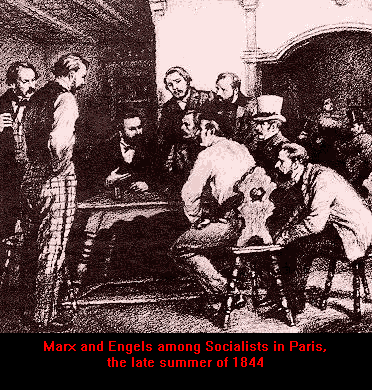
During Engels' short stay in Paris in 1844, Marx suggested the two of them should write a critique of the rage of their day, the Young Hegelians. In the doing was born the first joint writing project between the two men -- and a life-long association that would change the world.
At the end of August, 1844, Engels passed through Paris, en route to his employment in Manchester, England, from visiting his family in Barmen (Germany). During 10 days in the French capital, he met Marx (for the second time).
After talking, they began drawing up plans for a book about the Young Hegelian trend of thought very popular in academic circles. Agreeing to co-author the Foreword, they divided up the other sections. Engels finished his assigned chapters before leaving Paris. Marx had the larger share of work, and he completed it by the end of November 1844. (Marx would draw from his Economic and Philosophical Manuscripts, on which he'd been working the spring and summer of 1844.)
The foremost title line — “The Holy Family” — was added at the suggestion of the book publisher Lowenthal. It's a sarcastic reference to the Bauer brothers and their supporters.
The book made something of a splash in the newspapers. One paper noted, that it expressed socialist views since it criticised the “inadequacy of any half-measures directed at eliminating the social ailments of our time.” The conservative press immediately recognized the radical elements inherent in its many arguments. One paper wrote that, in The Holy Family, “every line preaches revolt... against the state, the church, the family, legality, religion and property.” It also noted that “prominence is given to the most radical and the most open communism, and this is all the more dangerous as Mr. Marx cannot be denied either extremely broad knowledge or the ability to make use of the polemical arsenal of Hegel’s logic, what is customarily called ‘iron logic.’
Lenin would later claim this work laid the foundations for what would develop into a scientific revolutionary materialist socialism.
Bruno Bauer attempted to rebut the book in the article “Charakteristik Ludwig Feuerbachs” — which was published in Wigand’s Vierteljahrsschrift, Leipzig 1845. Bauer essentially claimed that Marx and Engels misunderstood what he was really saying. Marx would reply to that article with his own article — published in the journal Gesellschaftsspiegel, Elberfeld, January 1846. And the matter was also discussed in chapter 2 of The German Ideology.
Source
@Communism
or Critique of Critical Criticism.
Against Bruno Bauer and Company
“When I visited Marx in Paris in the summer of 1844,
our complete agreement in all theoretical fields
became evident and our joint work dates from that time.”
Frederick Engels
During Engels' short stay in Paris in 1844, Marx suggested the two of them should write a critique of the rage of their day, the Young Hegelians. In the doing was born the first joint writing project between the two men -- and a life-long association that would change the world.
At the end of August, 1844, Engels passed through Paris, en route to his employment in Manchester, England, from visiting his family in Barmen (Germany). During 10 days in the French capital, he met Marx (for the second time).
After talking, they began drawing up plans for a book about the Young Hegelian trend of thought very popular in academic circles. Agreeing to co-author the Foreword, they divided up the other sections. Engels finished his assigned chapters before leaving Paris. Marx had the larger share of work, and he completed it by the end of November 1844. (Marx would draw from his Economic and Philosophical Manuscripts, on which he'd been working the spring and summer of 1844.)
The foremost title line — “The Holy Family” — was added at the suggestion of the book publisher Lowenthal. It's a sarcastic reference to the Bauer brothers and their supporters.
The book made something of a splash in the newspapers. One paper noted, that it expressed socialist views since it criticised the “inadequacy of any half-measures directed at eliminating the social ailments of our time.” The conservative press immediately recognized the radical elements inherent in its many arguments. One paper wrote that, in The Holy Family, “every line preaches revolt... against the state, the church, the family, legality, religion and property.” It also noted that “prominence is given to the most radical and the most open communism, and this is all the more dangerous as Mr. Marx cannot be denied either extremely broad knowledge or the ability to make use of the polemical arsenal of Hegel’s logic, what is customarily called ‘iron logic.’
Lenin would later claim this work laid the foundations for what would develop into a scientific revolutionary materialist socialism.
Bruno Bauer attempted to rebut the book in the article “Charakteristik Ludwig Feuerbachs” — which was published in Wigand’s Vierteljahrsschrift, Leipzig 1845. Bauer essentially claimed that Marx and Engels misunderstood what he was really saying. Marx would reply to that article with his own article — published in the journal Gesellschaftsspiegel, Elberfeld, January 1846. And the matter was also discussed in chapter 2 of The German Ideology.
Source
@Communism
👍7
THE HOLY FAMILY Karl Marx and Frederick Engels.pdf
13.7 MB
The Holy Family (1845) is a book written by Marx and Engels, where they criticize the young Hegelian philosophers, particularly Bruno Bauer. These philosophers focused on abstract ideas and idealism, rather than practical, material conditions. Marx and Engels argue that history and society should be understood through the lens of materialism and class struggle, not abstract theories. The book marks an early stage in their development of ideas that later became central to Marxist thought, laying the groundwork for their more famous works, like the Communist Manifesto. It's a shift from idealist philosophy to a materialist, class-based approach to understanding the world.
@Communism
#Book #PDF #KarlMarx #Marx #Engels
@Communism
👍10
Vladimir Mayakovsky 1917
Call To Account!
The drum of war thunders and thunders.
It calls: thrust iron into the living.
From every country
slave after slave
are thrown onto bayonet steel.
For the sake of what?
The earth shivers
hungry
and stripped.
Mankind is vapourised in a blood bath
only so
someone
somewhere
can get hold of Albania.
Human gangs bound in malice,
blow after blow strikes the world
only for
someone’s vessels
to pass without charge
through the Bosporus.
Soon
the world
won’t have a rib intact.
And its soul will be pulled out.
And trampled down
only for someone,
to lay
their hands on
Mesopotamia.
Why does
a boot
crush the Earth — fissured and rough?
What is above the battles’ sky -
Freedom?
God?
Money!
When will you stand to your full height,
you,
giving them your life?
When will you hurl a question to their faces:
Why are we fighting?
@Communism
Call To Account!
The drum of war thunders and thunders.
It calls: thrust iron into the living.
From every country
slave after slave
are thrown onto bayonet steel.
For the sake of what?
The earth shivers
hungry
and stripped.
Mankind is vapourised in a blood bath
only so
someone
somewhere
can get hold of Albania.
Human gangs bound in malice,
blow after blow strikes the world
only for
someone’s vessels
to pass without charge
through the Bosporus.
Soon
the world
won’t have a rib intact.
And its soul will be pulled out.
And trampled down
only for someone,
to lay
their hands on
Mesopotamia.
Why does
a boot
crush the Earth — fissured and rough?
What is above the battles’ sky -
Freedom?
God?
Money!
When will you stand to your full height,
you,
giving them your life?
When will you hurl a question to their faces:
Why are we fighting?
#Mayakovsky #Poetry #Poem
@Communism
❤10