Fidel Castro, talks to journalists about the successful Cuban Revolution to overthrow the dictator Batista in a press conference at the New Yorker Hotel on April 22, 1959 in New York City, New York, United States.
@Communism
We do not study Marxism out of mere philosophical or historical curiosity. No. For us, it’s vital, it’s fundamental, it’s crucial, to study Marxism and to teach Marxism: For the revolution, it’s vital and it’s crucial to study Marxism and to teach Marxism."
- Fidel Castro
#FidelCastro #Marxism
@Communism
👍8❤5🔥1
Communist Party of Turkey: "In Syria, Israel and the USA have won a temporary victory using the jihadists"
On the occasion of the fall of Damascus in the hands of the armed jihadists and the alleged overthrow of the Assad government, the Central Committee of the Communist Party of Turkey (TKP) issued the following statement:
"The plan put into effect by the US imperialism and the reactionary forces in the region about 15 years ago in order for the disintegration of Syria has succeeded as of yesterday. The jihadist forces mobilised by the USA, Israel, Britain and the AKP government overthrew the Syrian government in a short period of one week.
Peace and stability will not come to Syria as they claim. On the contrary, in Syria, where massacres, occupations, looting and plundering, endless conflicts have been taking place for years, the era of barbarism will be opened as the last remaining point that restrained all these, even if only a little, has been eliminated.
The winner of this picture is Israel for the time being. It has been proved once again that the Israeli issue is not a matter of religion. Jihadist groups and Israel have seized Syria by working in great harmony. The AKP government is the element that ensures this harmony.
Israel’s victory is the victory of US imperialism.
All the ‘winners’ in Syria today are allies of the US and Israel. Maybe there will be bloody clashes between the ‘winners’, maybe the ‘harmony’ witnessed in the field for a week will be established by the US.
However, US ‘peace’ is always bloody, always prone to new conflicts. Peace, stability and tranquility in Syria can only be established when imperialism and the jihadists are defeated.
A resistance against imperialism and Zionism will certainly emerge in Syria. That this resistance acts without relying on other international powers, with a revolutionary perspective, defending secularism and being unifying, depends to some extent on the developments in Turkey.
In Syria, Israel and the USA have won a temporary victory using the jihadists.
Israel, the USA and jihadism must be defeated in Turkey.
We appeal to all our citizens. This is not a game. If we care about our country and our future, we need to talk about how to stand up and get rid of this barbarism and do the necessary. What is happening in Syria is proof of what sectarianism, religionism, nationalism and relying on foreign powers can lead to.
Turkey must change if it is to continue to exist. There can be no unity in a country where exploitation, inequality and injustice are rife.
After the developments in Syria, it is essential to restrain the excitement of the Neo-Ottomanist circles who dream of ‘expansion’. This Neo-Ottomanist approach not only means attempting to cover up exploitation, inequality and injustice with conquestism, but also leads to the enactment of a plan that will lead to the disintegration of Turkey.
Our country and our citizens are facing a great test. Either we will defeat the exploitative, religious, Americanist mentality that has brought our country to the brink of the cliff, or we will tumble into that cliff.
We trust ourselves, our people and humanity.
The pleasure of the Israelis will be incomplete."
On the occasion of the fall of Damascus in the hands of the armed jihadists and the alleged overthrow of the Assad government, the Central Committee of the Communist Party of Turkey (TKP) issued the following statement:
"The plan put into effect by the US imperialism and the reactionary forces in the region about 15 years ago in order for the disintegration of Syria has succeeded as of yesterday. The jihadist forces mobilised by the USA, Israel, Britain and the AKP government overthrew the Syrian government in a short period of one week.
Peace and stability will not come to Syria as they claim. On the contrary, in Syria, where massacres, occupations, looting and plundering, endless conflicts have been taking place for years, the era of barbarism will be opened as the last remaining point that restrained all these, even if only a little, has been eliminated.
The winner of this picture is Israel for the time being. It has been proved once again that the Israeli issue is not a matter of religion. Jihadist groups and Israel have seized Syria by working in great harmony. The AKP government is the element that ensures this harmony.
Israel’s victory is the victory of US imperialism.
All the ‘winners’ in Syria today are allies of the US and Israel. Maybe there will be bloody clashes between the ‘winners’, maybe the ‘harmony’ witnessed in the field for a week will be established by the US.
However, US ‘peace’ is always bloody, always prone to new conflicts. Peace, stability and tranquility in Syria can only be established when imperialism and the jihadists are defeated.
A resistance against imperialism and Zionism will certainly emerge in Syria. That this resistance acts without relying on other international powers, with a revolutionary perspective, defending secularism and being unifying, depends to some extent on the developments in Turkey.
In Syria, Israel and the USA have won a temporary victory using the jihadists.
Israel, the USA and jihadism must be defeated in Turkey.
We appeal to all our citizens. This is not a game. If we care about our country and our future, we need to talk about how to stand up and get rid of this barbarism and do the necessary. What is happening in Syria is proof of what sectarianism, religionism, nationalism and relying on foreign powers can lead to.
Turkey must change if it is to continue to exist. There can be no unity in a country where exploitation, inequality and injustice are rife.
After the developments in Syria, it is essential to restrain the excitement of the Neo-Ottomanist circles who dream of ‘expansion’. This Neo-Ottomanist approach not only means attempting to cover up exploitation, inequality and injustice with conquestism, but also leads to the enactment of a plan that will lead to the disintegration of Turkey.
Our country and our citizens are facing a great test. Either we will defeat the exploitative, religious, Americanist mentality that has brought our country to the brink of the cliff, or we will tumble into that cliff.
We trust ourselves, our people and humanity.
The pleasure of the Israelis will be incomplete."
👍22
A rare fresco of Lenin inside an abandoned building (Armenia)
@Communism
Monopolies, oligarchy, the striving for domination and not for freedom, the exploitation of an increasing number of small or weak nations by a handful of the richest or most powerful nations — all these have given birth to those distinctive characteristics of imperialism which compel us to define it as parasitic or decaying capitalism.
Lenin, Imperialism: The Highest Stage of Capitalism (1914)
#Lenin #Imperialism
@Communism
❤18👍1
This is a very colorful mosaic of Lenin outside Riviera Park in Sochi.
@Communism
.. monopoly has grown out of colonial policy. To the numerous “old” motives of colonial policy, finance capital has added the struggle for the sources of raw materials, for the export of capital, for spheres of influence, i.e., for spheres for profitable deals, concessions, monopoly profits and so on, economic territory in general. When the colonies of the European powers,for instance, comprised only one-tenth of the territory of Africa(as was the case in 1876), colonial policy was able to develop—by methods other than those of monopoly—by the “free grabbing” of territories, so to speak.
But when nine-tenths of Africa had been seized (by 1900), when the whole world had been divided up,there was inevitably ushered in the era of monopoly possession of colonies and, consequently, of particularly intense struggle for the division and the redivision of the world.
Lenin, Imperialism: The Highest Stage of Capitalism (1914)
#Lenin
@Communism
👍14❤5
The first contradiction is the contradiction between labour and capital. Imperialism is the omnipotence of the monopolist trusts and syndicates, of the banks and the financial oligarchy, in the industrial countries. In the fight against this omnipotence, the customary methods of the working class-trade unions and cooperatives, parliamentary parties and the parliamentary struggle-have proved to be totally inadequate. Either place yourself at the mercy of capital, eke out a wretched existence as of old and sink lower and lower, or adopt a new weapon-this is the alternative imperialism puts before the vast masses of the proletariat. Imperialism brings the working class to revolution.
Joseph Stalin
The Foundations of Leninism
@Communism
Joseph Stalin
The Foundations of Leninism
#Stalin
@Communism
❤14👍4
On this day, 14 December 1936, sexual acts between men were criminalised in Palestine by British colonial authorities.
In the British Mandate Criminal Code Ordinance 1936, Section 152(2), published on this take, so-called “carnal knowledge against the order of nature” was to be punished by a sentence of up to 10 years’ imprisonment.
In 1951 homosexuality was decriminalised in the West Bank, but as of 2024, the colonial-era law remains in force in Gaza.
Britain banned homosexuality across its empire, in a legacy which lasts to this day. Of the 69 countries in which homosexuality was illegal in 2021, two-thirds of them were former British colonies.
Working Class History
In the British Mandate Criminal Code Ordinance 1936, Section 152(2), published on this take, so-called “carnal knowledge against the order of nature” was to be punished by a sentence of up to 10 years’ imprisonment.
In 1951 homosexuality was decriminalised in the West Bank, but as of 2024, the colonial-era law remains in force in Gaza.
Britain banned homosexuality across its empire, in a legacy which lasts to this day. Of the 69 countries in which homosexuality was illegal in 2021, two-thirds of them were former British colonies.
Working Class History
#FreePalestine #BritishColonialism #QueerHistory #LGBTQRights
❤7👎3
Media is too big
VIEW IN TELEGRAM
In 2024, Germany saw alarming police violence as authorities ruthlessly suppressed solidarity with Palestine. From protest camp crackdowns to assaults on activists and shutting down the Palestine Congress, these actions placed Germany on the wrong side of history once again.
theredstream
theredstream
#FreePalestine #Germany
🔥2
🔴 The Hegemony of the Dollar
✍🏻 Prabhat Patnaik
LIBERAL opinion holds that the international monetary and financial system is a device for promoting the interests of all participating countries by providing a convenient payments arrangement within which trade can be carried on. The reality however is altogether different: the international system is founded upon the hegemony of western imperialism, and in turn sustains this hegemony. Since the US dollar is the lynchpin of this international system, one can say that the hegemony of the dollar in the international economy is both sustained by and in turn sustains, the hegemony of western imperialism; and this hegemony even comes in the way of mutually convenient trade between participating countries.
An example will make this point clear. Suppose country 1 requires commodity x which country 2 has, and country 2 in turn requires commodity y that country 1 has. They do not, under the current system, simply exchange these two commodities among themselves. Each of them must get hold of dollars first before buying the other’s commodity. And unless each of them has sufficient dollar reserves to start with, this trade would simply not occur. In other words, the dollar being the medium of circulation in international transactions, a shortage of dollars in the hands of some countries would hold up even their mutual transactions. This is especially true of trade between third world countries, which remains constricted because each of them is afflicted by a paucity of dollars. They could expand their mutual trade if they could trade in their own currencies, that is, “de-dollarise”. The term “de-dollarisation” refers to reduced reliance on the US dollar as a medium of circulation, unit of account, or form of holding reserves for international transactions.
Read more
✍🏻 Prabhat Patnaik
LIBERAL opinion holds that the international monetary and financial system is a device for promoting the interests of all participating countries by providing a convenient payments arrangement within which trade can be carried on. The reality however is altogether different: the international system is founded upon the hegemony of western imperialism, and in turn sustains this hegemony. Since the US dollar is the lynchpin of this international system, one can say that the hegemony of the dollar in the international economy is both sustained by and in turn sustains, the hegemony of western imperialism; and this hegemony even comes in the way of mutually convenient trade between participating countries.
An example will make this point clear. Suppose country 1 requires commodity x which country 2 has, and country 2 in turn requires commodity y that country 1 has. They do not, under the current system, simply exchange these two commodities among themselves. Each of them must get hold of dollars first before buying the other’s commodity. And unless each of them has sufficient dollar reserves to start with, this trade would simply not occur. In other words, the dollar being the medium of circulation in international transactions, a shortage of dollars in the hands of some countries would hold up even their mutual transactions. This is especially true of trade between third world countries, which remains constricted because each of them is afflicted by a paucity of dollars. They could expand their mutual trade if they could trade in their own currencies, that is, “de-dollarise”. The term “de-dollarisation” refers to reduced reliance on the US dollar as a medium of circulation, unit of account, or form of holding reserves for international transactions.
Read more
The articles and linked websites may not align with our channel's positions. They are shared to encourage discussions from a communist perspective.
#PoliticalEconomy #Imperialism #Dollar

👍2
condition-working-class-england.pdf
1.4 MB
At the same time the destruction of the former organisation of hand-work, and the disappearance of the lower middle-class deprived the workingman of all possibility of rising into the middle-class himself.
Friedrich Engels
The Condition of the Working Class in England
@Communism
Friedrich Engels
The Condition of the Working Class in England
#Engels #PDF
@Communism
👍9
Condition of the Working Class in England, by Engels, 1845
The Industrial Proletariat
The order of our investigation of the different sections of the proletariat follows naturally from the foregoing history of its rise. The first proletarians were connected with manufacture, were engendered by it, and accordingly, those employed in manufacture, in the working up of raw materials, will first claim our attention. The production of raw materials and of fuel for manufacture attained importance only in consequence of the industrial change, and engendered a new proletariat, the coal and metal miners. Then, in the third place, manufacture influenced agriculture, and in the fourth, the condition of Ireland; and the fractions of the proletariat belonging to each, will find their place accordingly. We shall find, too, that with the possible exception of the Irish, the degree of intelligence of the various workers is in direct proportion to their relation to manufacture; and that the factory-hands are most enlightened as to their own interests, the miners somewhat less so, the agricultural labourers scarcely at all. We shall find the same order again among the industrial workers, and shall see how the factory-hands, eldest children of the industrial revolution, have from the beginning to the present day formed the nucleus of the Labour Movement, and how the others have joined this movement just in proportion as their handicraft has been invaded by the progress of machinery. We shall thus learn from the example which England offers, from the equal pace which the Labour Movement has kept with the movement of industrial development, the historical significance of manufacture.
Since, however, at the present moment, pretty much the whole industrial proletariat is involved in the movement, and the condition of the separate sections has much in common, because they all are industrial, we shall have first to examine the condition of the industrial proletariat as a whole, in order later to notice more particularly each separate division with its own peculiarities.
It has been already suggested that manufacture centralises property in the hands of the few. It requires large capital with which to erect the colossal establishments that ruin the petty trading bourgeoisie and with which to press into its service the forces of Nature, so driving the hand-labour of the independent workman out of the market. The division of labour, the application of water and especially steam, and the application of machinery, are the three great levers with which manufacture, since the middle of the last century, has been busy putting the world out of joint. Manufacture, on a small scale, created the middle-class; on a large scale, it created the working-class, and raised the elect of the middle-class to the throne, but only to overthrow them the more surely when the time comes. Meanwhile, it is an undenied and easily explained fact that the numerous petty middle-class of the "good old times" has been annihilated by manufacture, and resolved into rich capitalists on the one hand and poor workers on the other. (Compare on this point my "Outlines of a Critique of Political Economy" in the Deutsch-Französische Jahrbücher. In this essay "free competition" is the starting-point; but industry is only the practice of free competition and the latter is only the principle on which industry is based.-- Note by Engels.)
The Industrial Proletariat
The order of our investigation of the different sections of the proletariat follows naturally from the foregoing history of its rise. The first proletarians were connected with manufacture, were engendered by it, and accordingly, those employed in manufacture, in the working up of raw materials, will first claim our attention. The production of raw materials and of fuel for manufacture attained importance only in consequence of the industrial change, and engendered a new proletariat, the coal and metal miners. Then, in the third place, manufacture influenced agriculture, and in the fourth, the condition of Ireland; and the fractions of the proletariat belonging to each, will find their place accordingly. We shall find, too, that with the possible exception of the Irish, the degree of intelligence of the various workers is in direct proportion to their relation to manufacture; and that the factory-hands are most enlightened as to their own interests, the miners somewhat less so, the agricultural labourers scarcely at all. We shall find the same order again among the industrial workers, and shall see how the factory-hands, eldest children of the industrial revolution, have from the beginning to the present day formed the nucleus of the Labour Movement, and how the others have joined this movement just in proportion as their handicraft has been invaded by the progress of machinery. We shall thus learn from the example which England offers, from the equal pace which the Labour Movement has kept with the movement of industrial development, the historical significance of manufacture.
Since, however, at the present moment, pretty much the whole industrial proletariat is involved in the movement, and the condition of the separate sections has much in common, because they all are industrial, we shall have first to examine the condition of the industrial proletariat as a whole, in order later to notice more particularly each separate division with its own peculiarities.
It has been already suggested that manufacture centralises property in the hands of the few. It requires large capital with which to erect the colossal establishments that ruin the petty trading bourgeoisie and with which to press into its service the forces of Nature, so driving the hand-labour of the independent workman out of the market. The division of labour, the application of water and especially steam, and the application of machinery, are the three great levers with which manufacture, since the middle of the last century, has been busy putting the world out of joint. Manufacture, on a small scale, created the middle-class; on a large scale, it created the working-class, and raised the elect of the middle-class to the throne, but only to overthrow them the more surely when the time comes. Meanwhile, it is an undenied and easily explained fact that the numerous petty middle-class of the "good old times" has been annihilated by manufacture, and resolved into rich capitalists on the one hand and poor workers on the other. (Compare on this point my "Outlines of a Critique of Political Economy" in the Deutsch-Französische Jahrbücher. In this essay "free competition" is the starting-point; but industry is only the practice of free competition and the latter is only the principle on which industry is based.-- Note by Engels.)
👍8
The centralising tendency of manufacture does not, however, stop here. Population becomes centralised just as capital does; and, very naturally, since the human being, the worker, is regarded in manufacture simply as a piece of capital for the use of which the manufacturer pays interest under the name of wages. A manufacturing establishment requires many workers employed together in a single building, living near each other and forming a village of themselves in the case of a good-sized factory. They have needs for satisfying which other people are necessary; handicraftsmen, shoemakers, tailors, bakers, carpenters, stonemasons, settle at hand. The inhabitants of the village, especially the younger generation, accustom themselves to factory work, grow skilful in it, and when the first mill can no longer employ them all, wages fall, and the immigration of fresh manufacturers is the consequence. So the village grows into a small town, and the small town into a large one. The greater the town, the greater its advantages. It offers roads, railroads, canals; the choice of skilled labour increases constantly, new establishments can be built more cheaply, because of the competition among builders and machinists who are at hand, than in remote country districts, whither timber, machinery, builders, and operatives must be brought; it offers a market to which buyers crowd, and direct communication with the markets supplying raw material or demanding finished goods. Hence the marvellously rapid growth of the great manufacturing towns. The country, on the other hand, had the advantage that wages are usually lower than in town, and so town and country are in constant competition; and, if the advantage is on the side of the town today, wages sink so low in the country tomorrow that new investments are most profitably made there. But the centralising tendency of manufacture continues in full force, and every new factory built in the country bears in it the germ of a manufacturing town. If it were possible for this mad rush of manufacture to go on at this rate for another century, every manufacturing district of England would be one great manufacturing town, and Manchester and Liverpool would meet at Warrington or Newton; for in commerce, too, this centralisation of the population works in precisely the same way, and hence it is that one or two great harbours, such as Hull and Liverpool, Bristol and London, monopolise almost the whole maritime commerce of Great Britain.
Since commerce and manufacture attain their most complete development in these great towns, their influence upon the proletariat is also most clearly observable here. Here the centralisation of property has reached the highest point; here the morals and customs of the good old times are most completely obliterateded; here it has gone so far that the name Merry Old England conveys no meaning, for Old England itself is unknown to memory and to the tales of our grandfathers. Hence, too, there exist here only a rich and a poor class, for the lower middle-class vanishes more completely with every passing day. Thus the class formerly most stable has become the most restless one. It consists today of a few remnants of a past time, and a number of people eager to make fortunes, industrial Micawbers and speculators of whom one may amass a fortune, while ninety-nine become insolvent, and more than half of the ninety-nine live by perpetually repeated failure.
But in these towns the proletarians are the infinite majority, and how they fare, what influence the great town exercises upon them, we have now to investigate.
Condition of the Working Class in England, by Engels, 1845 The Industrial Proletariat
@Communism
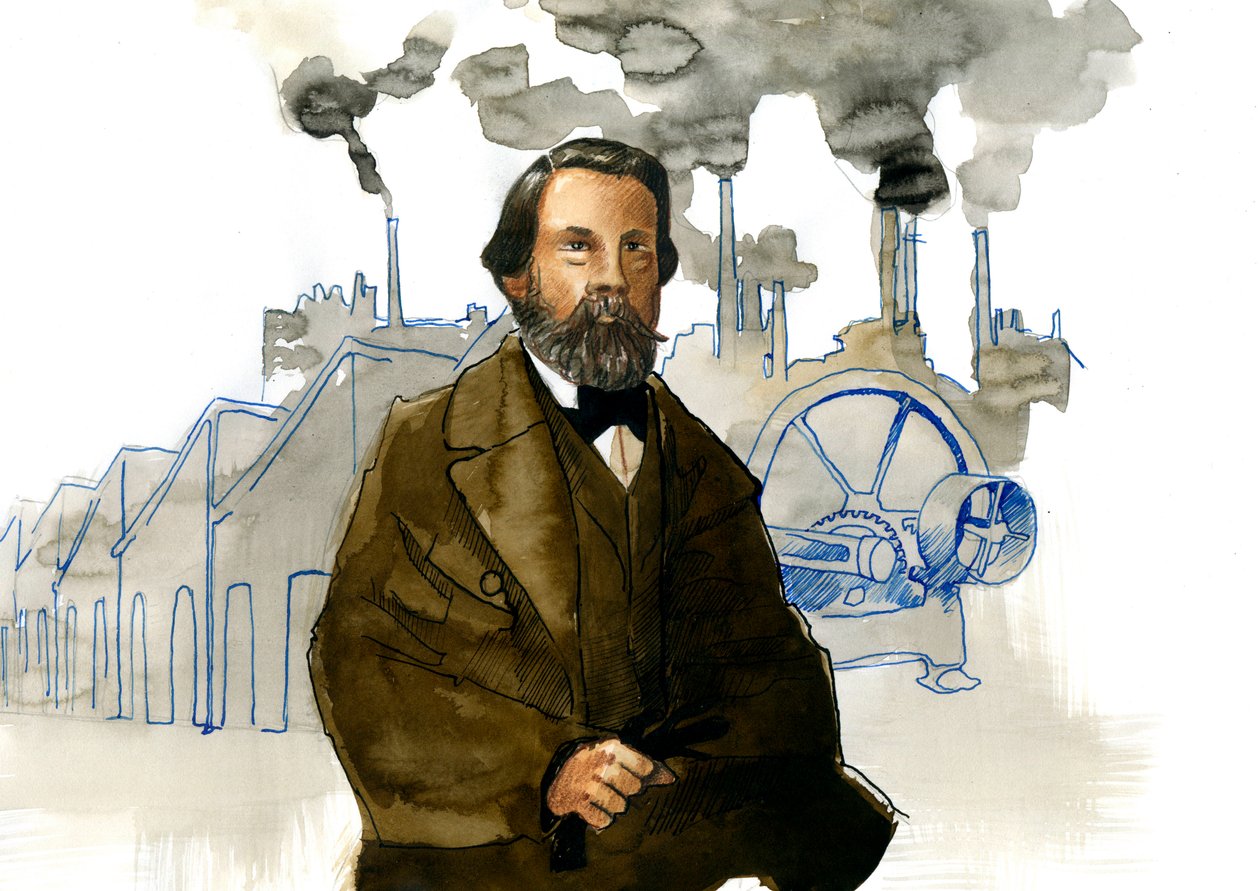
Portrait of Friedrich Engels by Alessandro Lonati
Since commerce and manufacture attain their most complete development in these great towns, their influence upon the proletariat is also most clearly observable here. Here the centralisation of property has reached the highest point; here the morals and customs of the good old times are most completely obliterateded; here it has gone so far that the name Merry Old England conveys no meaning, for Old England itself is unknown to memory and to the tales of our grandfathers. Hence, too, there exist here only a rich and a poor class, for the lower middle-class vanishes more completely with every passing day. Thus the class formerly most stable has become the most restless one. It consists today of a few remnants of a past time, and a number of people eager to make fortunes, industrial Micawbers and speculators of whom one may amass a fortune, while ninety-nine become insolvent, and more than half of the ninety-nine live by perpetually repeated failure.
But in these towns the proletarians are the infinite majority, and how they fare, what influence the great town exercises upon them, we have now to investigate.
Condition of the Working Class in England, by Engels, 1845 The Industrial Proletariat
#Engels
@Communism
Portrait of Friedrich Engels by Alessandro Lonati
👍9
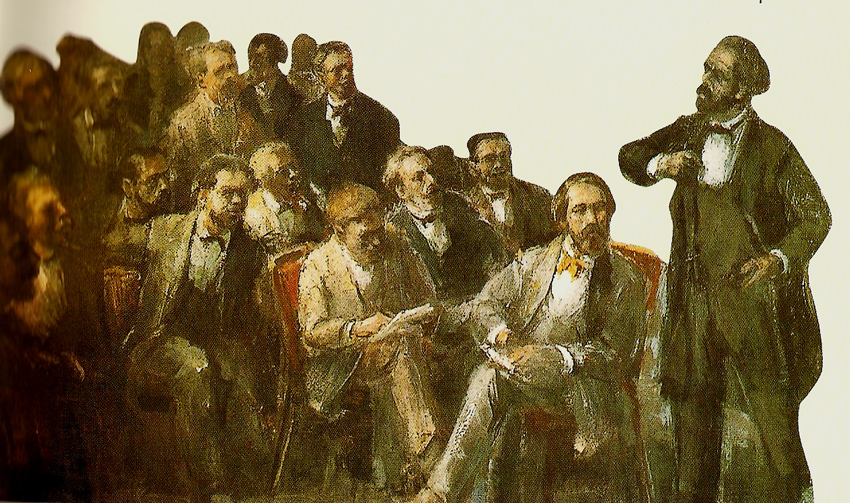
“Further, the division of labour implies the contradiction between the interest of the separate individual or the individual family and the communal interest of all individuals who have intercourse with one another. And indeed, this communal interest does not exist merely in the imagination, as the “general interest,” but first of all in reality, as the mutual interdependence of the individuals among whom the labour is divided. And finally, the division of labour offers us the first example of how, as long as man remains in natural society, that is, as long as a cleavage exists between the particular and the common interest, as long, therefore, as activity is not voluntarily, but naturally, divided, man’s own deed becomes an alien power opposed to him, which enslaves him instead of being controlled by him. For as soon as the distribution of labour comes into being, each man has a particular, exclusive sphere of activity, which is forced upon him and from which he cannot escape. He is a hunter, a fisherman, a herdsman, or a critical critic, and must remain so if he does not want to lose his means of livelihood; while in communist society, where nobody has one exclusive sphere of activity but each can become accomplished in any branch he wishes, society regulates the general production and thus makes it possible for me to do one thing today and another tomorrow, to hunt in the morning, fish in the afternoon, rear cattle in the evening, criticise after dinner, just as I have a mind, without ever becoming hunter, fisherman, herdsman or critic. This fixation of social activity, this consolidation of what we ourselves produce into an objective power above us, growing out of our control, thwarting our expectations, bringing to naught our calculations, is one of the chief factors in historical development up till now.”
~The German Ideology, by Karl Marx and Friedrich Engels
@Communism
~The German Ideology, by Karl Marx and Friedrich Engels
#KarlMarx #FriedrichEngels #Engels #Marx
@Communism
👍10
This media is not supported in your browser
VIEW IN TELEGRAM
For this year’s best instant-karma moment, let us not forget when a racist was brilliantly shut down and put to sleep on a London train after repeatedly threatening a young Black man.
theredstream
theredstream
#Good_night_right_side
👍11
Audio
15 December 1897 Scottish mill worker, songwriter and socialist Mary Brooksbank was born in Aberdeen.Growing up in poverty, her baby brother died of diphtheria before the age of three
Moving to Dundee, Brooksbank began work in jute mills aged 11,and at 14 engaged in her first strike for a pay increase after a young woman walked around the area mills blowing a whistle to call the workers out on strike
Brooksbank later got involved in opposition to World War I,and founded the Working Women Guild to fight for better health and social services, and was active in organising women workers on the railways. She was imprisoned three times in her life for her activities, which she continued until her death aged 82
Brooksbank's songs were mostly about working class life, and perhaps her most famous work,The Jute Mill, includes the lines:
"Oh dear me, the world is ill-divided,/Them that works the hardest are the least provided./I maun work the harder, dark days or fine,/Tae feed and cled my bairnies affen ten and nine."
Moving to Dundee, Brooksbank began work in jute mills aged 11,and at 14 engaged in her first strike for a pay increase after a young woman walked around the area mills blowing a whistle to call the workers out on strike
Brooksbank later got involved in opposition to World War I,and founded the Working Women Guild to fight for better health and social services, and was active in organising women workers on the railways. She was imprisoned three times in her life for her activities, which she continued until her death aged 82
Brooksbank's songs were mostly about working class life, and perhaps her most famous work,The Jute Mill, includes the lines:
"Oh dear me, the world is ill-divided,/Them that works the hardest are the least provided./I maun work the harder, dark days or fine,/Tae feed and cled my bairnies affen ten and nine."
❤8
With what moral authority can they speak of human rights - the rulers of a nation in which the millionaire and beggar coexist; the Indian is exterminated; the black man is discriminated against; the woman is prostituted; and the great masses of Chicanos, Puerto Ricans, and Latin Americans are scorned, exploited, and humiliated? How can they do this - the bosses of an empire where the mafia, gambling, and child prostitution are imposed; where the CIA organizes plans of global subversion and espionage, and the Pentagon creates neutron bombs capable of preserving material assets and wiping out human beings.
@Communism
Join the @Communists
@Communism
Join the @Communists
👍9❤3