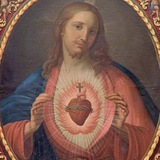
From Challoner's Meditations:
FOURTH SUNDAY IN LENT
ON OUR SAVIOUR'S PRAYER IN THE GARDEN
Consider first, that our Saviour's passion began the night before his death; when, after having eaten the paschal lamb with his disciples, humbly washed their feet, instituted the great Passover of the new covenant, and given them, in an admirable sacrament of love, his own most precious body and blood, he went out with them unto Mount Olivet - the place to which he was accustomed to resort after the preaching and labours of the day, to spend the evening, if not the whole night, in prayer. Hither he went on this his last night, to prepare himself for his passion by prayer; not for any need he had of it for himself, but to give us an example, and for our instruction. O learn, my soul, by this great example, how thou art to arm thyself against all trials and temptations! Learn from whence all thy strength is to come, in the time of battle. Give ear to what our Lord said to his disciples upon this occasion, Matt. xxvi. 41, 'Watch ye and pray, that ye enter not into temptation; the spirit indeed is willing, but the flesh is weak.' O take heed, lest if thou sleep as Peter did, when thou shouldst pray, thou deny thy Lord when thou comest to the trial.
Consider 2ndly, how our Saviour began to disclose to his disciples the mortal anguish, fear, and sadness which he then suffered in his soul. 'My soul' (saith he) 'is sorrowful, even unto death;' that is to say with a sadness which is capable of even now taking away my life, if I did not, by miracle, support myself for enduring the other torments of my passion. Sweet Jesus, what can be the meaning of this? Didst thou not from the first instant of life accept of and embrace, in the midst of thy heart, all that thou art now going to suffer - forasmuch as it would be for the glory of thy Father, and the redemption of man? Hast thou not even a longing desire of accomplishing this great sacrifice of our redemption? And how comes it that thou art now thus oppressed with sadness and anguish? Where is that courage and fortitude which thou hast imparted to thy martyrs, which has made even tender maids despise the worst of torments, when they endured them for the love of thee? And shalt thou, who art the strengths of the martyrs, shrink at the fear of death? But O! very well understand that it is at thy own choice thou hast condescended to all this sadness, fear, and anguish; to the end that thou mightest suffer the more for me, and engage me to love thee the more; it is that thou mightest teach me how to behave under all my interior anguishes and afflictions, and how to endure them for the love of thee.
Consider 3rdly, the prayer our Saviour made on this occasion, that if it were agreeable to the will of his Father, the bitter cup might pass away from him. But O with what fervour did he pray? 'With a strong cry and tears.' - Heb. v. 7. With what reverence and humility? - lying prostrate upon the ground, Matt. xxvi. 39. With what earnestness and perseverance? - continuing a long time in prayer, and repeating again and again the same supplication. Learn, my soul, to imitate him under all thy distresses and betake thyself to prayer; but see thou pray, as the Lord did, with fervour, humility, and perseverance; see thou pray with the like resignation! 'Not my will but thine be done.' Remember that in thy prayers thou art not to seek thy own pleasure or comfort, but the holy will of God: O make this holy will thy pleasure and comfort, and thy prayer will be always acceptable. 'Stay thou here and watch with me,' saith our Lord to His disciples; but at every time that he came to them, he found them still asleep; and no help or comfort had he from their company, in this his desolate condition. O my soul, do thou at least pity thy Saviour under all this anguish and desolation; do thou stay and watch with him, by a frequent meditation on his sufferings.
FOURTH SUNDAY IN LENT
ON OUR SAVIOUR'S PRAYER IN THE GARDEN
Consider first, that our Saviour's passion began the night before his death; when, after having eaten the paschal lamb with his disciples, humbly washed their feet, instituted the great Passover of the new covenant, and given them, in an admirable sacrament of love, his own most precious body and blood, he went out with them unto Mount Olivet - the place to which he was accustomed to resort after the preaching and labours of the day, to spend the evening, if not the whole night, in prayer. Hither he went on this his last night, to prepare himself for his passion by prayer; not for any need he had of it for himself, but to give us an example, and for our instruction. O learn, my soul, by this great example, how thou art to arm thyself against all trials and temptations! Learn from whence all thy strength is to come, in the time of battle. Give ear to what our Lord said to his disciples upon this occasion, Matt. xxvi. 41, 'Watch ye and pray, that ye enter not into temptation; the spirit indeed is willing, but the flesh is weak.' O take heed, lest if thou sleep as Peter did, when thou shouldst pray, thou deny thy Lord when thou comest to the trial.
Consider 2ndly, how our Saviour began to disclose to his disciples the mortal anguish, fear, and sadness which he then suffered in his soul. 'My soul' (saith he) 'is sorrowful, even unto death;' that is to say with a sadness which is capable of even now taking away my life, if I did not, by miracle, support myself for enduring the other torments of my passion. Sweet Jesus, what can be the meaning of this? Didst thou not from the first instant of life accept of and embrace, in the midst of thy heart, all that thou art now going to suffer - forasmuch as it would be for the glory of thy Father, and the redemption of man? Hast thou not even a longing desire of accomplishing this great sacrifice of our redemption? And how comes it that thou art now thus oppressed with sadness and anguish? Where is that courage and fortitude which thou hast imparted to thy martyrs, which has made even tender maids despise the worst of torments, when they endured them for the love of thee? And shalt thou, who art the strengths of the martyrs, shrink at the fear of death? But O! very well understand that it is at thy own choice thou hast condescended to all this sadness, fear, and anguish; to the end that thou mightest suffer the more for me, and engage me to love thee the more; it is that thou mightest teach me how to behave under all my interior anguishes and afflictions, and how to endure them for the love of thee.
Consider 3rdly, the prayer our Saviour made on this occasion, that if it were agreeable to the will of his Father, the bitter cup might pass away from him. But O with what fervour did he pray? 'With a strong cry and tears.' - Heb. v. 7. With what reverence and humility? - lying prostrate upon the ground, Matt. xxvi. 39. With what earnestness and perseverance? - continuing a long time in prayer, and repeating again and again the same supplication. Learn, my soul, to imitate him under all thy distresses and betake thyself to prayer; but see thou pray, as the Lord did, with fervour, humility, and perseverance; see thou pray with the like resignation! 'Not my will but thine be done.' Remember that in thy prayers thou art not to seek thy own pleasure or comfort, but the holy will of God: O make this holy will thy pleasure and comfort, and thy prayer will be always acceptable. 'Stay thou here and watch with me,' saith our Lord to His disciples; but at every time that he came to them, he found them still asleep; and no help or comfort had he from their company, in this his desolate condition. O my soul, do thou at least pity thy Saviour under all this anguish and desolation; do thou stay and watch with him, by a frequent meditation on his sufferings.
Conclude never to forget what thy Saviour suffered for thee in his soul, during his prayer in the garden. No sufferings can be greater than such as immediately affect the soul. St. Teresa did not let a night pass, from her very childhood, without reflecting, before she fell asleep, on our Saviour’s sufferings in that part of his passion; and, by this means, she gradually arrived at the perfection of mental prayer, and of all holiness. Do thou likewise.
INTROIT (Isa. 66:10-11) Rejoice, O Jerusalem, and come together all you who love her. rejoice with joy, you who have been in sorrow, that you may exalt, and be filled from the abundance of your consolation.
Ps. 121:1. I rejoice at the tidings that were told me, "We shall go into the house of the Lord."
V. Glory be . . .
COLLECT
O Almighty God, we are being justly punished for our sins, but comfort us with Your grace, that we may live. Through Our Lord . . .
EPISTLE (Gal. 4:22-31)
Brethren: For it is written that Abraham had two sons: the one by a bondwoman and the other by a free woman. But he who was of the bondwoman was born according to the flesh: but he of the free woman was by promise. Which things are said by an allegory. For these are the two testaments. The one from Mount Sinai, engendering unto bondage, which is Agar. For Sina is a mountain in Arabia, which hath affinity to that Jerusalem which now is: and is in bondage with her children. But that Jerusalem which is above is free: which is our mother. For it is written:
"Rejoice, thou barren, that bearest not: break forth and cry thou that travailest not: for many are the children of the desolate, more than of her that hath a husband."
Now we, brethren, as Isaac was, are the children of promise. But as then he that was born according to the flesh persecuted him that was after the spirit: so also it is now. But what saith the scripture? "Cast out the bondwoman and her son: for the son of the bondwoman shall not be heir with the son of the free woman." So then, brethren, we are not the children of the bondwoman but of the free: by the freedom wherewith Christ has made us free.
GRADUAL (Ps. 121:1, 7)
I rejoice at the tidings that were told me, "We shall go into the house of the Lord." V. May peace be within your walls, and prosperity within your towers.
TRACT (Ps. 124:1-2)
They who trust in the Lord are like Mount Sion; he who dwells in Jerusalem shall never be moved.
V. Mountains are round about it, and the Lord is round about His people, from henceforth and forever.
GOSPEL (John 6:1-15)
At that time, After these things Jesus went over the sea of Galilee, which is that of Tiberias. And a great multitude followed him, because they saw the miracles which he did on them that were diseased. Jesus therefore went up into a mountain: and there he sat with his disciples.
Now the pasch, the festival day of the Jews, was near at hand. When Jesus therefore had lifted up his eyes and seen that a very great multitude cometh to him, he said to Philip: "Whence shall we buy bread, that these may eat?" And this he said to try him: for he himself knew what he would do.
Philip answered him: "Two hundred pennyworth of bread is not sufficient for them that every one may take a little." One of his disciples, Andrew, the brother of Simon Peter, saith to him: "There is a boy here that hath five barley loaves and two fishes. But what are these among so many?" Then Jesus said: "Make the men sit down."
Now, there was much grass in the place. The men therefore sat down, in number about five thousand. And Jesus took the loaves: and when he had given thanks, he distributed to them that were set down. In like manner also of the fishes, as much as they would. And when they were filled, he said to his disciples: "Gather up the fragments that remain, lest they be lost." They gathered up therefore and filled twelve baskets with the fragments of the five barley loaves which remained over and above to them that had eaten.
Now those men, when they had seen what a miracle Jesus had done, said: "This is of a truth the prophet that is to come into the world." Jesus therefore, when he knew that they would come to take him by force and make him king, fled again into the mountains, himself alone.
OFFERTORY ANTIPHON (Ps. 134:3, 6)
Praise the Lord, for He is good; sing praise to His name, for He is sweet. All He has willed, He has done in heaven and on earth.
SECRET
Look with favor upon these offerings, O Lord, that they may be an aid to our devotion and to our salvation. Through Our Lord . . .
Ps. 121:1. I rejoice at the tidings that were told me, "We shall go into the house of the Lord."
V. Glory be . . .
COLLECT
O Almighty God, we are being justly punished for our sins, but comfort us with Your grace, that we may live. Through Our Lord . . .
EPISTLE (Gal. 4:22-31)
Brethren: For it is written that Abraham had two sons: the one by a bondwoman and the other by a free woman. But he who was of the bondwoman was born according to the flesh: but he of the free woman was by promise. Which things are said by an allegory. For these are the two testaments. The one from Mount Sinai, engendering unto bondage, which is Agar. For Sina is a mountain in Arabia, which hath affinity to that Jerusalem which now is: and is in bondage with her children. But that Jerusalem which is above is free: which is our mother. For it is written:
"Rejoice, thou barren, that bearest not: break forth and cry thou that travailest not: for many are the children of the desolate, more than of her that hath a husband."
Now we, brethren, as Isaac was, are the children of promise. But as then he that was born according to the flesh persecuted him that was after the spirit: so also it is now. But what saith the scripture? "Cast out the bondwoman and her son: for the son of the bondwoman shall not be heir with the son of the free woman." So then, brethren, we are not the children of the bondwoman but of the free: by the freedom wherewith Christ has made us free.
GRADUAL (Ps. 121:1, 7)
I rejoice at the tidings that were told me, "We shall go into the house of the Lord." V. May peace be within your walls, and prosperity within your towers.
TRACT (Ps. 124:1-2)
They who trust in the Lord are like Mount Sion; he who dwells in Jerusalem shall never be moved.
V. Mountains are round about it, and the Lord is round about His people, from henceforth and forever.
GOSPEL (John 6:1-15)
At that time, After these things Jesus went over the sea of Galilee, which is that of Tiberias. And a great multitude followed him, because they saw the miracles which he did on them that were diseased. Jesus therefore went up into a mountain: and there he sat with his disciples.
Now the pasch, the festival day of the Jews, was near at hand. When Jesus therefore had lifted up his eyes and seen that a very great multitude cometh to him, he said to Philip: "Whence shall we buy bread, that these may eat?" And this he said to try him: for he himself knew what he would do.
Philip answered him: "Two hundred pennyworth of bread is not sufficient for them that every one may take a little." One of his disciples, Andrew, the brother of Simon Peter, saith to him: "There is a boy here that hath five barley loaves and two fishes. But what are these among so many?" Then Jesus said: "Make the men sit down."
Now, there was much grass in the place. The men therefore sat down, in number about five thousand. And Jesus took the loaves: and when he had given thanks, he distributed to them that were set down. In like manner also of the fishes, as much as they would. And when they were filled, he said to his disciples: "Gather up the fragments that remain, lest they be lost." They gathered up therefore and filled twelve baskets with the fragments of the five barley loaves which remained over and above to them that had eaten.
Now those men, when they had seen what a miracle Jesus had done, said: "This is of a truth the prophet that is to come into the world." Jesus therefore, when he knew that they would come to take him by force and make him king, fled again into the mountains, himself alone.
OFFERTORY ANTIPHON (Ps. 134:3, 6)
Praise the Lord, for He is good; sing praise to His name, for He is sweet. All He has willed, He has done in heaven and on earth.
SECRET
Look with favor upon these offerings, O Lord, that they may be an aid to our devotion and to our salvation. Through Our Lord . . .
PREFACE
LENT PREFACE
It is said from Ash Wednesday to Passion Sunday, in all the Masses of the Season, Feasts and Vigils, unless there is a proper Preface.
It is truly meet and just, right and for our salvation, that we should at all times, and in all places, give thanks unto Thee, O holy Lord, Father almighty, everlasting God; Who by this bodily fast, dost curb our vices, dost lift up our minds and bestow on us strength and rewards; through Christ our Lord. Through whom the Angels praise Thy Majesty, the Dominations worship it, the Powers stand in awe. The Heavens and the heavenly hosts together with the blessed Seraphim in triumphant chorus unite to celebrate it. Together with these we entreat Thee that Thou mayest bid our voices also to be admitted while we say with lowly praise:
COMMUNION ANTIPHON (Ps. 121:3-4)
Jerusalem was built as a city with compact unity; to it the tribes went up, the tribes of the Lord, to give praise to Your name, O Lord.
POSTCOMMUNION
O merciful God, we never fail to be nourished by Your Sacrament. May we offer it with true devotion and receive it always with faith. Through Our Lord . . .
LENT PREFACE
It is said from Ash Wednesday to Passion Sunday, in all the Masses of the Season, Feasts and Vigils, unless there is a proper Preface.
It is truly meet and just, right and for our salvation, that we should at all times, and in all places, give thanks unto Thee, O holy Lord, Father almighty, everlasting God; Who by this bodily fast, dost curb our vices, dost lift up our minds and bestow on us strength and rewards; through Christ our Lord. Through whom the Angels praise Thy Majesty, the Dominations worship it, the Powers stand in awe. The Heavens and the heavenly hosts together with the blessed Seraphim in triumphant chorus unite to celebrate it. Together with these we entreat Thee that Thou mayest bid our voices also to be admitted while we say with lowly praise:
COMMUNION ANTIPHON (Ps. 121:3-4)
Jerusalem was built as a city with compact unity; to it the tribes went up, the tribes of the Lord, to give praise to Your name, O Lord.
POSTCOMMUNION
O merciful God, we never fail to be nourished by Your Sacrament. May we offer it with true devotion and receive it always with faith. Through Our Lord . . .
Audio
Thomas A. Droleskey
St. Alphonsus - Fourth Sunday Of Lent - On The Tender Compassion Which Jesus Christ Entertains Towards Sinners
@Catholicismus
@Catholicismus
https://t.me/ModernistsGoToHell/1841
The Catholic Roman rite of the Mass ("The Latin Mass") was banned by the Anti-Pope Paul VI in the New Conciliar Church before once the Novus Ordo Missae was introduced in 1970. Priests would face penalties for saying it and you could not find it in your local parish. Many heroic priests resisted and defended the true Mass at much personal cost.
It was only re-introduced in its Indult form in 1984 by the Anti-Pope John Paul II as a way to prevent huge numbers of Catholics leaving the Vatican II Church.
Anti-Pope Francis I hates the true Catholic faith and it is only a matter of time before he removes any semblance of it completely and probably force a Pagan Novus Ordo "Mass" on everyone to replace it.
The Catholic Roman rite of the Mass ("The Latin Mass") was banned by the Anti-Pope Paul VI in the New Conciliar Church before once the Novus Ordo Missae was introduced in 1970. Priests would face penalties for saying it and you could not find it in your local parish. Many heroic priests resisted and defended the true Mass at much personal cost.
It was only re-introduced in its Indult form in 1984 by the Anti-Pope John Paul II as a way to prevent huge numbers of Catholics leaving the Vatican II Church.
Anti-Pope Francis I hates the true Catholic faith and it is only a matter of time before he removes any semblance of it completely and probably force a Pagan Novus Ordo "Mass" on everyone to replace it.
Telegram
Modernists Go To Hell
Next step is him trying to ban it universally, which is illegal and impossible, so too bad for him I guess.
https://youtu.be/F_wIzVcsBiU
https://youtu.be/F_wIzVcsBiU
Forwarded from ⚔PROCINCTU⚔
When our prayers for temporal favors, either for ourselves or in behalf of others, are not granted, we should consider God's refusal a real benefit rather than a misfortune. In beseeching God for temporals we should be indifferent as to the result of our prayers, being equally ready to accept the refusal as a favorable hearing from Him. If such should be our dispositions, God, when refusing our request, will not fail to compensate us by bestowing on us more excellent favors which we do not think of asking. We have no reason to hope that God will hear our prayers for those temporal favors that may prove hurtful to our salvation, or that He will exempt us from certain corporal pains and trials, if such an exemption would lead us to sin or endanger our salvation. The granting of such prayers would be, not a favor, but a terrible punishment. We, should, then, ask for temporal favors conditionally - that is, under the condition that they may promote our salvation, or at least not hinder it. We ought never to lose sight of this saying of our loving Redeemer: "What doth it profit a man, if he gain the whole world, and suffer the loss of his own soul? (Matt. xvi 26)
-Father Girardey, C.SS.R., in Popular Instructions on Prayer
-Father Girardey, C.SS.R., in Popular Instructions on Prayer
Forwarded from This Day in Jew History
1492: Queen Isabella of Castile orders 150,000 jewish subjects to convert to Christianity or face expulsion.
BERGOGLIO IS NOT THE PROBLEM
March 13, 2013 is Bergoglio’s 8th anniversary. All are shocked by his approval of adultery and sodomy. In so doing, he has exceeded everyone’s expectations, and has opened a whole new world for the Novus Ordo, a world that they cannot change.
This bold and shameless violation of the natural law has caused a significant uptick in interest in sedevacantism. The reason is very simple.
The sedevacantist position rests on principles which are unassailable, namely:
(1) that it is impossible that a true Roman Pontiff together with a true Catholic episcopate promulgate to the whole Church false doctrines, evil disciplines and false liturgical practices, and...
(2) that it is impossible that a public heretic be a pope. These principles come directly from the Church’s teaching, as well as the unanimous consent of popes and theologians. There is no argument about these principles. Indeed, one could not deny them without falling into serious error or even heresy.
The whole force of the sedevacantist argument, therefore, does not consist in defending these general principles, but in pointing out the evidence for the accusation. The sedevacantists must prove that in fact Vatican 2 and its reforms do constitute a new and false religion, and that therefore the hierarchy which has promulgated it cannot have the authority from Christ to rule the Church. The sedevacantists must also point out that the Vatican 2 “popes” are guilty of public heresy, which can be manifested not only in word but also in deed, that is, through heretical practices.
The sedevacantist position, therefore, rises or falls on the evidence of deviation from the true faith in Vatican 2 and its reforms, as well as in the “popes’ who have promulgated them.
It is quite simple to figure out that Bergoglio is a heretic when he approves of adultery and sodomy. For adultery is contrary to the Sixth Commandment, and sodomy is contrary to the natural law.
However, this deviation from the Catholic Faith must not be seen merely as a “Francis phenomenon,” but has its roots very firmly in Vatican 2.
Vatican 2 declared in its Declaration on Religious Liberty:
<<It follows that he [man] is not to be forced to act in a manner contrary to his conscience. Nor, on the other hand, is he to be restrained from acting in accordance with his conscience, especially in matters religious.>>
(Dignitatis Humanæ, No. 3)
In vain does one look for this principle enunciated in any Catholic book before the Council. It is a distortion of the commonly taught doctrine that one must follow his conscience, even if it is objectively erroneous. The obligation, however, to follow even an erroneous conscience does not create a right to perform what is an objectively sinful act. Those who commit immoral acts ought to be constrained from the evil which they are doing, no matter how much their consciences should dictate it, even if they are convinced that they are obeying God in what they do. Suicide bombers are convinced that they are obeying Allah as they blow themselves up and kill people. Should they not be constrained?
Adultery and sodomy are being approved not in themselves and objectively. The Novus Ordo catechisms have not — yet — been altered. These evil acts are approved because the persons who are committing these sins are acting according to their consciences. Vatican 2 enthroned conscience over the teaching of the Catholic Church, and we are now seeing the fruits of it.
The same could be said of ecumenism. False religions are considered true religions for the reason that the adherents of these religions are acting according to their consciences. Bergoglio even gave atheists a path to heaven, because they were following their consciences.
In other words, there is nothing in Bergoglio which has not been previously found in Vatican 2.
Bergoglio is not the problem. Vatican 2 is the problem.
- Bishop Donald Sanborn
Original: https://inveritateblog.com/.../francis-is-not-the-problem/
March 13, 2013 is Bergoglio’s 8th anniversary. All are shocked by his approval of adultery and sodomy. In so doing, he has exceeded everyone’s expectations, and has opened a whole new world for the Novus Ordo, a world that they cannot change.
This bold and shameless violation of the natural law has caused a significant uptick in interest in sedevacantism. The reason is very simple.
The sedevacantist position rests on principles which are unassailable, namely:
(1) that it is impossible that a true Roman Pontiff together with a true Catholic episcopate promulgate to the whole Church false doctrines, evil disciplines and false liturgical practices, and...
(2) that it is impossible that a public heretic be a pope. These principles come directly from the Church’s teaching, as well as the unanimous consent of popes and theologians. There is no argument about these principles. Indeed, one could not deny them without falling into serious error or even heresy.
The whole force of the sedevacantist argument, therefore, does not consist in defending these general principles, but in pointing out the evidence for the accusation. The sedevacantists must prove that in fact Vatican 2 and its reforms do constitute a new and false religion, and that therefore the hierarchy which has promulgated it cannot have the authority from Christ to rule the Church. The sedevacantists must also point out that the Vatican 2 “popes” are guilty of public heresy, which can be manifested not only in word but also in deed, that is, through heretical practices.
The sedevacantist position, therefore, rises or falls on the evidence of deviation from the true faith in Vatican 2 and its reforms, as well as in the “popes’ who have promulgated them.
It is quite simple to figure out that Bergoglio is a heretic when he approves of adultery and sodomy. For adultery is contrary to the Sixth Commandment, and sodomy is contrary to the natural law.
However, this deviation from the Catholic Faith must not be seen merely as a “Francis phenomenon,” but has its roots very firmly in Vatican 2.
Vatican 2 declared in its Declaration on Religious Liberty:
<<It follows that he [man] is not to be forced to act in a manner contrary to his conscience. Nor, on the other hand, is he to be restrained from acting in accordance with his conscience, especially in matters religious.>>
(Dignitatis Humanæ, No. 3)
In vain does one look for this principle enunciated in any Catholic book before the Council. It is a distortion of the commonly taught doctrine that one must follow his conscience, even if it is objectively erroneous. The obligation, however, to follow even an erroneous conscience does not create a right to perform what is an objectively sinful act. Those who commit immoral acts ought to be constrained from the evil which they are doing, no matter how much their consciences should dictate it, even if they are convinced that they are obeying God in what they do. Suicide bombers are convinced that they are obeying Allah as they blow themselves up and kill people. Should they not be constrained?
Adultery and sodomy are being approved not in themselves and objectively. The Novus Ordo catechisms have not — yet — been altered. These evil acts are approved because the persons who are committing these sins are acting according to their consciences. Vatican 2 enthroned conscience over the teaching of the Catholic Church, and we are now seeing the fruits of it.
The same could be said of ecumenism. False religions are considered true religions for the reason that the adherents of these religions are acting according to their consciences. Bergoglio even gave atheists a path to heaven, because they were following their consciences.
In other words, there is nothing in Bergoglio which has not been previously found in Vatican 2.
Bergoglio is not the problem. Vatican 2 is the problem.
- Bishop Donald Sanborn
Original: https://inveritateblog.com/.../francis-is-not-the-problem/
Bp. Sanborn's Blog
Francis is not the problem
[Previously published post, now available here] * * * All are shocked, as I am, by Francis’ approval of adultery and sodomy. In so doing, he has exceeded everyone’s expectations, and has …
From Challoner's Meditations:
MONDAY, FOURTH WEEK IN LENT
ON OUR SAVIOUR’S AGONY AND BLOODY SWEAT
Consider first, what pangs, what anguish, what floods of sorrow overwhelmed the soul of our dear Redeemer during his prayer in this his last night. Alas! no tongue can sufficiently express, nor heart conceive them! However, that thou mayest make some sort of judgment of them from their effects, consider how they cast him into a mortal agony; how they forced from his body a wonderful sweat of blood, which not only imbrued all his garments, but also trickled down from his body upon the ground, on which he lay prostrate in prayer. O how inconceivable a torture must he have endured in his interior, when the pangs of his soul had such a strong operation exteriorly, and produced such strange effects in the body! But why all this agony, dear Lord? Why these pangs? Why this prodigious sweat of blood? Was not the death of the cross sufficient for our redemption? Why then these anticipated sorrows? Thy love alone can account for them. O blessed be thy infinite charity!
Consider 2ndly, how bitter were the ingredients of this chalice which our Saviour so much dreaded to drink. Ah! my soul, they were bitter indeed. He had at this time before his eyes a most lively apprehension, a most clear and express representation of all and every particular injury and indignity, stripe and torment, that he was afterward successively to endure in the whole course of his passion, now all at once assaulting his soul, and making him feel beforehand all the sorrows which afterwards only came one by one. But what was more terrible to our Saviour was the clear sight and lively sense he had then of all the sins and abominations of the whole world, from the first to the last, with all their filthiness and horror, all now laid upon him as if they were his own; and himself, like the 'emissary goat,' Levit. xvi. 21, charged with all the maledictions due to them, and with the wrath of his Father justly enkindled by them. Sweet Jesus, any one of these monsters is more odious to thee than hell. And how then must thou be affected, when thou not only hast before thy eyes this infinite number of millions of millions of these odious monsters, mortal enemies of thy Father, mustered up all against thee, but also feelest their enormous weight laid upon thy shoulders? O what a share had my sins in this tragical scene; how did they depress the soul of my Redeemer! How did they force from him this shower of blood, as if all the pores of his body were turned into eyes to weep for my sins. O let thy agony and bloody sweat teach me effectually how heinous my sins are in thy eyes, and in what manner I ought to bewail them.
Consider 3rdly, another bitter ingredient of that cup of thy Redeemer, which was the foresight he then had of the little sense the greatest part even of Christians would have of all his sufferings, of their ingratitude for his infinite charity, of their abuse of all those graces he was going to purchase for them with the last drop of his blood, of their perverseness in taking occasion from his very passion to sin more freely, and to draw down the more dreadful judgments upon their own heads; and in fine, of the eternal loss of innumerable souls, who, notwithstanding all his sufferings, through their obstinacy in sin, and final impenitence, would incur the second and everlasting death. Consider that every one of those poor souls was more dear to Christ than his own life, since he parted with his life to save them. What a cruel anguish then must it have been to his tender and charitable heart to see so many of them blindly and wilfully running into the bottomless pit of endless and irremediable evils, and plunging themselves for ever into the flames of hell! No wonder after this that so many lamentable objects presenting themselves at once before the eyes of his soul, and joined with all those mentioned in the foregoing consideration, should cast him into a mortal agony and bloody sweat.
MONDAY, FOURTH WEEK IN LENT
ON OUR SAVIOUR’S AGONY AND BLOODY SWEAT
Consider first, what pangs, what anguish, what floods of sorrow overwhelmed the soul of our dear Redeemer during his prayer in this his last night. Alas! no tongue can sufficiently express, nor heart conceive them! However, that thou mayest make some sort of judgment of them from their effects, consider how they cast him into a mortal agony; how they forced from his body a wonderful sweat of blood, which not only imbrued all his garments, but also trickled down from his body upon the ground, on which he lay prostrate in prayer. O how inconceivable a torture must he have endured in his interior, when the pangs of his soul had such a strong operation exteriorly, and produced such strange effects in the body! But why all this agony, dear Lord? Why these pangs? Why this prodigious sweat of blood? Was not the death of the cross sufficient for our redemption? Why then these anticipated sorrows? Thy love alone can account for them. O blessed be thy infinite charity!
Consider 2ndly, how bitter were the ingredients of this chalice which our Saviour so much dreaded to drink. Ah! my soul, they were bitter indeed. He had at this time before his eyes a most lively apprehension, a most clear and express representation of all and every particular injury and indignity, stripe and torment, that he was afterward successively to endure in the whole course of his passion, now all at once assaulting his soul, and making him feel beforehand all the sorrows which afterwards only came one by one. But what was more terrible to our Saviour was the clear sight and lively sense he had then of all the sins and abominations of the whole world, from the first to the last, with all their filthiness and horror, all now laid upon him as if they were his own; and himself, like the 'emissary goat,' Levit. xvi. 21, charged with all the maledictions due to them, and with the wrath of his Father justly enkindled by them. Sweet Jesus, any one of these monsters is more odious to thee than hell. And how then must thou be affected, when thou not only hast before thy eyes this infinite number of millions of millions of these odious monsters, mortal enemies of thy Father, mustered up all against thee, but also feelest their enormous weight laid upon thy shoulders? O what a share had my sins in this tragical scene; how did they depress the soul of my Redeemer! How did they force from him this shower of blood, as if all the pores of his body were turned into eyes to weep for my sins. O let thy agony and bloody sweat teach me effectually how heinous my sins are in thy eyes, and in what manner I ought to bewail them.
Consider 3rdly, another bitter ingredient of that cup of thy Redeemer, which was the foresight he then had of the little sense the greatest part even of Christians would have of all his sufferings, of their ingratitude for his infinite charity, of their abuse of all those graces he was going to purchase for them with the last drop of his blood, of their perverseness in taking occasion from his very passion to sin more freely, and to draw down the more dreadful judgments upon their own heads; and in fine, of the eternal loss of innumerable souls, who, notwithstanding all his sufferings, through their obstinacy in sin, and final impenitence, would incur the second and everlasting death. Consider that every one of those poor souls was more dear to Christ than his own life, since he parted with his life to save them. What a cruel anguish then must it have been to his tender and charitable heart to see so many of them blindly and wilfully running into the bottomless pit of endless and irremediable evils, and plunging themselves for ever into the flames of hell! No wonder after this that so many lamentable objects presenting themselves at once before the eyes of his soul, and joined with all those mentioned in the foregoing consideration, should cast him into a mortal agony and bloody sweat.
Conclude to admire and adore the wondrous ways of God in bringing about the redemption of man. Embrace with all the affections of thy heart the infinite charity of thy Redeemer, which shines forth so bright in this mystery. And see thou be no longer one of that unhappy number who repay all his mercy and love with sin and ingratitude.
MARCH 15.
[For some Places and Congregations:]
ST. LOUISE DE MARILLAC.
Widow.
St. Louise De Marillac, born in France, was trained to holiness by St. Vincent de Paul. Under his direction she founded the Sisters of Charity. She died A.D. 1660.
O God, the author and the reward of charity, who didst raise up a new family in Thy Church, and didst will that blessed Louise should be its mother: grant unto us, we beseech Thee, to attain, by doing works of charity, to their promised reward in heaven. Through Our Lord Jesus Christ, Thy Son, Who liveth and reigneth with Thee in the unity of the Holy Ghost, God, world without end. Amen.
[For some Places and Congregations:]
ST. LOUISE DE MARILLAC.
Widow.
St. Louise De Marillac, born in France, was trained to holiness by St. Vincent de Paul. Under his direction she founded the Sisters of Charity. She died A.D. 1660.
O God, the author and the reward of charity, who didst raise up a new family in Thy Church, and didst will that blessed Louise should be its mother: grant unto us, we beseech Thee, to attain, by doing works of charity, to their promised reward in heaven. Through Our Lord Jesus Christ, Thy Son, Who liveth and reigneth with Thee in the unity of the Holy Ghost, God, world without end. Amen.
From the Lives of the Saints:
MARCH 15.—ST LONGINUS, MARTYR (FIRST CENTURY)
THE story of St Longinus, who is commemorated on this day in the Roman Martyrology and is there associated with the city of Caesarea in Cappadocia, may conveniently be given in the terms of Bd James of Voragine's Golden Legend. St Longinus, according to this account, was the centurion who, standing by Pilate's direction with other soldiers beside the cross of our Lord, pierced His side with a lance, and seeing the portents which followed, the darkening of the sun and the earthquake, believed in Christ. But what influenced him most, as some relate, was that though his sight was failing him, either through age or infirmity, the blood of our Saviour running down the lance touched his eyes, and straightway he saw clearly. For this reason he gave up his soldiering, and, after being instructed by the apostles, he led a monastic life in Caesarea of Cappadocia, by his words and example winning many souls to Christ. Having been brought to trial and refusing to offer sacrifice, the governor ordered all his teeth to be knocked out and his tongue cut off. Nevertheless Longinus did not in consequence lose his power of speech. Catching up an axe, he broke the idols into fragments, and cried aloud, " Now we shall see whether they are gods". But a pack of demons issuing forth from the idols entered into the governor and his attendants. Then gibbering and howling they fell down at Longinus's feet. Thereupon Longinus said to them, " Why take ye up your abode in idols?" Who answered, " Where the name of Christ is not heard and the sign of His cross is not imposed, there is our dwelling-place". Meanwhile the governor continued to rave and he was now blind. So Longinus said to him, " Know that thou canst only be cured when thou hast put me to death. But as soon as I shall have surrendered my life by thy act, I will pray for thee, and I will obtain for thee health both of body and of soul" Straightway then the governor ordered his head to be cut off; and immediately this was done he threw himself down beside the corpse and with tears manifested his repentance. But in that same moment he recovered his sanity along with his sight, and he ended his life in the doing of all good works.
The untrustworthy character of this account, which is supported by no documentary evidence of the early centuries, is patent upon the face of it. The" centurion " of Mark (xv 29) is unwarrantably identified with the" soldier" (John xix 34) who pierced the side of Jesus. To this latter, in the apocryphal" Gospel of Nicodemus ", otherwise known as the" Acts of Pilate ", the name Longinus is given in its later recensions; but there seems every probability that it was suggested by the Greek word λόγχη (a lance), the weapon he is recorded to have used. There is a Syriac manuscript of the gospels in the Laurentian Library at Florence written by a certain monk Rabulus in 586, which contains a miniature of the crucifixion. In this the soldier piercing our Lord's side has the name Loginus written over his head in Greek characters. This may, however, have been a later addition. What we know for certain is that there were several different stories in circulation regarding Longinus which have given rise to different feasts at different dates. The most notable legend is that of Mantua, which claims that Longinus came to that city shortly after the death of our Lord, and that there, after preaching the gospel for some years, he suffered martyrdom. He is said, moreover, to have brought with him a portion of the precious blood shed upon the cross, which relic is alleged to be still preserved at Mantua, as well as the body of the saint.
MARCH 15.—ST LONGINUS, MARTYR (FIRST CENTURY)
THE story of St Longinus, who is commemorated on this day in the Roman Martyrology and is there associated with the city of Caesarea in Cappadocia, may conveniently be given in the terms of Bd James of Voragine's Golden Legend. St Longinus, according to this account, was the centurion who, standing by Pilate's direction with other soldiers beside the cross of our Lord, pierced His side with a lance, and seeing the portents which followed, the darkening of the sun and the earthquake, believed in Christ. But what influenced him most, as some relate, was that though his sight was failing him, either through age or infirmity, the blood of our Saviour running down the lance touched his eyes, and straightway he saw clearly. For this reason he gave up his soldiering, and, after being instructed by the apostles, he led a monastic life in Caesarea of Cappadocia, by his words and example winning many souls to Christ. Having been brought to trial and refusing to offer sacrifice, the governor ordered all his teeth to be knocked out and his tongue cut off. Nevertheless Longinus did not in consequence lose his power of speech. Catching up an axe, he broke the idols into fragments, and cried aloud, " Now we shall see whether they are gods". But a pack of demons issuing forth from the idols entered into the governor and his attendants. Then gibbering and howling they fell down at Longinus's feet. Thereupon Longinus said to them, " Why take ye up your abode in idols?" Who answered, " Where the name of Christ is not heard and the sign of His cross is not imposed, there is our dwelling-place". Meanwhile the governor continued to rave and he was now blind. So Longinus said to him, " Know that thou canst only be cured when thou hast put me to death. But as soon as I shall have surrendered my life by thy act, I will pray for thee, and I will obtain for thee health both of body and of soul" Straightway then the governor ordered his head to be cut off; and immediately this was done he threw himself down beside the corpse and with tears manifested his repentance. But in that same moment he recovered his sanity along with his sight, and he ended his life in the doing of all good works.
The untrustworthy character of this account, which is supported by no documentary evidence of the early centuries, is patent upon the face of it. The" centurion " of Mark (xv 29) is unwarrantably identified with the" soldier" (John xix 34) who pierced the side of Jesus. To this latter, in the apocryphal" Gospel of Nicodemus ", otherwise known as the" Acts of Pilate ", the name Longinus is given in its later recensions; but there seems every probability that it was suggested by the Greek word λόγχη (a lance), the weapon he is recorded to have used. There is a Syriac manuscript of the gospels in the Laurentian Library at Florence written by a certain monk Rabulus in 586, which contains a miniature of the crucifixion. In this the soldier piercing our Lord's side has the name Loginus written over his head in Greek characters. This may, however, have been a later addition. What we know for certain is that there were several different stories in circulation regarding Longinus which have given rise to different feasts at different dates. The most notable legend is that of Mantua, which claims that Longinus came to that city shortly after the death of our Lord, and that there, after preaching the gospel for some years, he suffered martyrdom. He is said, moreover, to have brought with him a portion of the precious blood shed upon the cross, which relic is alleged to be still preserved at Mantua, as well as the body of the saint.