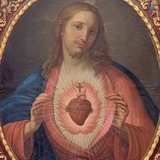
From Challoner's Meditations:
FRIDAY, THIRD WEEK IN LENT
ON OTHER CONSIDERATIONS TO EXCITE IN THE SOUL THE LOVE OF OUR SUFFERING JESUS
Consider first, how affectionate is the love that Christ bears us in his passion. It is stronger than deaths; he loves us more than his own life, since he parts with his life for the love of us. It is more tender than the love of the tenderest mother, since he voluntarily embraces the pangs of death to give us life; he sheds his blood to cleanse our souls from sin; he offers his own body in sacrifice to be our victim, our ransom, and our food. At the very time he is suffering amid dying for us, he has every one of us in his heart; he embraces each with an incomparable affection; weeps over each one, prays for each one, and pours out his blood for each one, no less than if he had suffered for that one alone. O my soul, had we then a place in the heart of our Jesus, when he was hanging upon the cross? and shall we ever refuse him a place in our heart? No, dear Saviour, my heart is thine; it desires nothing better than to be for ever a servant of thy love.
Consider 2ndly, how effectual is the love that Christ shows us in his passion; it contents not itself with words or professions of affection, nor with such passing sentiments of tenderness as we imagine we have for him in certain fits of devotion, at times when nothing occurs for us to suffer for his sake; but it shows itself by its effects, by his taking upon himself all our evils, to procure effectually all good for us. His love has made him divest himself of all his beauty and comeliness, and hide all his glory and majesty, that he might become for us, 'despised and the most abject of men, a man of sorrow and acquainted with infirmity.' Isaia iii. 'He hath borne our infirmities and carried our sorrows' out of pure love. He has made himself for the love of us, 'as it were a leper, and as one struck by God and afflicted. He was wounded for our iniquities, and bruised for our sins. For we like sheep have gone astray, and the Lord laid on him the iniquity of us all. He was offered because it was his own will.' And it was his own will, because he loved us, and desired to transfer to himself the punishment due to us, that he might deliver us from the wrath to come, and open to us the fountains of mercy, grace, and life. This was an effectual love indeed. Does our love for him show itself by the like effects? Are we willing to renounce our own will, to mortify our inclinations and passions, to suffer and to bear our crosses for him? A generous lover is as willing to be with him on mount Calvary, as on mount Thabor. Is this our disposition?
Consider 3rdly, how disinterested is the love that Christ shows us in his passion. He loves us without any merit on our side; we deserved nothing from him but hell. He loves us without any prospect of gain to himself from us, or any return that we can make to him; we can give him nothing but what he must first give us; we can offer him no good thing but what his love has purchased for us; we can have nothing but what is his. He stands in no need at all of us, or our goods. O how truly generous is this love of our Redeemer in his passion! How bountiful is he to us! He makes over to us the infinite treasures of his merits; he wants them not for himself, but bequeaths them all to us. His love for us knows no bounds. It hath possessed his heart from the first instant of his conception: it burned there for every moment of his life; it carried him through all his sufferings, even to death. It is without beginning or end; it endures from eternity to eternity. O bright fire, mayest thou take possession of my soul, for time and eternity!
Conclude, since thou canst make no better return, to offer at least daily thy heart with all its affections to thy loving Saviour. But that it may be worthy of his acceptance, beg that he would cleanse it by his precious blood, and inflame it with his love.
FRIDAY, THIRD WEEK IN LENT
ON OTHER CONSIDERATIONS TO EXCITE IN THE SOUL THE LOVE OF OUR SUFFERING JESUS
Consider first, how affectionate is the love that Christ bears us in his passion. It is stronger than deaths; he loves us more than his own life, since he parts with his life for the love of us. It is more tender than the love of the tenderest mother, since he voluntarily embraces the pangs of death to give us life; he sheds his blood to cleanse our souls from sin; he offers his own body in sacrifice to be our victim, our ransom, and our food. At the very time he is suffering amid dying for us, he has every one of us in his heart; he embraces each with an incomparable affection; weeps over each one, prays for each one, and pours out his blood for each one, no less than if he had suffered for that one alone. O my soul, had we then a place in the heart of our Jesus, when he was hanging upon the cross? and shall we ever refuse him a place in our heart? No, dear Saviour, my heart is thine; it desires nothing better than to be for ever a servant of thy love.
Consider 2ndly, how effectual is the love that Christ shows us in his passion; it contents not itself with words or professions of affection, nor with such passing sentiments of tenderness as we imagine we have for him in certain fits of devotion, at times when nothing occurs for us to suffer for his sake; but it shows itself by its effects, by his taking upon himself all our evils, to procure effectually all good for us. His love has made him divest himself of all his beauty and comeliness, and hide all his glory and majesty, that he might become for us, 'despised and the most abject of men, a man of sorrow and acquainted with infirmity.' Isaia iii. 'He hath borne our infirmities and carried our sorrows' out of pure love. He has made himself for the love of us, 'as it were a leper, and as one struck by God and afflicted. He was wounded for our iniquities, and bruised for our sins. For we like sheep have gone astray, and the Lord laid on him the iniquity of us all. He was offered because it was his own will.' And it was his own will, because he loved us, and desired to transfer to himself the punishment due to us, that he might deliver us from the wrath to come, and open to us the fountains of mercy, grace, and life. This was an effectual love indeed. Does our love for him show itself by the like effects? Are we willing to renounce our own will, to mortify our inclinations and passions, to suffer and to bear our crosses for him? A generous lover is as willing to be with him on mount Calvary, as on mount Thabor. Is this our disposition?
Consider 3rdly, how disinterested is the love that Christ shows us in his passion. He loves us without any merit on our side; we deserved nothing from him but hell. He loves us without any prospect of gain to himself from us, or any return that we can make to him; we can give him nothing but what he must first give us; we can offer him no good thing but what his love has purchased for us; we can have nothing but what is his. He stands in no need at all of us, or our goods. O how truly generous is this love of our Redeemer in his passion! How bountiful is he to us! He makes over to us the infinite treasures of his merits; he wants them not for himself, but bequeaths them all to us. His love for us knows no bounds. It hath possessed his heart from the first instant of his conception: it burned there for every moment of his life; it carried him through all his sufferings, even to death. It is without beginning or end; it endures from eternity to eternity. O bright fire, mayest thou take possession of my soul, for time and eternity!
Conclude, since thou canst make no better return, to offer at least daily thy heart with all its affections to thy loving Saviour. But that it may be worthy of his acceptance, beg that he would cleanse it by his precious blood, and inflame it with his love.
Today, Friday of the third week in Lent, is the commemoration of the Five Holy Wounds of Our Lord Jesus Christ.
O God, who, by the passion of Thine only begotten Son, and by the blood shed through his five most sacred wounds, hast raised up mankind, lost because of sin; grant, we beseech Thee, that we who on Earth adore the wounds our Saviour received, may in Heaven rejoice in the glory he, at the price of His precious blood, hath brought back for us. Through the same Jesus Christ Thy Son our Lord, Who with Thee liveth and reigneth in the unity of the Holy Ghost, God, world without end.
Amen.
O God, who, by the passion of Thine only begotten Son, and by the blood shed through his five most sacred wounds, hast raised up mankind, lost because of sin; grant, we beseech Thee, that we who on Earth adore the wounds our Saviour received, may in Heaven rejoice in the glory he, at the price of His precious blood, hath brought back for us. Through the same Jesus Christ Thy Son our Lord, Who with Thee liveth and reigneth in the unity of the Holy Ghost, God, world without end.
Amen.
MARCH 12.
ST GREGORY I.
Pope, Confessor, Doctor of the Church.
St. Gregory the Great transformed his house into a monastery and founded many others where the rule of St. Benedict was strictly observed. Elected in turn Abbot, Cardinal and Supreme Pontiff, he was one of the greatest popes of the Middle Ages. To him belongs the honor of collecting those harmonious melodies known as the "Gregorian Chant." St. Gregory is one of the four great Latin Doctors of the Church. He died A.D. 604.
O God, who didst give to the soul of Thy servant Gregory, rewards of everlasting bliss: mercifully grant, that we, who are oppressed by the burden of our sins, may be raised up by his intercession with Thee. Through Our Lord Jesus Christ, Thy Son, Who liveth and reigneth with Thee in the unity of the Holy Ghost, God, world without end.
ST GREGORY I.
Pope, Confessor, Doctor of the Church.
St. Gregory the Great transformed his house into a monastery and founded many others where the rule of St. Benedict was strictly observed. Elected in turn Abbot, Cardinal and Supreme Pontiff, he was one of the greatest popes of the Middle Ages. To him belongs the honor of collecting those harmonious melodies known as the "Gregorian Chant." St. Gregory is one of the four great Latin Doctors of the Church. He died A.D. 604.
O God, who didst give to the soul of Thy servant Gregory, rewards of everlasting bliss: mercifully grant, that we, who are oppressed by the burden of our sins, may be raised up by his intercession with Thee. Through Our Lord Jesus Christ, Thy Son, Who liveth and reigneth with Thee in the unity of the Holy Ghost, God, world without end.
This media is not supported in your browser
VIEW IN TELEGRAM
On a day like today, March 12, 1939, Cardinal Pacelli, Noble Roman Patrician, was crowned Pope, who reigned under the name of Pius XII, "Pastor Angelicus" according to the Prophecies of St. Malachy.
His predecessor, Pius XI, had died on February 10 and on March 1 the Conclave met to elect the Cardinal who would take his place at the head of the Catholic Church. The chosen one was Cardinal Eugenio Maria Pacelli, who occupied the Chair of the Prince of the Apostles until his death on October 9, 1958.
Pope Pacelli would be the guarantor of the Roman Aristocracy, austere, pious and exemplary, which he would always encourage, even as Pontiff, to be a stimulus for all social classes, under the Apostolate of the Catholic Tradition.
Providence wanted that from his surname, Pacelli, "the peace that comes from Heaven", as well as his pontifical coat of arms, with Noah's dove with the olive tree in its beak, Pius XII saw and suffered the Second World War, the one who faced the excesses of Fascism and Nazism, helping and protecting the most disadvantaged of the conflict.
Pius XII consecrated the world to the Immaculate Heart of Mary in 1952 and thus entrusted to the Mother of God the designs of this society increasingly separated from the Love of God. Of this Good Mother he would preach Her loves and the need to consecrate ourselves to Her through Her Scapular of Carmel.
His love for the Blessed Virgin encouraged him to exalt Our Lady by proclaiming the Dogma of the Assumption in 1950, which became the rubric of a whole Marian tradition that claimed the clear definition of the incorruptibility of the Virgin Mary after Her dormition and Her Assumption body and soul into Paradise. If anything stood out in Pius XII, let us not doubt that it was his determination to correct doctrinal errors by publishing numerous encyclicals, where he clearly exposed the Catholic Magisterium in the face of the philosophical novelties that hovered at the gates of Rome.
Indeed, Pope Pacelli was "the peace come from Heaven", because with his doctrine and example Pius XII marked a path for the times of iniquity that came after his death, a time in which God has disposed us to be present to keep alive the Catholic Faith and Doctrine of always in opposition to the continuous novelties that appear and pretend, as the only objective, to remove God from the thought of his creatures.
Pope Pacelli would be the guarantor of the Roman Aristocracy, austere, pious and exemplary, which he would always encourage, even as Pontiff, to be a stimulus for all social classes, under the Apostolate of the Catholic Tradition.
Providence wanted that from his surname, Pacelli, "the peace that comes from Heaven", as well as his pontifical coat of arms, with Noah's dove with the olive tree in its beak, Pius XII saw and suffered the Second World War, the one who faced the excesses of Fascism and Nazism, helping and protecting the most disadvantaged of the conflict.
Pius XII consecrated the world to the Immaculate Heart of Mary in 1952 and thus entrusted to the Mother of God the designs of this society increasingly separated from the Love of God. Of this Good Mother he would preach Her loves and the need to consecrate ourselves to Her through Her Scapular of Carmel.
His love for the Blessed Virgin encouraged him to exalt Our Lady by proclaiming the Dogma of the Assumption in 1950, which became the rubric of a whole Marian tradition that claimed the clear definition of the incorruptibility of the Virgin Mary after Her dormition and Her Assumption body and soul into Paradise. If anything stood out in Pius XII, let us not doubt that it was his determination to correct doctrinal errors by publishing numerous encyclicals, where he clearly exposed the Catholic Magisterium in the face of the philosophical novelties that hovered at the gates of Rome.
Indeed, Pope Pacelli was "the peace come from Heaven", because with his doctrine and example Pius XII marked a path for the times of iniquity that came after his death, a time in which God has disposed us to be present to keep alive the Catholic Faith and Doctrine of always in opposition to the continuous novelties that appear and pretend, as the only objective, to remove God from the thought of his creatures.
From Challoner's Meditations:
SATURDAY, THIRD WEEK IN LENT
ON THE SUFFERINGS OF OUR SAVIOUR, BEFORE HIS PASSION
Consider first, how truly did the devout author of the 'Following of Christ,' say:- 'The whole life of Christ was a Cross and a Martyrdom. He came into this world to be a victim for our sins; and from the first instant of his conception in his mother’s womb, he offered himself for all the sufferings he was to undergo in life and death.' Hear how he then addresses himself to his Father, Ps. xxxiv. 7, 'sacrifice and oblation thou didst not desire, but thou hast pierced ears for me. Burnt-offering and sin-offering thou didst not require: then said I, behold I come. In the head of the book it is written of me, that I should do thy will. O my God, I have desired it, and thy name is in the midst of my heart.' And what was this will and this law, which from his first conception he embraced in the midst of his heart; but that instead of all other sacrifices he should become himself both our priest and victim, and through his sufferings should mediate our peace, and reconcile us to his Father? Thus he accepted beforehand all that he was afterwards to endure; and by the clear and distinct foresight, which he had all along of his whole passion, suffered in some measure all his lifetime, what afterwards he endured at his death. O how early did my Jesus embrace his cross for the love of me! O how early did I prefer my pleasures before his love!
Consider 2ndly, divers other sufferings which our Lord went through in the course of his mortal life. His nine months confinement in his mother’s womb, most sensible to him, who from his first conception had the perfect use of reason, and who by a violence which he offered to his zeal and love, was kept so long from action. The hardships he endured at his birth, from the rigour of the season and the poverty of his accommodations; his circumcision; his flight into Egypt; the sense that he had of the murder of the Innocents; the austerity of his life; his frequent hunger, thirst, and want of necessaries; his labours and fatigues. But all this was nothing to what his boundless charity and his zeal for the honour of his Father and the salvation of souls, made him continually suffer, from the sight and knowledge of the sins of men. He had all the sins of the world always before his eyes, for the whole time of his life, with all their enormity and opposition to the infinite majesty and sanctity of God, and his divine honour and glory, and the dreadful havoc they did, and would make in the souls of men, with all the dismal consequences of them both in time and eternity; and this sight which was always present to him, was infinitely more grievous to his soul than the very pangs of death. For if St. Paul had such a sense of the evil of sin, as to be quite on fire when he saw any one fall into sin, 2 Cor. xi. 29, how much more did this fire devour our Saviour?
SATURDAY, THIRD WEEK IN LENT
ON THE SUFFERINGS OF OUR SAVIOUR, BEFORE HIS PASSION
Consider first, how truly did the devout author of the 'Following of Christ,' say:- 'The whole life of Christ was a Cross and a Martyrdom. He came into this world to be a victim for our sins; and from the first instant of his conception in his mother’s womb, he offered himself for all the sufferings he was to undergo in life and death.' Hear how he then addresses himself to his Father, Ps. xxxiv. 7, 'sacrifice and oblation thou didst not desire, but thou hast pierced ears for me. Burnt-offering and sin-offering thou didst not require: then said I, behold I come. In the head of the book it is written of me, that I should do thy will. O my God, I have desired it, and thy name is in the midst of my heart.' And what was this will and this law, which from his first conception he embraced in the midst of his heart; but that instead of all other sacrifices he should become himself both our priest and victim, and through his sufferings should mediate our peace, and reconcile us to his Father? Thus he accepted beforehand all that he was afterwards to endure; and by the clear and distinct foresight, which he had all along of his whole passion, suffered in some measure all his lifetime, what afterwards he endured at his death. O how early did my Jesus embrace his cross for the love of me! O how early did I prefer my pleasures before his love!
Consider 2ndly, divers other sufferings which our Lord went through in the course of his mortal life. His nine months confinement in his mother’s womb, most sensible to him, who from his first conception had the perfect use of reason, and who by a violence which he offered to his zeal and love, was kept so long from action. The hardships he endured at his birth, from the rigour of the season and the poverty of his accommodations; his circumcision; his flight into Egypt; the sense that he had of the murder of the Innocents; the austerity of his life; his frequent hunger, thirst, and want of necessaries; his labours and fatigues. But all this was nothing to what his boundless charity and his zeal for the honour of his Father and the salvation of souls, made him continually suffer, from the sight and knowledge of the sins of men. He had all the sins of the world always before his eyes, for the whole time of his life, with all their enormity and opposition to the infinite majesty and sanctity of God, and his divine honour and glory, and the dreadful havoc they did, and would make in the souls of men, with all the dismal consequences of them both in time and eternity; and this sight which was always present to him, was infinitely more grievous to his soul than the very pangs of death. For if St. Paul had such a sense of the evil of sin, as to be quite on fire when he saw any one fall into sin, 2 Cor. xi. 29, how much more did this fire devour our Saviour?
Consider 3rdly, how much our Lord suffered from being obliged to live and converse amongst men, whose manners were so widely different from and so infinitely opposite to his; how sensibly he was touched with the crying disorders of the people of the Jews, amongst whom he lived; with their malice, their violences, their injustices, their deceits, their blasphemies, and the licentiousness of their lives; the pride, ambition, covetousness, and hypocrisy of their priests, scribes, and Pharisees; their oppressions of the poor; their contempt of virtue and of truth; and their general forgetfulness of God and their salvation. Add to this, how sensibly he must have been afflicted with the hardness of their hearts, with which they resisted his graces; their obstinacy in their evil ways; their ingratitude; the opposition they made to his heavenly Gospel; their blasphemous judgments of his person and miracles; their slanders and murmurings against him; and their continually laying snares for him, and persecuting him even unto death. O, who can sufficiently apprehend how much our Saviour’s soul was affected by all these evils; with this reception and treatment he met with from his chosen people, and with those dreadful judgments they were thereby drawing down upon their own heads, instead of that mercy, which he came to purchase for them by his blood! Death itself was not so sensible to him.
Conclude, if thou would’st be a true disciple of Jesus Christ, to conform thyself to a life of crosses and sufferings: thus shalt thou wear his livery, and shalt be entitled to a share in his heavenly kingdom.
Conclude, if thou would’st be a true disciple of Jesus Christ, to conform thyself to a life of crosses and sufferings: thus shalt thou wear his livery, and shalt be entitled to a share in his heavenly kingdom.
Pray, Pray Continuously
In all things, pray continuously, for you can do nothing without God's help. Nothing is as powerful as prayer to give us divine energy. And nothing is as useful as it is to obtain for us God's benevolence. The practice of the commandments is all contained in prayer. For there is nothing higher than the love of God.
Prayer without distractions is a sign of the love of God in the one who perseveres. Neglect and distraction when praying denounce love of pleasure. He who, without difficulty, watches, perserves and prays visibly receives the Holy Spirit. But he who does all this with difficulty and keeps his resolution is also answered without delay.
If you want to do a favor to someone who likes to learn, show him prayer, right faith and patience in trial. It is with these three virtues that you obtain the rest of the good things. Escape temptation by patience and prayer. If you think of fighting it without these virtues, you will be attacked by it again. Anything we can say or do without prayer becomes dangerous or useless.
We have to seek the inner dwelling place of Christ, since we are God's dwelling place, and, through prayer, persevere in knocking at his door (cf. Mt 7:7), so that, now or at the hour of our death, the Lord may open it for us and not say to us as to negligent men: "I do not know where you are from" (Lk 13:25). And we have, not only to ask and receive, but to keep what has been given to us. For there are those who lose after they have received.
Saint Mark the Ascetic, a hegumen in Asia Minor in 'On those who think they are justified by their works'.
In all things, pray continuously, for you can do nothing without God's help. Nothing is as powerful as prayer to give us divine energy. And nothing is as useful as it is to obtain for us God's benevolence. The practice of the commandments is all contained in prayer. For there is nothing higher than the love of God.
Prayer without distractions is a sign of the love of God in the one who perseveres. Neglect and distraction when praying denounce love of pleasure. He who, without difficulty, watches, perserves and prays visibly receives the Holy Spirit. But he who does all this with difficulty and keeps his resolution is also answered without delay.
If you want to do a favor to someone who likes to learn, show him prayer, right faith and patience in trial. It is with these three virtues that you obtain the rest of the good things. Escape temptation by patience and prayer. If you think of fighting it without these virtues, you will be attacked by it again. Anything we can say or do without prayer becomes dangerous or useless.
We have to seek the inner dwelling place of Christ, since we are God's dwelling place, and, through prayer, persevere in knocking at his door (cf. Mt 7:7), so that, now or at the hour of our death, the Lord may open it for us and not say to us as to negligent men: "I do not know where you are from" (Lk 13:25). And we have, not only to ask and receive, but to keep what has been given to us. For there are those who lose after they have received.
Saint Mark the Ascetic, a hegumen in Asia Minor in 'On those who think they are justified by their works'.
PRAYER TO PRESERVE THE TRUE FAITH.
Prayer of St. Peter Canisius
Prayer written by St. Peter Canisius (1521-1597), of the Society of Jesus, apostle of the Counter-Reformation in Germany, called "hammer of the heretics". He was beatified by Pope Pius IX in 1868 and canonized by Pius XI in 1925, who named him Doctor of the Church.
For my salvation, I confess aloud all that Catholics have rightly always believed in their hearts. I abhor Luther, I hate Calvin, I curse all heretics; I do not want to have anything in common with them, because they neither speak nor listen rightly, and do not possess the one rule of the true faith proposed by the one, holy, catholic, apostolic and Roman Church. I unite myself in communion with Her, embrace the faith, follow the religion and approve the doctrine of those who listen to and follow Christ, not only what is taught in the Scriptures, but also in the Ecumenical Councils and what is defined by the mouth of the Chair of Peter, testifying to it with the authority of the Fathers. I also declare myself to be a son of the Roman Church, which the impious and blasphemers persecute, despise and abominate as if it were anti-Christian; I do not in any point turn away from its authority, nor do I refuse to give my life and shed my blood in its defense. I believe that salvation through the merits of Christ we can attain only in the unity of this same Church.
With St. Jerome, I declare to remain united with all those who are united to the Chair of Peter; with St. Ambrose, I promise to follow in all things the Roman Church which I respectfully acknowledge, with St. Cyprian, as the root and mother of the universal Church. I base this faith on the doctrine which I learned as a child, which as a young man I confirmed as I was taught by adults and which, until now, I have defended with my feeble strength. In making this profession I am moved by no other reason than the glory and honor of God, the awareness of the truth, the canonical authority of Holy Scripture, the consensus of the Fathers of the Church, the testimony of faith that I must give to my brethren and, finally, the eternal salvation in Heaven and the happiness promised to true believers.
If it should happen that because of my faith, I am despised, mistreated and persecuted, I will consider it as an extraordinary grace and favor, because it will mean that You, my God, grant me the opportunity to suffer for justice and do not want to be benevolent to me those who, as declared enemies of the Church and of Catholic truth, cannot be your friends. Nevertheless, forgive them, O Lord, because instigated by the devil, and blinded by the brilliance of a false doctrine, they do not know or do not want to know what they are doing.
Grant me this grace, both in life and in death, and may I always be a trustworthy witness of the sincerity and fidelity which I owe to You, to the Church and to the truth, that I may not turn away from your holy love, and that I may remain in communion with those who fear and keep your precepts in the Holy Roman Church, to whose judgment I submit myself and all my works, with a prompt and respectful spirit. May all the saints, triumphant in heaven or militant on earth, united indissolubly in the bond of peace with the Catholic Church exalting your immense goodness, pray for me. To you, who are the beginning and end of all my goods, be all honor and glory forever and ever. Amen.
Prayer of St. Peter Canisius
Prayer written by St. Peter Canisius (1521-1597), of the Society of Jesus, apostle of the Counter-Reformation in Germany, called "hammer of the heretics". He was beatified by Pope Pius IX in 1868 and canonized by Pius XI in 1925, who named him Doctor of the Church.
For my salvation, I confess aloud all that Catholics have rightly always believed in their hearts. I abhor Luther, I hate Calvin, I curse all heretics; I do not want to have anything in common with them, because they neither speak nor listen rightly, and do not possess the one rule of the true faith proposed by the one, holy, catholic, apostolic and Roman Church. I unite myself in communion with Her, embrace the faith, follow the religion and approve the doctrine of those who listen to and follow Christ, not only what is taught in the Scriptures, but also in the Ecumenical Councils and what is defined by the mouth of the Chair of Peter, testifying to it with the authority of the Fathers. I also declare myself to be a son of the Roman Church, which the impious and blasphemers persecute, despise and abominate as if it were anti-Christian; I do not in any point turn away from its authority, nor do I refuse to give my life and shed my blood in its defense. I believe that salvation through the merits of Christ we can attain only in the unity of this same Church.
With St. Jerome, I declare to remain united with all those who are united to the Chair of Peter; with St. Ambrose, I promise to follow in all things the Roman Church which I respectfully acknowledge, with St. Cyprian, as the root and mother of the universal Church. I base this faith on the doctrine which I learned as a child, which as a young man I confirmed as I was taught by adults and which, until now, I have defended with my feeble strength. In making this profession I am moved by no other reason than the glory and honor of God, the awareness of the truth, the canonical authority of Holy Scripture, the consensus of the Fathers of the Church, the testimony of faith that I must give to my brethren and, finally, the eternal salvation in Heaven and the happiness promised to true believers.
If it should happen that because of my faith, I am despised, mistreated and persecuted, I will consider it as an extraordinary grace and favor, because it will mean that You, my God, grant me the opportunity to suffer for justice and do not want to be benevolent to me those who, as declared enemies of the Church and of Catholic truth, cannot be your friends. Nevertheless, forgive them, O Lord, because instigated by the devil, and blinded by the brilliance of a false doctrine, they do not know or do not want to know what they are doing.
Grant me this grace, both in life and in death, and may I always be a trustworthy witness of the sincerity and fidelity which I owe to You, to the Church and to the truth, that I may not turn away from your holy love, and that I may remain in communion with those who fear and keep your precepts in the Holy Roman Church, to whose judgment I submit myself and all my works, with a prompt and respectful spirit. May all the saints, triumphant in heaven or militant on earth, united indissolubly in the bond of peace with the Catholic Church exalting your immense goodness, pray for me. To you, who are the beginning and end of all my goods, be all honor and glory forever and ever. Amen.
From Challoner's Meditations:
FOURTH SUNDAY IN LENT
ON OUR SAVIOUR'S PRAYER IN THE GARDEN
Consider first, that our Saviour's passion began the night before his death; when, after having eaten the paschal lamb with his disciples, humbly washed their feet, instituted the great Passover of the new covenant, and given them, in an admirable sacrament of love, his own most precious body and blood, he went out with them unto Mount Olivet - the place to which he was accustomed to resort after the preaching and labours of the day, to spend the evening, if not the whole night, in prayer. Hither he went on this his last night, to prepare himself for his passion by prayer; not for any need he had of it for himself, but to give us an example, and for our instruction. O learn, my soul, by this great example, how thou art to arm thyself against all trials and temptations! Learn from whence all thy strength is to come, in the time of battle. Give ear to what our Lord said to his disciples upon this occasion, Matt. xxvi. 41, 'Watch ye and pray, that ye enter not into temptation; the spirit indeed is willing, but the flesh is weak.' O take heed, lest if thou sleep as Peter did, when thou shouldst pray, thou deny thy Lord when thou comest to the trial.
Consider 2ndly, how our Saviour began to disclose to his disciples the mortal anguish, fear, and sadness which he then suffered in his soul. 'My soul' (saith he) 'is sorrowful, even unto death;' that is to say with a sadness which is capable of even now taking away my life, if I did not, by miracle, support myself for enduring the other torments of my passion. Sweet Jesus, what can be the meaning of this? Didst thou not from the first instant of life accept of and embrace, in the midst of thy heart, all that thou art now going to suffer - forasmuch as it would be for the glory of thy Father, and the redemption of man? Hast thou not even a longing desire of accomplishing this great sacrifice of our redemption? And how comes it that thou art now thus oppressed with sadness and anguish? Where is that courage and fortitude which thou hast imparted to thy martyrs, which has made even tender maids despise the worst of torments, when they endured them for the love of thee? And shalt thou, who art the strengths of the martyrs, shrink at the fear of death? But O! very well understand that it is at thy own choice thou hast condescended to all this sadness, fear, and anguish; to the end that thou mightest suffer the more for me, and engage me to love thee the more; it is that thou mightest teach me how to behave under all my interior anguishes and afflictions, and how to endure them for the love of thee.
Consider 3rdly, the prayer our Saviour made on this occasion, that if it were agreeable to the will of his Father, the bitter cup might pass away from him. But O with what fervour did he pray? 'With a strong cry and tears.' - Heb. v. 7. With what reverence and humility? - lying prostrate upon the ground, Matt. xxvi. 39. With what earnestness and perseverance? - continuing a long time in prayer, and repeating again and again the same supplication. Learn, my soul, to imitate him under all thy distresses and betake thyself to prayer; but see thou pray, as the Lord did, with fervour, humility, and perseverance; see thou pray with the like resignation! 'Not my will but thine be done.' Remember that in thy prayers thou art not to seek thy own pleasure or comfort, but the holy will of God: O make this holy will thy pleasure and comfort, and thy prayer will be always acceptable. 'Stay thou here and watch with me,' saith our Lord to His disciples; but at every time that he came to them, he found them still asleep; and no help or comfort had he from their company, in this his desolate condition. O my soul, do thou at least pity thy Saviour under all this anguish and desolation; do thou stay and watch with him, by a frequent meditation on his sufferings.
FOURTH SUNDAY IN LENT
ON OUR SAVIOUR'S PRAYER IN THE GARDEN
Consider first, that our Saviour's passion began the night before his death; when, after having eaten the paschal lamb with his disciples, humbly washed their feet, instituted the great Passover of the new covenant, and given them, in an admirable sacrament of love, his own most precious body and blood, he went out with them unto Mount Olivet - the place to which he was accustomed to resort after the preaching and labours of the day, to spend the evening, if not the whole night, in prayer. Hither he went on this his last night, to prepare himself for his passion by prayer; not for any need he had of it for himself, but to give us an example, and for our instruction. O learn, my soul, by this great example, how thou art to arm thyself against all trials and temptations! Learn from whence all thy strength is to come, in the time of battle. Give ear to what our Lord said to his disciples upon this occasion, Matt. xxvi. 41, 'Watch ye and pray, that ye enter not into temptation; the spirit indeed is willing, but the flesh is weak.' O take heed, lest if thou sleep as Peter did, when thou shouldst pray, thou deny thy Lord when thou comest to the trial.
Consider 2ndly, how our Saviour began to disclose to his disciples the mortal anguish, fear, and sadness which he then suffered in his soul. 'My soul' (saith he) 'is sorrowful, even unto death;' that is to say with a sadness which is capable of even now taking away my life, if I did not, by miracle, support myself for enduring the other torments of my passion. Sweet Jesus, what can be the meaning of this? Didst thou not from the first instant of life accept of and embrace, in the midst of thy heart, all that thou art now going to suffer - forasmuch as it would be for the glory of thy Father, and the redemption of man? Hast thou not even a longing desire of accomplishing this great sacrifice of our redemption? And how comes it that thou art now thus oppressed with sadness and anguish? Where is that courage and fortitude which thou hast imparted to thy martyrs, which has made even tender maids despise the worst of torments, when they endured them for the love of thee? And shalt thou, who art the strengths of the martyrs, shrink at the fear of death? But O! very well understand that it is at thy own choice thou hast condescended to all this sadness, fear, and anguish; to the end that thou mightest suffer the more for me, and engage me to love thee the more; it is that thou mightest teach me how to behave under all my interior anguishes and afflictions, and how to endure them for the love of thee.
Consider 3rdly, the prayer our Saviour made on this occasion, that if it were agreeable to the will of his Father, the bitter cup might pass away from him. But O with what fervour did he pray? 'With a strong cry and tears.' - Heb. v. 7. With what reverence and humility? - lying prostrate upon the ground, Matt. xxvi. 39. With what earnestness and perseverance? - continuing a long time in prayer, and repeating again and again the same supplication. Learn, my soul, to imitate him under all thy distresses and betake thyself to prayer; but see thou pray, as the Lord did, with fervour, humility, and perseverance; see thou pray with the like resignation! 'Not my will but thine be done.' Remember that in thy prayers thou art not to seek thy own pleasure or comfort, but the holy will of God: O make this holy will thy pleasure and comfort, and thy prayer will be always acceptable. 'Stay thou here and watch with me,' saith our Lord to His disciples; but at every time that he came to them, he found them still asleep; and no help or comfort had he from their company, in this his desolate condition. O my soul, do thou at least pity thy Saviour under all this anguish and desolation; do thou stay and watch with him, by a frequent meditation on his sufferings.
Conclude never to forget what thy Saviour suffered for thee in his soul, during his prayer in the garden. No sufferings can be greater than such as immediately affect the soul. St. Teresa did not let a night pass, from her very childhood, without reflecting, before she fell asleep, on our Saviour’s sufferings in that part of his passion; and, by this means, she gradually arrived at the perfection of mental prayer, and of all holiness. Do thou likewise.