
👹 MAN IN THE MIDDLE ATTACK✈
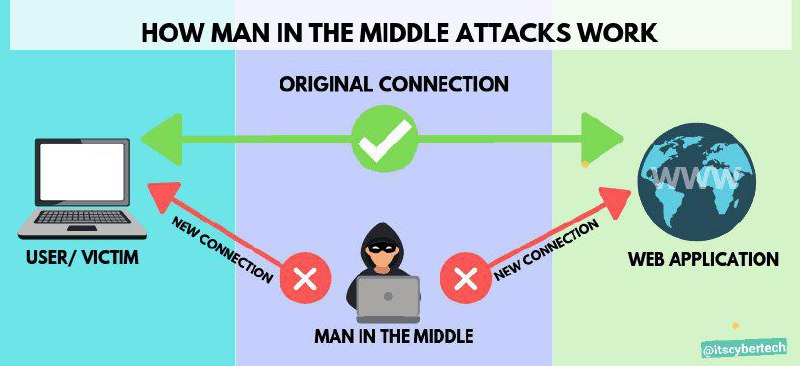
Man-in-the-Middle (MITM) attack happens when a hacker inserts themselves between a user and a website.
Attackers have many different reasons and methods for using a MITM attack. Typically, they’re trying to steal something, like credit card numbers or user login credentials. Sometimes they’re snooping on private conversations, which might include trade secrets or other valuable information
😉Usefull Types of Man-in-the Middle Attacks
⭐ Wi-Fi Eavesdropping
If you’ve ever used a laptop in a coffee shop, you may have noticed a pop-up that says “This network is not secure.” Public wi-fi is usually provided “as-is,” with no guarantees over the quality of service.
However, unencrypted wi-fi connections are easy to eavesdrop. It’s much like having a conversation in a public restaurant – anyone can listen in
Another Wi-Fi Eavesdropping attack happens when a hacker creates its own wi-fi hotspot, called an “Evil Twin.” They make the connection look just like the authentic one, down to the network ID and passwords. Users may accidentally (or automatically) connect to the “evil twin,” allowing the hacker to snoop on their activity.
⭐ Email Hijacking
In this type of cyber security attack, a hacker compromises a user’s email account. Often, the hacker silently waits, gathering information and eavesdropping on the email conversations. Hackers may have a search script that looks for specific keywords, like “bank” or “secret Democrat strategies.”
Email hijacking works well with social engineering. Hackers might use information from a hacked email account to impersonate an online friend. They may also use spear-phishing to manipulate a user to install malicious software.
⭐ Session Hijacking
This type of Man-in-the attack is typically used to compromise social media accounts. With most social media sites, the website stores a “session browser cookie” on the user’s machine. This cookie is invalidated when the user logs off. But while the session is active, the cookie provides identity, access, and tracking information.
A Session Hijack occurs when an attacker steals a session cookie. This can happen if the user’s machine is infected with malware or browser hijackers. It can also happen when an attacker uses a cross-scripting XSS attack – where the attacker injects malicious code into a frequently-used website.
Man-in-the-Middle (MITM) attack happens when a hacker inserts themselves between a user and a website.
Attackers have many different reasons and methods for using a MITM attack. Typically, they’re trying to steal something, like credit card numbers or user login credentials. Sometimes they’re snooping on private conversations, which might include trade secrets or other valuable information
😉Usefull Types of Man-in-the Middle Attacks
⭐ Wi-Fi Eavesdropping
If you’ve ever used a laptop in a coffee shop, you may have noticed a pop-up that says “This network is not secure.” Public wi-fi is usually provided “as-is,” with no guarantees over the quality of service.
However, unencrypted wi-fi connections are easy to eavesdrop. It’s much like having a conversation in a public restaurant – anyone can listen in
Another Wi-Fi Eavesdropping attack happens when a hacker creates its own wi-fi hotspot, called an “Evil Twin.” They make the connection look just like the authentic one, down to the network ID and passwords. Users may accidentally (or automatically) connect to the “evil twin,” allowing the hacker to snoop on their activity.
⭐ Email Hijacking
In this type of cyber security attack, a hacker compromises a user’s email account. Often, the hacker silently waits, gathering information and eavesdropping on the email conversations. Hackers may have a search script that looks for specific keywords, like “bank” or “secret Democrat strategies.”
Email hijacking works well with social engineering. Hackers might use information from a hacked email account to impersonate an online friend. They may also use spear-phishing to manipulate a user to install malicious software.
⭐ Session Hijacking
This type of Man-in-the attack is typically used to compromise social media accounts. With most social media sites, the website stores a “session browser cookie” on the user’s machine. This cookie is invalidated when the user logs off. But while the session is active, the cookie provides identity, access, and tracking information.
A Session Hijack occurs when an attacker steals a session cookie. This can happen if the user’s machine is infected with malware or browser hijackers. It can also happen when an attacker uses a cross-scripting XSS attack – where the attacker injects malicious code into a frequently-used website.
👍1
Have you heard of the mysterious hacking group known only as Anonymous? Behind their trademark Guy Fawkes masks lurks a global collective of cyber-vigilantes who hijack computer systems in pursuit of their own brand of justice.
Anonymous first caught the public's attention by taking down the Church of Scientology's websites after the church tried to censor an embarrassing video. But their technological prowess was only just beginning.
In 2011, Anonymous launched attacks on Middle Eastern governments to support Arab Spring protestors. Calling themselves "hacktivists," they disabled government websites and accessed sensitive documents to expose corruption. Authorities scrambled to stop their infiltration but with little success against these digital rebels!
Perhaps most brazen was Anonymous' revenge on the FBI for shutting down the dark web site Silk Road. Within days, Anonymous hackers seized control of FBI servers and released sensitive files revealing the irony of the FBI's own hacking programs! A bold attack on the world's top law enforcement agency.
While their methods are legally and ethically questionable, Anonymous continues to thrive. This decentralized collective has proven nearly impossible to stop, going wherever their unique code of online vigilantism takes them.
Does Anonymous' brand of rogue hacking do more good than harm? Or are they cyber-terrorists who should be stopped? What do you think? Share your thoughts below!
Anonymous first caught the public's attention by taking down the Church of Scientology's websites after the church tried to censor an embarrassing video. But their technological prowess was only just beginning.
In 2011, Anonymous launched attacks on Middle Eastern governments to support Arab Spring protestors. Calling themselves "hacktivists," they disabled government websites and accessed sensitive documents to expose corruption. Authorities scrambled to stop their infiltration but with little success against these digital rebels!
Perhaps most brazen was Anonymous' revenge on the FBI for shutting down the dark web site Silk Road. Within days, Anonymous hackers seized control of FBI servers and released sensitive files revealing the irony of the FBI's own hacking programs! A bold attack on the world's top law enforcement agency.
While their methods are legally and ethically questionable, Anonymous continues to thrive. This decentralized collective has proven nearly impossible to stop, going wherever their unique code of online vigilantism takes them.
Does Anonymous' brand of rogue hacking do more good than harm? Or are they cyber-terrorists who should be stopped? What do you think? Share your thoughts below!
😱3👍2🔥1
🚀 Welcome to BeNN channel
Hey everyone! I’m rebooting this channel—not just as a place to post, but as a hub for deep, open discussions on everything that sparks curiosity. If you love exploring big ideas, pushing boundaries, and debating the unknown, you’re in the right place.
🔹 AI – From from Machine learning various models, Neural Nets to cutting-edge transformers, breaking down "Attention Is All You Need" and other groundbreaking papers. Siamese networks, reinforcement learning, AGI speculation—nothing’s off-limits.
🔹Programming – Python and its endless libraries, but also the forgotten legends like FORTRAN. Let’s talk about code, algorithms, and the beauty behind the logic.
🔹Physics – From the elegance of "Einstein’s General Relativity" to the enigma of Hawking’s Black Holes. Astrophysics, time dilation, the heat death of the universe—let’s question reality itself.
🔹Quantum Mechanics – Schrödinger’s cat, the Uncertainty Principle, quantum computing, and whether we really do live in a superposition of infinite possibilities.
🔹Mathematics – Number theory, calculus, Euler’s madness, Gauss’s elegance, Gödel’s incompleteness, and the unsolved mysteries that keep mathematicians awake at night.
🔹Movies & Series 🍿 – Breaking down cinematic masterpieces, Debating on GOAT series, other than Game of Thrones 😆 just raise your reason if you wanna say Breaking Bad😎.
🔹Life & Ideas – Philosophies, random musings, thought experiments—why do we exist, and what should we do about it?
This is a space for unfiltered discussion. No barriers, no limits—just raw curiosity and the freedom to think. Drop a message, challenge ideas, and let’s explore the unknown together. 🔥
#AI #MachineLearning #Physics #Quantum #Math #Programming #Movies #Ideas
Hey everyone! I’m rebooting this channel—not just as a place to post, but as a hub for deep, open discussions on everything that sparks curiosity. If you love exploring big ideas, pushing boundaries, and debating the unknown, you’re in the right place.
🔹 AI – From from Machine learning various models, Neural Nets to cutting-edge transformers, breaking down "Attention Is All You Need" and other groundbreaking papers. Siamese networks, reinforcement learning, AGI speculation—nothing’s off-limits.
🔹Programming – Python and its endless libraries, but also the forgotten legends like FORTRAN. Let’s talk about code, algorithms, and the beauty behind the logic.
🔹Physics – From the elegance of "Einstein’s General Relativity" to the enigma of Hawking’s Black Holes. Astrophysics, time dilation, the heat death of the universe—let’s question reality itself.
🔹Quantum Mechanics – Schrödinger’s cat, the Uncertainty Principle, quantum computing, and whether we really do live in a superposition of infinite possibilities.
🔹Mathematics – Number theory, calculus, Euler’s madness, Gauss’s elegance, Gödel’s incompleteness, and the unsolved mysteries that keep mathematicians awake at night.
🔹Movies & Series 🍿 – Breaking down cinematic masterpieces, Debating on GOAT series, other than Game of Thrones 😆 just raise your reason if you wanna say Breaking Bad😎.
🔹Life & Ideas – Philosophies, random musings, thought experiments—why do we exist, and what should we do about it?
This is a space for unfiltered discussion. No barriers, no limits—just raw curiosity and the freedom to think. Drop a message, challenge ideas, and let’s explore the unknown together. 🔥
#AI #MachineLearning #Physics #Quantum #Math #Programming #Movies #Ideas
👍5🔥3😱1
The Turing Test
Imagine you’re chatting with two mysterious entities—one is human, the other is a machine. You can ask anything: riddles, jokes, deep philosophical questions. If you can’t tell which one is human, does that mean the machine is thinking?
This is the essence of the Turing Test, a challenge proposed by Alan Turing, the father of modern computing.
Who Was Alan Turing?
Alan Turing wasn’t just another mathematician—he was a war hero, a codebreaker, and a visionary. During World War II, he cracked the Nazi Enigma code, saving millions of lives. But his mind didn’t stop at cryptography. He asked one of the most profound questions of all time:
"Can machines think?"
Since “thinking” is hard to define, Turing proposed a test in 1950. If a machine could convince a human that it was also human, then it should be considered intelligent.
How Does the Turing Test Work?
Picture this:
1. You’re the judge, sitting at a computer.
2. You’re chatting with two entities—one human, one AI.
3. Your job? Figure out which is which.
If the AI manages to fool you as often as a real human would, it passes the test. Simple, right?
Alan Turing’s idea sparked the AI revolution, but we’re still far from machines that truly think (maybe Not😁). Maybe one day, an AI won’t just pass the Turing Test—it will ask us its own questions.
Imagine you’re chatting with two mysterious entities—one is human, the other is a machine. You can ask anything: riddles, jokes, deep philosophical questions. If you can’t tell which one is human, does that mean the machine is thinking?
This is the essence of the Turing Test, a challenge proposed by Alan Turing, the father of modern computing.
Who Was Alan Turing?
Alan Turing wasn’t just another mathematician—he was a war hero, a codebreaker, and a visionary. During World War II, he cracked the Nazi Enigma code, saving millions of lives. But his mind didn’t stop at cryptography. He asked one of the most profound questions of all time:
"Can machines think?"
Since “thinking” is hard to define, Turing proposed a test in 1950. If a machine could convince a human that it was also human, then it should be considered intelligent.
How Does the Turing Test Work?
Picture this:
1. You’re the judge, sitting at a computer.
2. You’re chatting with two entities—one human, one AI.
3. Your job? Figure out which is which.
If the AI manages to fool you as often as a real human would, it passes the test. Simple, right?
Alan Turing’s idea sparked the AI revolution, but we’re still far from machines that truly think (maybe Not😁). Maybe one day, an AI won’t just pass the Turing Test—it will ask us its own questions.
⚡4👍1🔥1🤔1
Forwarded from Artificial Intelligence (Artificial Intelligence)
CEOs in 2025: "AI will write 90% of the code...!"
CEOs in 2026: "AI will write 100% of the code..!!"
CEOs in 2027: 'Wait… why is nothing working?"
Devs in 2027: "AI is now writing only 10% of the code… and we're getting paid 2x more to clean up the mess it made. The circle of tech life continues!" 😆💸
AI writing code is cool… until you realize debugging AI’s “creativity” is way harder than writing code yourself. AI won’t replace Devs - it’ll just make them more necessary😆
CEOs in 2026: "AI will write 100% of the code..!!"
CEOs in 2027: 'Wait… why is nothing working?"
Devs in 2027: "AI is now writing only 10% of the code… and we're getting paid 2x more to clean up the mess it made. The circle of tech life continues!" 😆💸
AI writing code is cool… until you realize debugging AI’s “creativity” is way harder than writing code yourself. AI won’t replace Devs - it’ll just make them more necessary😆
👍7
How a 17th-century math troll kept the world busy for 358 years?
I’ve always been fascinated by number theory — and one theorem that stole my heart (and everyone's patience) was "Fermat’s Last Theorem".
Quick refresher:
👉 Fermat claimed that there are no positive integers a, b, and c that satisfy:
a^n + b^n = c^n
for any n > 2 .
He even wrote, "I have a truly marvelous proof of this proposition, but this margin is too small to contain it."
(The ultimate flex.)
Fast forward 358 years— it took the legendary Andrew Wiles, hiding in his attic for years, to finally prove it in 1994. A proof so intricate that it combined deep modern mathematics (like elliptic curves and modular forms).
💻 Recently, I challenged myself to implement Fermat's Last Theorem computationally:
- I checked small cases manually (no luck — Fermat was right!).
- Then visualized how cn grows way faster than a^n + b^n or a^n - b^n — intuitively showing why no integer solution sneaks in.
Here's the implementation: https://github.com/benasphy/Mathematics/blob/main/Fermat's_Last_Theorem.ipynb
Moral of the story?
Sometimes, even the tiniest scribble in the margin can spark centuries of obsession, genius, and breakthroughs.
#NumberTheory #Mathematics #CodingFun #FermatsLastTheorem #CuriosityNeverDies
I’ve always been fascinated by number theory — and one theorem that stole my heart (and everyone's patience) was "Fermat’s Last Theorem".
Quick refresher:
👉 Fermat claimed that there are no positive integers a, b, and c that satisfy:
a^n + b^n = c^n
for any n > 2 .
He even wrote, "I have a truly marvelous proof of this proposition, but this margin is too small to contain it."
(The ultimate flex.)
Fast forward 358 years— it took the legendary Andrew Wiles, hiding in his attic for years, to finally prove it in 1994. A proof so intricate that it combined deep modern mathematics (like elliptic curves and modular forms).
💻 Recently, I challenged myself to implement Fermat's Last Theorem computationally:
- I checked small cases manually (no luck — Fermat was right!).
- Then visualized how cn grows way faster than a^n + b^n or a^n - b^n — intuitively showing why no integer solution sneaks in.
Here's the implementation: https://github.com/benasphy/Mathematics/blob/main/Fermat's_Last_Theorem.ipynb
Moral of the story?
Sometimes, even the tiniest scribble in the margin can spark centuries of obsession, genius, and breakthroughs.
#NumberTheory #Mathematics #CodingFun #FermatsLastTheorem #CuriosityNeverDies
GitHub
Mathematics/Fermat's_Last_Theorem.ipynb at main · benasphy/Mathematics
Contribute to benasphy/Mathematics development by creating an account on GitHub.
👍10
⚙️📊🤖Master ML with 30 Projects💪
After months of refining, I’m finally sharing 30+ hands-on Machine Learning projects — clean, practical, and designed to help you understand and master ML, not just learn it.
Tired of tutorials that just show you how to predict house prices for the 100th time? 🏠📉 Same here. That’s why I built these projects to actually make sense — helping you learn the real stuff, from classic algorithms to applied ideas you can use, tweak, and build on.
GitHub Repo: https://github.com/benasphy/ML_projects 💻
Live Demo: https://mlprojects-algorithmslist.streamlit.app 🚀
✨Don't forget to Star and fork it!!
Explore, Star, fork, learn — and if you want to connect, collab, or just nerd out over ML:
TG: @benasphy 💬
Let’s build smarter, together!
#MachineLearning #MLProjects #GitHub #AI #LearningByBuilding
After months of refining, I’m finally sharing 30+ hands-on Machine Learning projects — clean, practical, and designed to help you understand and master ML, not just learn it.
Tired of tutorials that just show you how to predict house prices for the 100th time? 🏠📉 Same here. That’s why I built these projects to actually make sense — helping you learn the real stuff, from classic algorithms to applied ideas you can use, tweak, and build on.
GitHub Repo: https://github.com/benasphy/ML_projects 💻
Live Demo: https://mlprojects-algorithmslist.streamlit.app 🚀
✨Don't forget to Star and fork it!!
Explore, Star, fork, learn — and if you want to connect, collab, or just nerd out over ML:
TG: @benasphy 💬
Let’s build smarter, together!
#MachineLearning #MLProjects #GitHub #AI #LearningByBuilding
GitHub
GitHub - benasphy/ML_projects
Contribute to benasphy/ML_projects development by creating an account on GitHub.
🔥9👍2
BeNN
⚙️📊🤖Master ML with 30 Projects💪 After months of refining, I’m finally sharing 30+ hands-on Machine Learning projects — clean, practical, and designed to help you understand and master ML, not just learn it. Tired of tutorials that just show you how…
I'll post a details into those ML algorithms and stay tuned!
🔥9
For anyone interested in ML and wanna do a lot in it, but got confused. Here's my advice