
So'z boyligimizni oshiramiz
🚩 Predlogli birikmalar
💥 at war - urushda
💥 at peace - tinchlik vaqtida
💥 at ease - erkin
💥 at rest - dam olishda
💥 at sea - dengiz bo‘yida
💥 at lunch - tushlikda
💥 in danger - xatarda
💥 in need - muhtojlikda
💥 in tears - ko‘z yosh to‘kib
💥 in reply - javoban
💥 in love - oshiqlikda
💥 in difficulty - qiyinchilikda
💥 on guard - himoyada
💥 on purpose - ataylab
💥 on fire - o‘t ichida
💥 on sale - sotuvda
💥 on vacation - o‘quv ta’tilida
💥 on time - vaqtida
💥 on duty - navbatchilikda
💥 on land - yerda
💥 on sea - dengizda
💥 by accident - tasodifan
💥 by design - qasddan
💥 out of control - nazoratdan chiqqan
💥 out of danger - xatardan holi
💥 out of date - eskirgan
💥 out of door - tashqarida
💥 out of order - buzilgan
💥 out of stock - qolmagan
💥 out of turn - navbatdan tashqari
#vocabulary
🎓 @grammar_ingliz- Follow to continue improving your English✨
👍7😁2👎1
#vocabulary
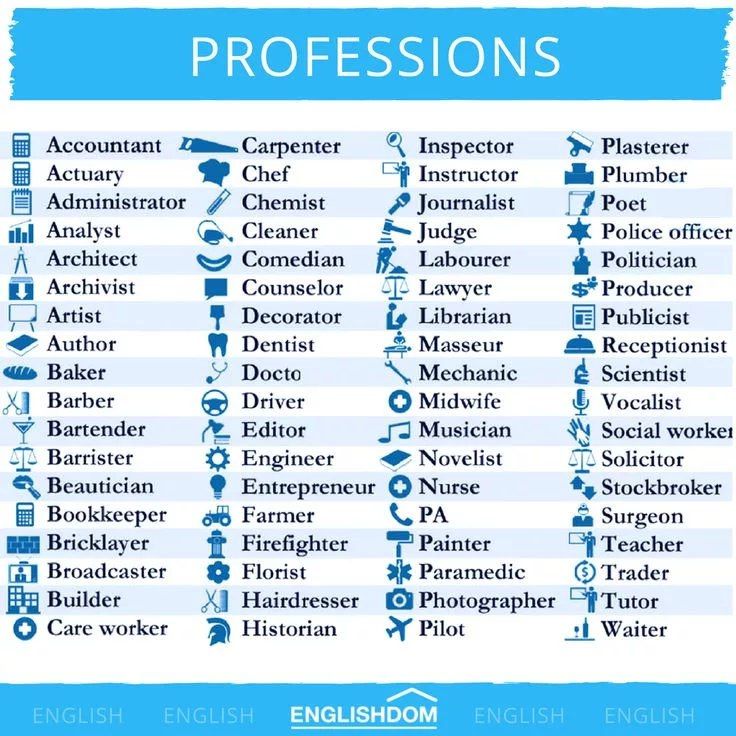
Professions - kasblar
Accountant - hisobchi
Actuary - sug'urta ishlari bilan shug'ullanuvchi
Administrator - administrator
Analyst - tahlilchi
Architect - arxitektor
Archivist - arxivchi
Artist - rassom
Author - muallif
Baker - novvoy
Barber - erkaklar sartaroshi
Bartender - bar xizmatchisi
Barrister - advokat
Beautician - kosmetolog
Bookkeeper - buxgalter
Bricklayer - g'isht teruvchi
Broadcaster - radioeshittiruvchi
Builder - quruvchi
Care worker - tez yordam xodimi
Carpenter - duradgor
Chef - oshpaz
Chemist - kimyogar
Cleaner - farrosh
Comedian - komediyachi
Counselor - konsul
Decorator - dekoratsiyachi
Dentist - tish shifokori
Doctor - shifokor
Driver - haydovchi
Editor - muharrir
Engineer - injiner
Enterpreneur - tadbirkor
Farmer - fermer
Firefighter - o't o'chiruvchi
Florist - gul sotuvchi
Hairdresser - salonchi, stilist
Historian - tarixchi
Inspector - inspektor, nazoratchi
Instructor - instruktor, o'rgatuvchi
Journalist - jurnalist
Judge - sudya
Labourer - yollanma ishchi
Lawyer - advokat
Librarian - kutubxonachi
Masseur - masajchi
Mechanic - mexanik
Midwife - doya, akusher
Musician - musiqachi
Novelist - romannavis
Nurse - hamshira
PA - (personal assistent)
Painter - bo'yoqchi
Paramedic - oliy ma'lumotga ega bo'lmagan tibbiyot xodimi
Photographer - suratchi
Pilot - uchuvchi
Plasterer - suvoqchi
Plumber - vodoporovodchi
Poet - shoir
Police oficcer - politsiya offitseri
Politician - siyosatchi
Producer - prodyuser
Publicist - publisist
Receptionist - qabulchi
Scientist - olim
Vocalist - ashulachi
Social worker - ijtimoiy ishchi
Solicitor - advokat (British)
Stockbroker - birja ishchisi
Surgeon - jarroh
Teacher - o'qituvchi
Trader - tijoratchi
Tutor - repetitor
Waiter - ofitsant
⚡️Share with your friends👇
@grammar_ingliz
❤6👍2
Media is too big
VIEW IN TELEGRAM
🔥 MUVAFFAQIYAT KALITI
🎬 MOTIVATSION VIDEO
☑️Kanalimiz sizga foydali bo'lsa quyidagi manzil orqali do'stlaringizni taklif qiling👇
🍀@grammar_ingliz
🎬 MOTIVATSION VIDEO
☑️Kanalimiz sizga foydali bo'lsa quyidagi manzil orqali do'stlaringizni taklif qiling👇
🍀@grammar_ingliz
📌 Like fe'li bilan ishlatilinadigan eng ommaviy 10 ta iboralar
💥 Sleep like a log - Chuqur va qattiq uyquga ketmoq
💥 Sell like hotcakes - Tez va yaxshi darajada biror narsa sotmoq
💥 Like a fish out of water - Batamom begona bo'lgan joyda bo'lish
💥 Feel like a million - Juda baxtli his qilmoq
💥 Like a bump on a log - Atrofidagi narsalarga foydali yoki kerakli deb qaramaslik
💥 Read someone like a book - So'ramasdan biror kim nima haqida o'ylayotganini o'qiy bilish
💥 Watch someone like a Hawk - Kimnidir ehtiyotkorlik bilan kuzatish, ayniqsa xato qilishini kutgan holda
💥 Know someone or something like the back of one’s hand - Biror kimni yoki narsani har tomondan to'laqonli bilish
💥 Fit like a glove - Juda mos/to'g'ri keladi
💥 Eat like a bird - Juda kam miqdorda nimadir yeyish
#speaking
➥🎓 @grammar_ingliz- Follow to continue improving your English✨
👍3
✍Complete the sentences with given words
✅factor, change, outcome, impact, role
1. The area had undergone many . . . in recent years
2. To achieve the best . . . , it is important to initiate change at a local level.
3. The climate has played a major . . . in this region's economic history.
4. Technology has had a huge . . . on our lives.
5. The main . . . contributing to success in any organization is a happy workforce.
#IELTS
➥🎓 @grammar_ingliz- Follow to continue improving your English✨
👍1👎1🔥1
This media is not supported in your browser
VIEW IN TELEGRAM
⚡️Don't use I think😡
❗️Watch the video and learn synonyms of I think 🤔
☑️Kanalimiz sizga foydali bo'lsa quyidagi manzil orqali do'stlaringizni taklif qiling👇
🍀@grammar_ingliz
❗️Watch the video and learn synonyms of I think 🤔
☑️Kanalimiz sizga foydali bo'lsa quyidagi manzil orqali do'stlaringizni taklif qiling👇
🍀@grammar_ingliz
👍2👎2
👍9👎1
✅ Phrasal verbs with " Have "
💎 Have a good time - yaxshi vaqt o'tkazmoq
💎 Have a rest - dam olmoq
💎 Have a break - tanaffus qilmoq
💎 Have a cold - shamollamoq
💎 Have 3 meals a day - kuniga 3 mahal ovqatlanmoq
💎 Have a headache - boshi ogrimoq
💎 Have a toothache - tishi ogrimoq
💎 Have a backache - beli ogrimoq
💎 Have a stomachache - oshqozoni ogrimoq
💎 Have a sore throat - tomogi ogrimoq
💎 Have a flu - gripp bolmoq
💎 Have a cough - yotalmoq
💎 Have a sneeze - aksirmoq
💎 Have one's English - Ingliz tili bilan shug'ullanmoq
💎 Have a smoke - chekmoq
💎 Have a tea - choy ichmoq
💎 Have a dictation - diktant yozmoq
🎓@grammar_ingliz - Follow to continue improving your English✨
👍8👎1👏1
🥰13👍12👎2🔥2💩2
🥝Informal & 🍋Formal verbs
🍏 It’s about ➖ It concerns, It’s in regards to
🍏 need to ➖ required
🍏 think about ➖ consider
🍏 get ➖ obtain
🍏 put up ➖ tolerate
🍏 deal with ➖ handle
🍏 seem ➖ appear
🍏 show ➖ demonstrate, illustrate, portray
🍏 start ➖ commence
🍏 keep ➖ retain
🍏 free ➖ release
🍏 get on someone’s nerves ➖
bother
🍏 ring up ➖ call
🍏 show up ➖ arrive
🍏 let ➖ permit
🍏 fill in ➖ substitute, inform
🍏 block ➖ undermine
🍏 give the go ahead, greenlight ➖ authorize, authorise
🎓 @grammar_ingliz- Follow to continue improving your English✨
👍4🔥3
IELTS Listening Test 2 – Section 1 [www.ieltsscore.com]
www.ieltsscore.com
#AUDIO
😊Do not forget to share with your friends
If you share with others, i will be happy . 👇👇
Kanal sizga yoqyapdimi ⁉️
⚡️ @grammar_ingliz⚡️
😊Do not forget to share with your friends
If you share with others, i will be happy . 👇👇
Kanal sizga yoqyapdimi ⁉️
⚡️ @grammar_ingliz⚡️
🔥1
📚 Idioms 📚
🌺A snake in the grass - Unrecognisable danger
🌺To talk through one's hat - To talk nonsense
🌺To smell a rat - To suspect a trick or deceit
🌺To throw down the glove - To give a challenge
🌺To be a rolling in money - To be very rich
📚 Phrasal Verbs 📚
🌼Account for - To explain the reason for
🌼Ask after - To make inquiries about the health of
🌼Ask for - To demand
🌼Attend on - To serve
🌼Back up - To support
🎓 @grammar_ingliz- Follow to continue improving your English
👍2
Basic English
🧑💻 IELTS MOCK EXAM🧑💻 Mana bugun listening section 1 kòrib chiqamiz👇👇 ⚡️ @grammar_ingliz ⚡️
#ANSWER
😊Do not forget to share with your friends
If you share with others, i will be happy . 👇👇
Kanal sizga yoqyapdimi ⁉️
⚡️ @grammar_ingliz⚡️
😊Do not forget to share with your friends
If you share with others, i will be happy . 👇👇
Kanal sizga yoqyapdimi ⁉️
⚡️ @grammar_ingliz⚡️
👎2
✅Writing Time
Below is a handy list of words that are both useful and appropriate to academic language.
🔷️ Describing similarities
-Likewise
-Correspondingly
-Equally
-Not only… but also
-In the same way
-Similarly
🔷️ Showing cause and effect
-Consequently
-As a result
-Thus
-Hence (never ‘hence why’)
-Since (try to avoid ‘as’ when showing cause and effect)
-Because
-Therefore
-Accordingly
-This suggests that
-It follows that
-For this reason
🔷️ Comparing and contrasting
-Alternatively
-However
-Conversely
-On the other hand
-Instead
-Yet
-On the contrary
🔷️ Showing limitation or contradiction
-Despite/in spite of
-While (not whilst!)
-Even so
-On the contrary
-Nevertheless
-Nonetheless
-Although
-Admittedly
🎓 @grammar_ingliz - Follow to continue improving your English✨
👍5👏4🥰1
❇️ used to ❇️
♦️ We use "used to" when we refer to things in the past which are no longer true. It can refer to repeated actions or to a state or situation:
For example:
- I used to have long hair (but now I have short hair).
- He used to smoke (but now he doesn't smoke).
- They used to live in India (but now they live in Germany).
- He used to play football for the local team, but he’s too old now.
♦️ Negative: didn’t use to:
The negative of "used to" is most commonly "didn’t use(d) to". Sometimes we write it with a final -d, sometimes not. Both forms are common, but many people consider the form with the final -d to be incorrect, and you should not use it in formal writing:
- It didn’t use to be so crowded in the shops as it is nowadays.
- I didn’t used to like broccoli when I was younger, but I love it now. (Don’t use this form in exams, because it is informal.)
In very formal styles, we can use the negative form "used not to":
- She used not to live as poorly as she does now.
♦️Questions:
The most common form of question is the auxiliary "did" + use(d) to. Many people consider the form with a final -d to be incorrect, and you should not use it in formal writing:
- I think we met once, a couple of years ago. Did you use to work with Kevin Harris?
- Didn’t she used to live in the same street as us? (Don’t use this form in written Academic exams.)
♦️ Emphatic "did"
We can use the emphatic auxiliary "did" with "used to":
- We never used to mix very much with the neighbours, but we did used to say hello to them in the street. (Don’t use this form in written Academic exams.)
♦️"used to" or "be used to"?
"used to" (when used as a verb) refers to actions and situations in the past which no longer happen or are no longer true. It always refers to the past:
- She used to sing in a choir, but she gave it up. (She sang, but she doesn’t sing any more)
"be used to" (when used as an adjective) means ‘be accustomed to’ or ‘be familiar with’. It can refer to the past, present or future. We follow "be used to" with a noun (phrase), a pronoun or the -ing form of a verb "the gerund":
- I work in a hospital, so I’m used to long hours. (I am accustomed to/familiar with long hours.)
- She lives in a very small village and hates traffic. She’s not used to it.
- I'm used to getting up early, so I don't mind doing it (= getting up early is normal for me, it's what I usually do).
♦️Note that we make the negative or the question with the verb 'be' in the normal way. The 'used to' doesn't change:
- Lucy isn't used to staying up late, so she's very tired today.
- Are your children used to walking a lot?
♦️ We can use 'get used to + verb-ing' (which is considered more formal than "be used to") to talk about the change of not normal to normal. We can also use this in any tense:
- Don't worry if your new job is hard at first. You will get used to it.
- It took me a few months to get used to living in Japan. At first everything seemed very different, but then gradually it became normal for me.
#grammar_time
➥🎓 @grammar_ingliz- Follow to continue improving your English✨
👍7
Assalomu alekum hammaga!
Bugun IELTS ning qaysi qiysmidan test bòlishni hohlesiz? Yoki Dtm businmi?
20;00 da obunachilar fikrini inobatga olgan holda test uyushtriramiz!!!
Bugun IELTS ning qaysi qiysmidan test bòlishni hohlesiz? Yoki Dtm businmi?
20;00 da obunachilar fikrini inobatga olgan holda test uyushtriramiz!!!
Anonymous Poll
31%
Listening
23%
Reading
33%
DTM
12%
Writing
👍2
❗️Phrasal verbs with "Let"❗️
☘Let yourself go - dam olmoq
☘Let on - oshkor qilmoq
☘Let down - xafa qilmoq
☘Let out - chiqarmoq
☘Let up - to'xtamoq
☘Let through - o'tishiga ruxsat bermoq
☘Let off - ketishiga ruxsat bermoq
☘Let in on - sirni aytmoq
☘Let into - yuza qismiga qo'ymoq
☘Let in - kiritmoq
🎓 @grammar_ingliz - Follow to continue improving your English✨
👍3
🔖 So'zlashuvdagi iboralar
💠 Tashakkur, maqtov, minnaddorchilik.
🔻 I'm Proud of you - Siz bilan faxrlanaman
🔻 I have always been proud of you - Men siz bilan doim faxrlanganman
🔻 Although this is the first time, you did a good jab - Birinchi marta bo'lishiga qaramasdan yaxshi ishladingiz.
🔻 You get finished quickly. Well established - Ishni tez tugatibsiz, Yaxshi ishladingiz.
🔻 You learn quickly to work - Ishni tez o'rganar ekansiz.
🔻 You are healthy - Siz sog'lomsiz
🔻 I can not know how to express to you my gratitude - Sizga qanday qilib minnatdorchilik bildirishni bilmayman
🔻 Thank you for being nice to me - Menga yaxshi munosabatda bo'lganingiz uchun rahmat
🔻 I did it because I wanted - O'zim hohlaganim uchun shunday qildim
🔻 It's my pleasure! - Arzimaydi
🔻 Congratulations - Tabriklayman
🔻 Good - Yaxshi
🎓 @grammar_ingliz - Follow to continue improving your English✨
👍6
IELTS Listening Test 2 – Section 2 [www.ieltsscore.com]
www.ieltsscore.com
#AUDIO
😊Do not forget to share with your friends
If you share with others, i will be happy . 👇👇
Kanal sizga yoqyapdimi ⁉️
⚡️ @grammar_ingliz⚡️
😊Do not forget to share with your friends
If you share with others, i will be happy . 👇👇
Kanal sizga yoqyapdimi ⁉️
⚡️ @grammar_ingliz⚡️