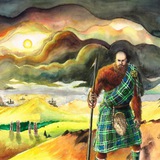
"Lenore" (1774) is a poem by Gottfried August Bürger.
The verse die Todten Reiten schnell ("The dead travel fast") is famous for being cited by Bram Stoker in the first chapter of his novel "Dracula" (1897)
"What! ride an hundred miles to-night,
By thy mad fancies driven!
Dost hear the bell with its sullen swell.
As it rumbles out eleven?"
"Look forth! look forth! the moon shines bright:
We and the dead gallop fast thro' the night.
'Tis for a wager I bear thee away
To the nuptial couch ere break of day."
The verse die Todten Reiten schnell ("The dead travel fast") is famous for being cited by Bram Stoker in the first chapter of his novel "Dracula" (1897)
"What! ride an hundred miles to-night,
By thy mad fancies driven!
Dost hear the bell with its sullen swell.
As it rumbles out eleven?"
"Look forth! look forth! the moon shines bright:
We and the dead gallop fast thro' the night.
'Tis for a wager I bear thee away
To the nuptial couch ere break of day."
Forwarded from Wild Folk
Wild Boar (Sus Scrofa)
A creature of myth and magic, the Wild Boar has been revered across the Isles for thousands of years. Honoured for its strength and courage, the boar (Eofor) features on many ancient heraldic crests.
In the Isles, Wild Boar are closely associated with the ‘otherworld’; linked with folk idols such as Fionn Mac Cumhaill, Culhwch & Olwen, and Odin, the creature was a precious totem for those of a warrior or hunter persuasion.
Amongst wise folk, the tusks of the boar were coveted as greatly powerful in keeping away malignant forces as well as an aid for women during child birth, their bristles would be boiled with fresh water in copper cauldrons to conjure rain and storms, and it’s flesh would be ritually consumed to impart valour and victory when going into battle.
A creature of myth and magic, the Wild Boar has been revered across the Isles for thousands of years. Honoured for its strength and courage, the boar (Eofor) features on many ancient heraldic crests.
In the Isles, Wild Boar are closely associated with the ‘otherworld’; linked with folk idols such as Fionn Mac Cumhaill, Culhwch & Olwen, and Odin, the creature was a precious totem for those of a warrior or hunter persuasion.
Amongst wise folk, the tusks of the boar were coveted as greatly powerful in keeping away malignant forces as well as an aid for women during child birth, their bristles would be boiled with fresh water in copper cauldrons to conjure rain and storms, and it’s flesh would be ritually consumed to impart valour and victory when going into battle.
Forwarded from Celta Lusitani Celtiberi Folk
Painting depicting an Anjana at a touristic fountain source in the Cantabrian valley.
The Anjana is a fairy-like mythical figure, nymph or witch forest in Cantabrian folklore. The same figures can be found as the 'Xanas' in Asturias, 'Janas' in León, the 'Mouras' in Galicia and the 'Lamiak' in Basque folklore.
These forest nymphs begin to appear resting by the rivers and fountains at the season of rebirth, Spring. They serve to protect the inhabitants of the deep rural forests from the local bad spirits. But they can also seduce and trick wandering men into falling in love with them.
The Anjana is a fairy-like mythical figure, nymph or witch forest in Cantabrian folklore. The same figures can be found as the 'Xanas' in Asturias, 'Janas' in León, the 'Mouras' in Galicia and the 'Lamiak' in Basque folklore.
These forest nymphs begin to appear resting by the rivers and fountains at the season of rebirth, Spring. They serve to protect the inhabitants of the deep rural forests from the local bad spirits. But they can also seduce and trick wandering men into falling in love with them.
“Telling the bees” is a European tradition which consists of alerting the bees to major events in the family, especially deaths.
It was believed that failing to do so would incur a penalty of sorts, such as loss of honey production or angry bees. The members of the family would speak deeply and honestly to the hives.
It was believed that failing to do so would incur a penalty of sorts, such as loss of honey production or angry bees. The members of the family would speak deeply and honestly to the hives.
Forwarded from Hyperborean Radio (The Final Episodes)
Nature Unveiling Herself Before Science by Louis-Ernest Barrias 1899
Forwarded from Hyperborean Radio (The Final Episodes)
The Wild Huntress is a title given to many goddesses including Gode, Perchta, Harke, Diana, Habonde, Baba Yaga, Frikka, but most notably Holle. Holle is a leader of The Wild Hunt as well as it under a different name "The Parade of Spirits" on Halloween or as the Pennsylvania Dutch call it Allelieweziel. After the Eternal Hunter takes the Plant spirits, Holle leads a procession across the sky dressed as an ethereal white woman, collecting the land spirits and ancestral spirits taking them to her mill for reincarnation. A Pennsylvania Dutch custom is to have a parade at about the same time, dressing as famous Mythical figures of Yule and similar holidays. Such as the Yule Cat, The Faithful Eckhart, among others. Mimicking the Procession of spirits, deities, and ancestors seen across the sky with Frau Holle.-TLK
The battle with the sea king dragon saving Princess Anastasiya Vahramyeevna.
Yeruslan Lazarevichis is the Russian folk-tale hero depicted.
Yeruslan Lazarevichis is the Russian folk-tale hero depicted.