Who is the real monster in the story?
"Devil! do you dare approach me? and do not you fear the fierce vengeance of my arm wreaked on your miserable head? Begone, vile insect! or rather, stay, that I may trample you to dust!...abhorred monster! fiend that thou art!"
- Mary Shelly’s Frankenstein
"Devil! do you dare approach me? and do not you fear the fierce vengeance of my arm wreaked on your miserable head? Begone, vile insect! or rather, stay, that I may trample you to dust!...abhorred monster! fiend that thou art!"
- Mary Shelly’s Frankenstein
The Brocken, the highest peak of the Harz mountain range in Northern Germany, has been associated with legends of apparitions and the ghosts of giants that haunt its craggy heights.
In his tragic play ‘Faust’, Johann Wolfgang von Goethe described the Brocken in as the center of revelry and festivity for witches on Walpurgisnacht, or Walpurgis Night.
“Now, to the Brocken, the witches ride;
The stubble is gold and the corn is green;
There is the carnival crew to be seen,
And Squire Urianus will come to preside.
So over the valleys, our company floats,
With witches a-farting on stinking old goats.”
The Harz housed a Saxon temple to the gods, and on the first of May, the spectral forms of the gods made the mountains their meeting place.
At the summit are huge blocks of granite called the ‘Sorcerer’s Chair’ and the ‘Witch’s altar’, while a close-by spring is known as the ‘Magic Fountain’. The anemone which grows here and around the sides is locally known as the ‘Sorcerer’s flower.’
In his tragic play ‘Faust’, Johann Wolfgang von Goethe described the Brocken in as the center of revelry and festivity for witches on Walpurgisnacht, or Walpurgis Night.
“Now, to the Brocken, the witches ride;
The stubble is gold and the corn is green;
There is the carnival crew to be seen,
And Squire Urianus will come to preside.
So over the valleys, our company floats,
With witches a-farting on stinking old goats.”
The Harz housed a Saxon temple to the gods, and on the first of May, the spectral forms of the gods made the mountains their meeting place.
At the summit are huge blocks of granite called the ‘Sorcerer’s Chair’ and the ‘Witch’s altar’, while a close-by spring is known as the ‘Magic Fountain’. The anemone which grows here and around the sides is locally known as the ‘Sorcerer’s flower.’
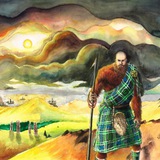
For ages, stories have been told of gigantic specters that have been seen haunting the mountain, which is often verified by marvelous stories by travelers and mountain climbers.
One such apparition is still believed to be “King of the Brocken” who appears angry with those that intrude on his domain.
A German traveler in the 18th century scaled the mountains 12 times in hopes that he might encounter the spectre.
He says: “In the course of my repeated tours through the Hartz, I ascended the Brocken twelve times, but had the good fortune only twice to see the spectre.”
“Ascending at that moment, the granite rocks called the Tempelskanzel, there appeared before me, though at great distance, the gigantic figure of a man as if standing on a large pedestal. Scarcely had I discovered it when it began to disappear, the clouds sank down and I saw it no more.”
One such apparition is still believed to be “King of the Brocken” who appears angry with those that intrude on his domain.
A German traveler in the 18th century scaled the mountains 12 times in hopes that he might encounter the spectre.
He says: “In the course of my repeated tours through the Hartz, I ascended the Brocken twelve times, but had the good fortune only twice to see the spectre.”
“Ascending at that moment, the granite rocks called the Tempelskanzel, there appeared before me, though at great distance, the gigantic figure of a man as if standing on a large pedestal. Scarcely had I discovered it when it began to disappear, the clouds sank down and I saw it no more.”
Forwarded from Hyperborean Radio (The Final Episodes) (T.L.K.)
Masking (The Good Wylde Way not modern BS) is an ancient tradition present in many holidays across our lands. Carnival, Yule Mumming, and most famously Halloween. The costumes often depicted spirits, heroes, and gods! The costume and mask served as a means of camouflage against more misanthropic spirits, while also serving as a sign to more benevolent spirits to not be scared and that they were among friends. In some cases it also allowed for a kind of spirits possession that many who have particiapated in Wilder Mann customs have spoken of. Of the spirit of the Perchten or Mari Lwyd or deity associated with such seemingly filling them. The costumes also allow the spirits to take physical form and mingle with the living as they are able to blend in among the monstrous visages of the various costumes.-TLK
Forwarded from Hyperborean Radio (The Final Episodes) (T.L.K.)
Why Hyperborean?
Why did we pick Hyperborean as our title and our general name for our people when there are many options? Well...
White: "What about the Northern Chinese, What about this person who looks white but is 1/4 Nigerian huh!? Huh!?" Also naming your people after a color is kind of sad. The term also is used for Arabs on the US Census.
European: What is European? This has been said for centuries using Jewish migrants, non-native immigrants, and plenty of others. It also excludes the Diaspora and our tribes still outside of Europe.
Westerner: We are not a direction, and this inevitably splits our people into threes.
Aryan: While the meaning of a mythical noble tribe is appreciated, this title can literally be purchased in South Asia, and is what Iran is named after, safe to say not our first pick. Also a Non-Starter for most.
So why Hyperborean? Because it literally means the people of the North, a mythic Idyllic way of our people, and our people have used it for ourselves before.
Why did we pick Hyperborean as our title and our general name for our people when there are many options? Well...
White: "What about the Northern Chinese, What about this person who looks white but is 1/4 Nigerian huh!? Huh!?" Also naming your people after a color is kind of sad. The term also is used for Arabs on the US Census.
European: What is European? This has been said for centuries using Jewish migrants, non-native immigrants, and plenty of others. It also excludes the Diaspora and our tribes still outside of Europe.
Westerner: We are not a direction, and this inevitably splits our people into threes.
Aryan: While the meaning of a mythical noble tribe is appreciated, this title can literally be purchased in South Asia, and is what Iran is named after, safe to say not our first pick. Also a Non-Starter for most.
So why Hyperborean? Because it literally means the people of the North, a mythic Idyllic way of our people, and our people have used it for ourselves before.