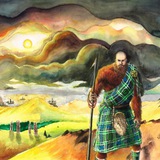
“I have been I have been where the soldiers of Britain were slain
From the east to the north
I am the escort of the grave.
I have been where the soldiers of Britain were slain.
From the east to the south
I am alive, they in death!”
- The Dialogue of Gwyn ap Nudd and Gwyddno Garanhir
Sculpture of Dafydd ap Gwilym by W Wheatley Wagstaff at City Hall, Cardiff.
From the east to the north
I am the escort of the grave.
I have been where the soldiers of Britain were slain.
From the east to the south
I am alive, they in death!”
- The Dialogue of Gwyn ap Nudd and Gwyddno Garanhir
Sculpture of Dafydd ap Gwilym by W Wheatley Wagstaff at City Hall, Cardiff.
Living lore
Fables, stories, tales, legends, myths, lore…
These words mean different things to us all, and bring to mind favorite versions of each that we’ve encountered.
They stay with us from when that twist in the plot makes our hair stand on end, or the feeling of excitement when something wonderful happens in the tale.
What if I told you that they never end? The legends of our heroes, facing insurmountable odds, only to win the day has a basis in truth.
When we are told about the gods, they have a mortal element to them because they themselves are connected to us, through the lore.
In a sense, our lore could be seen as history books of our people, and just because it’s not written down doesn’t mean it’s not myth.
That is the wonderful thing about Hyperboreans. We are living lore.
Fables, stories, tales, legends, myths, lore…
These words mean different things to us all, and bring to mind favorite versions of each that we’ve encountered.
They stay with us from when that twist in the plot makes our hair stand on end, or the feeling of excitement when something wonderful happens in the tale.
What if I told you that they never end? The legends of our heroes, facing insurmountable odds, only to win the day has a basis in truth.
When we are told about the gods, they have a mortal element to them because they themselves are connected to us, through the lore.
In a sense, our lore could be seen as history books of our people, and just because it’s not written down doesn’t mean it’s not myth.
That is the wonderful thing about Hyperboreans. We are living lore.
By our lives, we give witness to the gods.
They see our lives much like an open book, every day brings the stroke of a pen, adding another page in our book.
Living honorably, standing with your kin and tribe, makes for a legendary tale, worthy of being a limited-edition masterpiece.
Scraping by life, being lazy and going with the flow of modernity, makes for a cheaply made dime-novel.
What we do in this life is living lore by writing history, to be read both by gods and other men. It should be a thought-provoking, inspiring, heroic tale.
Not one to be tossed out with the trash.
Do great things, Hyperborean. Our story is still being written.
They see our lives much like an open book, every day brings the stroke of a pen, adding another page in our book.
Living honorably, standing with your kin and tribe, makes for a legendary tale, worthy of being a limited-edition masterpiece.
Scraping by life, being lazy and going with the flow of modernity, makes for a cheaply made dime-novel.
What we do in this life is living lore by writing history, to be read both by gods and other men. It should be a thought-provoking, inspiring, heroic tale.
Not one to be tossed out with the trash.
Do great things, Hyperborean. Our story is still being written.
Who is the real monster in the story?
"Devil! do you dare approach me? and do not you fear the fierce vengeance of my arm wreaked on your miserable head? Begone, vile insect! or rather, stay, that I may trample you to dust!...abhorred monster! fiend that thou art!"
- Mary Shelly’s Frankenstein
"Devil! do you dare approach me? and do not you fear the fierce vengeance of my arm wreaked on your miserable head? Begone, vile insect! or rather, stay, that I may trample you to dust!...abhorred monster! fiend that thou art!"
- Mary Shelly’s Frankenstein
The Brocken, the highest peak of the Harz mountain range in Northern Germany, has been associated with legends of apparitions and the ghosts of giants that haunt its craggy heights.
In his tragic play ‘Faust’, Johann Wolfgang von Goethe described the Brocken in as the center of revelry and festivity for witches on Walpurgisnacht, or Walpurgis Night.
“Now, to the Brocken, the witches ride;
The stubble is gold and the corn is green;
There is the carnival crew to be seen,
And Squire Urianus will come to preside.
So over the valleys, our company floats,
With witches a-farting on stinking old goats.”
The Harz housed a Saxon temple to the gods, and on the first of May, the spectral forms of the gods made the mountains their meeting place.
At the summit are huge blocks of granite called the ‘Sorcerer’s Chair’ and the ‘Witch’s altar’, while a close-by spring is known as the ‘Magic Fountain’. The anemone which grows here and around the sides is locally known as the ‘Sorcerer’s flower.’
In his tragic play ‘Faust’, Johann Wolfgang von Goethe described the Brocken in as the center of revelry and festivity for witches on Walpurgisnacht, or Walpurgis Night.
“Now, to the Brocken, the witches ride;
The stubble is gold and the corn is green;
There is the carnival crew to be seen,
And Squire Urianus will come to preside.
So over the valleys, our company floats,
With witches a-farting on stinking old goats.”
The Harz housed a Saxon temple to the gods, and on the first of May, the spectral forms of the gods made the mountains their meeting place.
At the summit are huge blocks of granite called the ‘Sorcerer’s Chair’ and the ‘Witch’s altar’, while a close-by spring is known as the ‘Magic Fountain’. The anemone which grows here and around the sides is locally known as the ‘Sorcerer’s flower.’