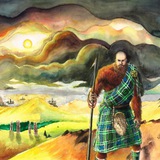
Rübezahl, Lord of the Mountains, appears as a capricious giant, gnome, or mountain spirit.
His stories are purely out of pagan origins, with ties going back to the Wild Hunt and even possibly Wotan.
While Rübezahl is the name by which he is commonly known, it is said he takes it as an insult, as it means ‘turnip counter’.
He much prefers to be known instead as ‘Lord of the Mountains’.
In Germanic legends, if you are a good person, he can be kind, teach you and give you gifts. If someone deceives or has Ill-will towards him, he can be vindictive, vengeful or a trickster.
His stories are purely out of pagan origins, with ties going back to the Wild Hunt and even possibly Wotan.
While Rübezahl is the name by which he is commonly known, it is said he takes it as an insult, as it means ‘turnip counter’.
He much prefers to be known instead as ‘Lord of the Mountains’.
In Germanic legends, if you are a good person, he can be kind, teach you and give you gifts. If someone deceives or has Ill-will towards him, he can be vindictive, vengeful or a trickster.
Jack-O-Lanterns
Grinning pumpkins with a glowing smile start arriving this time of year all around the world. Usually found on a front porch, doorstep or in a windowsill.
They were originally carried by Scottish children, who made them from the largest turnips they could find, upon which faces were carved and candles placed inside.
They were called “bogies” and were carried on Samhain (Halloween) to ward malicious spirits from ruining all of their fun.
This is also where the term “bogeyman” comes from. The Irish used potatoes and turnips, and the English turned to beets which they called “mangel-wurzels”.
Grinning pumpkins with a glowing smile start arriving this time of year all around the world. Usually found on a front porch, doorstep or in a windowsill.
They were originally carried by Scottish children, who made them from the largest turnips they could find, upon which faces were carved and candles placed inside.
They were called “bogies” and were carried on Samhain (Halloween) to ward malicious spirits from ruining all of their fun.
This is also where the term “bogeyman” comes from. The Irish used potatoes and turnips, and the English turned to beets which they called “mangel-wurzels”.
After migrating west to the new country of America, they came across large orange pumpkins and saw the opportunity for creativeness, continuing the tradition.
Early British were already accustomed to apparitions, specters, phantoms, and all sorts of things that go bump in the night, but one such entity scared them witless. The Lantern Men.
Also called “Hob-O’-Lanterns, Jack-O’-Lantern, Will-O’-the-Wisp”, they were commonly called “Corpse Candles” because they were seen as moving lights over marshes, bogs or freshly dug graves.
Was it evil spirits seeking the souls of the recently departed… or the living perhaps?
Or was it children having a little fun, scaring the pants off any passer-by?
Maybe both.
Early British were already accustomed to apparitions, specters, phantoms, and all sorts of things that go bump in the night, but one such entity scared them witless. The Lantern Men.
Also called “Hob-O’-Lanterns, Jack-O’-Lantern, Will-O’-the-Wisp”, they were commonly called “Corpse Candles” because they were seen as moving lights over marshes, bogs or freshly dug graves.
Was it evil spirits seeking the souls of the recently departed… or the living perhaps?
Or was it children having a little fun, scaring the pants off any passer-by?
Maybe both.
In Welsh mythology, Gwyn ap Nudd is a mighty king of the “fair folk” and commands the Wild Hunt, much like Wotan, Odin or Herne the Hunter in different regional versions.
He also collects the souls of the dead, escorts them to the otherworld and brags at being a witness to history's bloodiest battles. Gwyn's castle, Caer Sidi, is guarded by the souls of ancient Welsh folk heroes.
He also collects the souls of the dead, escorts them to the otherworld and brags at being a witness to history's bloodiest battles. Gwyn's castle, Caer Sidi, is guarded by the souls of ancient Welsh folk heroes.
👍1
“I have been I have been where the soldiers of Britain were slain
From the east to the north
I am the escort of the grave.
I have been where the soldiers of Britain were slain.
From the east to the south
I am alive, they in death!”
- The Dialogue of Gwyn ap Nudd and Gwyddno Garanhir
Sculpture of Dafydd ap Gwilym by W Wheatley Wagstaff at City Hall, Cardiff.
From the east to the north
I am the escort of the grave.
I have been where the soldiers of Britain were slain.
From the east to the south
I am alive, they in death!”
- The Dialogue of Gwyn ap Nudd and Gwyddno Garanhir
Sculpture of Dafydd ap Gwilym by W Wheatley Wagstaff at City Hall, Cardiff.
Living lore
Fables, stories, tales, legends, myths, lore…
These words mean different things to us all, and bring to mind favorite versions of each that we’ve encountered.
They stay with us from when that twist in the plot makes our hair stand on end, or the feeling of excitement when something wonderful happens in the tale.
What if I told you that they never end? The legends of our heroes, facing insurmountable odds, only to win the day has a basis in truth.
When we are told about the gods, they have a mortal element to them because they themselves are connected to us, through the lore.
In a sense, our lore could be seen as history books of our people, and just because it’s not written down doesn’t mean it’s not myth.
That is the wonderful thing about Hyperboreans. We are living lore.
Fables, stories, tales, legends, myths, lore…
These words mean different things to us all, and bring to mind favorite versions of each that we’ve encountered.
They stay with us from when that twist in the plot makes our hair stand on end, or the feeling of excitement when something wonderful happens in the tale.
What if I told you that they never end? The legends of our heroes, facing insurmountable odds, only to win the day has a basis in truth.
When we are told about the gods, they have a mortal element to them because they themselves are connected to us, through the lore.
In a sense, our lore could be seen as history books of our people, and just because it’s not written down doesn’t mean it’s not myth.
That is the wonderful thing about Hyperboreans. We are living lore.
By our lives, we give witness to the gods.
They see our lives much like an open book, every day brings the stroke of a pen, adding another page in our book.
Living honorably, standing with your kin and tribe, makes for a legendary tale, worthy of being a limited-edition masterpiece.
Scraping by life, being lazy and going with the flow of modernity, makes for a cheaply made dime-novel.
What we do in this life is living lore by writing history, to be read both by gods and other men. It should be a thought-provoking, inspiring, heroic tale.
Not one to be tossed out with the trash.
Do great things, Hyperborean. Our story is still being written.
They see our lives much like an open book, every day brings the stroke of a pen, adding another page in our book.
Living honorably, standing with your kin and tribe, makes for a legendary tale, worthy of being a limited-edition masterpiece.
Scraping by life, being lazy and going with the flow of modernity, makes for a cheaply made dime-novel.
What we do in this life is living lore by writing history, to be read both by gods and other men. It should be a thought-provoking, inspiring, heroic tale.
Not one to be tossed out with the trash.
Do great things, Hyperborean. Our story is still being written.