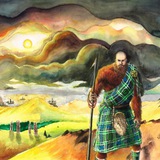
Running the Gauntlet
The word “Gauntlet” originates from France and specifically refers to a glove. Usually of leather, covered with plates of steel or chain mail, sometimes both.
When we hear the term “running the gauntlet” it usually means engagement in a critical ordeal or being attacked on all fronts, but this has nothing to do with wearing apparel in modern times.
The origin of the term is rooted in military historical context, as it was used in practice.
Two rows of fighting men, or soldiers, were lined up in a double row, facing each other. Between them, the offender to be disciplined would strip to the waist and run through the row.
Each of the men in the line were provided knotted cord, sometimes a rope or stick, and would strike the passing offender.
This description of “running the gauntlet” goes back to the Thirty Years War, when military hierarchy instituted the punishment, and was later adopted by the American legal system, first reference being in 1676.
The word “Gauntlet” originates from France and specifically refers to a glove. Usually of leather, covered with plates of steel or chain mail, sometimes both.
When we hear the term “running the gauntlet” it usually means engagement in a critical ordeal or being attacked on all fronts, but this has nothing to do with wearing apparel in modern times.
The origin of the term is rooted in military historical context, as it was used in practice.
Two rows of fighting men, or soldiers, were lined up in a double row, facing each other. Between them, the offender to be disciplined would strip to the waist and run through the row.
Each of the men in the line were provided knotted cord, sometimes a rope or stick, and would strike the passing offender.
This description of “running the gauntlet” goes back to the Thirty Years War, when military hierarchy instituted the punishment, and was later adopted by the American legal system, first reference being in 1676.
Forwarded from Hyperborean Radio (The Final Episodes) (T.L.K.)
New Article Discussing Cairns in Hyperborean Culture and Spirituality https://wylderhomesproject.life/2021/09/23/cairns/
Wylder Homes Project
Cairns
By J. A. Coburn The word cairn or càrn comes from the Scottish Gaelic language which describes stones dry stacked to form a balanced tower to great and impressive structures or megaliths. Cairns fr…
The Alpha Bearded man
Nature gave us hair originally as a means of protection. It cushions blows from assailants, and insulates the part of the body it grows on against temperature changes, and harsh artic climate.
Eyelashes protect from dust, and foreign matter, and partially shields squinted eyes from too much sun. Our eyebrows somewhat prevent perspiration from running down into our eyes, while nasal hair acts as an air filter.
Out of all of these bristly characteristics, none can hold a follicle to the majestic, magnificent, fierce, and noble face fur that encapsulates a man’s beard.
Not the well-manicured, tamed, hipster beard. I’m talking of the grizzly facial hair that displays the full glory of belonging to the tribe of the North…
The Hyperborean man.
The father that allows playful tugging at his facial hair, the husband or lover that allows his woman to take in the scent and the feel of her man’s striking feature that is plain for all to see.
Nature gave us hair originally as a means of protection. It cushions blows from assailants, and insulates the part of the body it grows on against temperature changes, and harsh artic climate.
Eyelashes protect from dust, and foreign matter, and partially shields squinted eyes from too much sun. Our eyebrows somewhat prevent perspiration from running down into our eyes, while nasal hair acts as an air filter.
Out of all of these bristly characteristics, none can hold a follicle to the majestic, magnificent, fierce, and noble face fur that encapsulates a man’s beard.
Not the well-manicured, tamed, hipster beard. I’m talking of the grizzly facial hair that displays the full glory of belonging to the tribe of the North…
The Hyperborean man.
The father that allows playful tugging at his facial hair, the husband or lover that allows his woman to take in the scent and the feel of her man’s striking feature that is plain for all to see.
There are advantages to having a manly beard that naked-faced men do not have.
To grow a beard is a natural thing to do, and to cut or shave it off is abnormal. Is it any wonder since the times of our forebears, the beard became an object of anxious concern?
Hyperborean men first cherished the beard for spiritual reasons, and were convinced that as the hair that grew as an extension of his face, it was saturated with his personality. It is for this reason that it had to be carefully guarded from possible assailants.
The beard was and is regarded as the special sign, privilege and ornament of manhood. It should not go unmentioned that the cutting-off of beards was reserved for defeated enemies.
In this treatment of one’s defeated adversary, it was a sign of disgrace, which was plain for all to see.
Continuing to grow your beard was and is regarded, like blood, an expression of vitality.
To grow a beard is a natural thing to do, and to cut or shave it off is abnormal. Is it any wonder since the times of our forebears, the beard became an object of anxious concern?
Hyperborean men first cherished the beard for spiritual reasons, and were convinced that as the hair that grew as an extension of his face, it was saturated with his personality. It is for this reason that it had to be carefully guarded from possible assailants.
The beard was and is regarded as the special sign, privilege and ornament of manhood. It should not go unmentioned that the cutting-off of beards was reserved for defeated enemies.
In this treatment of one’s defeated adversary, it was a sign of disgrace, which was plain for all to see.
Continuing to grow your beard was and is regarded, like blood, an expression of vitality.
The longer the beard, the more vigorous the man. It is therefore that our ancestral men reasoned that a beard was not only an indication of one’s virility, but also its very source, as well as, the seat of a man’s strength.
So what have you? Unless your profession requires that you are clean shaven, you are missing out on embracing a part of true masculinity.
If you are a beardless, I’m not saying you are a lesser man, but you are definitely not living up to your potential.
So what have you? Unless your profession requires that you are clean shaven, you are missing out on embracing a part of true masculinity.
If you are a beardless, I’m not saying you are a lesser man, but you are definitely not living up to your potential.
Much can be said about our women and their place in our lives.
Although I am a man, I do know that truly feminine woman will give us the opportunity to be truly masculine men.
We complement and feed off each other in a way that is difficult to describe, yet it is there in plain sight.
Men are waiting for someone to give their lives more purpose and meaning. The mother to his children, and the perfect companion to share this life with.
The influence of a genuine woman has the power to propel a man to greatness.
A woman’s true power lies in her ability to be the calming voice, the mother’s touch and brings beauty into our lives.
Here’s to you, ladies.
Future post on femininity to come.
Although I am a man, I do know that truly feminine woman will give us the opportunity to be truly masculine men.
We complement and feed off each other in a way that is difficult to describe, yet it is there in plain sight.
Men are waiting for someone to give their lives more purpose and meaning. The mother to his children, and the perfect companion to share this life with.
The influence of a genuine woman has the power to propel a man to greatness.
A woman’s true power lies in her ability to be the calming voice, the mother’s touch and brings beauty into our lives.
Here’s to you, ladies.
Future post on femininity to come.
👍1
La Pierre de Gargantua in Neaufles-Auvergny (Eure) is known as the giant’s whetstone.
After coming across exhausted harvesters he told them to rest, then ran off to fetch his giant scythe, sharpened it on the menhir (pictured) and then cut the entire field in a single sweep.
After coming across exhausted harvesters he told them to rest, then ran off to fetch his giant scythe, sharpened it on the menhir (pictured) and then cut the entire field in a single sweep.
The clyack sheaf was the name given in NE Scotland to the last sheaf gathered.
If the harvest was early, she was also known as the maiden; if the harvest was late, she was called the carline.
The sheaf was cut by the youngest boy or girl present, using a hyeuck (sickle) and gathered by young maidens so that it never touched the ground.
It was then bound across the knees of the master and decorated with ribbons as if a young girl.
Picture: The Birley Bush Steen at Birley Bush Community Garden, Kemnay, Aberdeenshire, showing a clyack sheaf, and the Carline (or Cailleach) both enthroned and gathering firewood. Sculptor: James Winnett
If the harvest was early, she was also known as the maiden; if the harvest was late, she was called the carline.
The sheaf was cut by the youngest boy or girl present, using a hyeuck (sickle) and gathered by young maidens so that it never touched the ground.
It was then bound across the knees of the master and decorated with ribbons as if a young girl.
Picture: The Birley Bush Steen at Birley Bush Community Garden, Kemnay, Aberdeenshire, showing a clyack sheaf, and the Carline (or Cailleach) both enthroned and gathering firewood. Sculptor: James Winnett
Myrddin Wyllt is possibly the most famous Wild Man in Welsh and North British Folklore.
He went mad at the sight of a battle, a legend associated with Suibne Geilt in Ireland and with Lailoken in Scotland.
This Myrddin is alluded to be Merlin, had the gift of prophecy, as well as surrounded by mysterious power.
“Seven score heroes, maddened by battle,
To the forest of Celyddon they fled,
Since I Myrddin, am second only to Talesin,
Let my words be heard as truth”
- excerpt from Dialogue Of Myrddin And Taliesin
He went mad at the sight of a battle, a legend associated with Suibne Geilt in Ireland and with Lailoken in Scotland.
This Myrddin is alluded to be Merlin, had the gift of prophecy, as well as surrounded by mysterious power.
“Seven score heroes, maddened by battle,
To the forest of Celyddon they fled,
Since I Myrddin, am second only to Talesin,
Let my words be heard as truth”
- excerpt from Dialogue Of Myrddin And Taliesin