Upon the head of the goddess there is sometimes an olive crown, which is a symbol of peace; either because war is only made that peace may follow; or because she first taught men the use of the olive tree.
Minerva is the inventress of “divers arts”,
especially of spinning; and therefore the distaff is ascribed to her.
By the fable of Minerva, the Roman poets’
Intent was to represent wisdom. That is, knowledge and skill of things joined with discreet and prudent actions; also the understanding of the noble arts; all accomplishments of the mind; the virtues, and especially chastity.
Minerva is the inventress of “divers arts”,
especially of spinning; and therefore the distaff is ascribed to her.
By the fable of Minerva, the Roman poets’
Intent was to represent wisdom. That is, knowledge and skill of things joined with discreet and prudent actions; also the understanding of the noble arts; all accomplishments of the mind; the virtues, and especially chastity.
Forwarded from Hyperborean Radio (The Final Episodes) (T.L.K.)
Frau Gode is a North German goddess, she is often referred to as a "Dog Goddess" due to her symbolism and most notable story. Where a Euhemerized version of her appears with her daughters and a love for the Hunt, she then proclaimed that hunting was better than heaven, and when she did so again she and her daughters were cursed. With her myriad of daughters (over 20) turning into bitches, growing fur, muzzles, and paws. They then flew off with her as they lifted their mother and themselves into the air, some of the daughters even ended up tied to her chariot carrying it up into the sky as part of the Wild Hunt. Frau Gode was often said to "Curse" people by sending the dog spirits into the home of people where they would have to perform certain traditions to "get rid of" the dog. This was likely a ruse to allow themselves to continue pagan customs under the guise of removing a demonic curse.-TLK
Forwarded from Hyperborean Radio (The Final Episodes) (T.L.K.)
The Orkney Isles of Scotland are a magical place. They have an interesting mix of Norse and Gaelic lore. With folklore of fae, Selkies, The Nuckalavee and the well known "Odin Stone" which dates back 3000 years but was likely renamed by Norse settlers. The region even once spoke a unique Germanic language known as "Norn" though that has since faded and they instead speak a Scots Gaelic/English dialect. Orkney is peppered with Standing stones (The Ring of Brodgar), ancient settlements (Skara Brae), and many many burial mounds.-TLK
Forwarded from Hyperborean Radio (The Final Episodes) (T.L.K.)
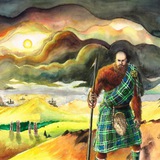
The Tartan pattern of the Scottish Kilt is often thought to be a result of the romanticism of the 17th century pushed by weavers. In actuality the Celts have been weaving the Tartan (Plaid) patterns for at least 3000 years, with archaeological finds in Austria dating back at least that far. While the diversity and prominence may have arose in the last few centuries different regions or large clans having their own distinct Tartans are nothing new and arise naturally over time. The designs were so meticulously kept down to a single string, that people have been sued successfully for taking creative liberty with the design. Different colors indicate different lineages and loyalties and histories, and are not simply artistic deference. A Scottish Wedding Tradition is for the man to use his families Plaid as a shawl for a bride after they're married to symbolize her joining his family. The Plaid Kilt is quintessentially Highland Scots and was even banned briefly by the government due to the Highlanders. -TLK
Forwarded from Hyperborean Radio (The Final Episodes) (T.L.K.)
Ogham also known as "Sticks and Trees" and "The Tree Alphabet" is an ancient form of writing known largely from Ireland and the Celtic peoples. It was a gift from the god Ogma. An attempt to reconstruct it has been made though it is incomplete. Ogham is an extremely complex form of writing said to be used for everything from writing words to birdsong to the sound of a brook or even drawing maps, In this way Ogham is more comparable to modern music notes than the Latin alphabet.-TLK