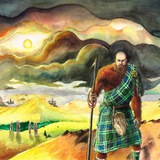
At the end of summer the Holly King defeats the Oak King as ruler of the dark months of the year.
Druids considered holly sacred and used it around the winter solstice, and it’s symbolic importance is hidden in plain sight.
The Holly King wore a Holly wreath as a crown and wore red.
Remind you of anyone? Father Christmas.
This is another fine example of how our lore will be covered up if we allow it to happen.
Oak trees that are sacred to the Celts lose their leaves in Winter while the holly trees are green year round.
But at the Winter Solstice the Oak King starts his new reign of dominance and the cycle starts anew.
To celebrate the Holly King’s midwinter dominance, we decorate our homes with holly and ivy, in anticipation of the upcoming Yule season.
Druids considered holly sacred and used it around the winter solstice, and it’s symbolic importance is hidden in plain sight.
The Holly King wore a Holly wreath as a crown and wore red.
Remind you of anyone? Father Christmas.
This is another fine example of how our lore will be covered up if we allow it to happen.
Oak trees that are sacred to the Celts lose their leaves in Winter while the holly trees are green year round.
But at the Winter Solstice the Oak King starts his new reign of dominance and the cycle starts anew.
To celebrate the Holly King’s midwinter dominance, we decorate our homes with holly and ivy, in anticipation of the upcoming Yule season.
Forwarded from European Native Faiths
Rübezahl
Rübezahl, also known as Krakonoš in Czech, is a mountain spirit inhabiting the Giant Mountains between Silesia and Bohemia. Using the name Rübezahl provokes his anger, instead respectful names such as “Lord of the Mountains” should be used.
He is usually a friendly character towards good people, giving them knowledge and presents. Towards bad people however, he will play the role of a trickster to take his revenge om them.
Rübezahl, also known as Krakonoš in Czech, is a mountain spirit inhabiting the Giant Mountains between Silesia and Bohemia. Using the name Rübezahl provokes his anger, instead respectful names such as “Lord of the Mountains” should be used.
He is usually a friendly character towards good people, giving them knowledge and presents. Towards bad people however, he will play the role of a trickster to take his revenge om them.
Forwarded from European Native Faiths
Willemstad Figurine
The Willemstad Figurine is a small wooden idol, found in the Netherlands between the roots of an oak tree. It must have been placed there on purpose by the people who used it 6500 years ago.
While it is difficult to know exactly what this idol was used for by the hunter-gatherers of that period, it is known that idols were used by them at burial sites to establish contact with the realm of spirits.
The Willemstad Figurine is a small wooden idol, found in the Netherlands between the roots of an oak tree. It must have been placed there on purpose by the people who used it 6500 years ago.
While it is difficult to know exactly what this idol was used for by the hunter-gatherers of that period, it is known that idols were used by them at burial sites to establish contact with the realm of spirits.
*Abbots Bromley Dance, cont..*
References are made to the Abbots Bromley Horn Dance in 1236 and again in 1532 before continual mention from 1660 onwards, while the antlers the dancers carry have been radiocarbon dated to the late Anglo Saxon period (around year 1,000).
The procession and dance are performed once a year on Wake Monday, usually the first Monday in September, starting at St Nicholas Church.
So why dancing with antlers?
Nobody is really sure but the most popular theory is that this is reminiscent of an ancient hunting ritual to appease the god of the hunt or as an act to increase chances of a successful hunt.
References are made to the Abbots Bromley Horn Dance in 1236 and again in 1532 before continual mention from 1660 onwards, while the antlers the dancers carry have been radiocarbon dated to the late Anglo Saxon period (around year 1,000).
The procession and dance are performed once a year on Wake Monday, usually the first Monday in September, starting at St Nicholas Church.
So why dancing with antlers?
Nobody is really sure but the most popular theory is that this is reminiscent of an ancient hunting ritual to appease the god of the hunt or as an act to increase chances of a successful hunt.
One of the ten men plays the role of an archer. The other three unhorned dancers are a man dressed as a woman referred to as Maid Marian for some reason, a musician and a fool, or jester.
It could have once been a ceremony originally performed telling of the Wild Hunt, or perhaps to appease an older, more primal god of the hunt.
It could have once been a ceremony originally performed telling of the Wild Hunt, or perhaps to appease an older, more primal god of the hunt.
Word to the wise…
Mother Nature always wins in the end, and she is very patient.
Mother Nature always wins in the end, and she is very patient.