Forwarded from Art of Neale Rundgren
Thanks to Hyperborean Radio for inviting me on to their show last night. We had lots of fun talking about my spiritual awakening https://www.youtube.com/watch?v=qoBVpyMKNLU
YouTube
Aethelwulfs Song / W: Neale Rundgren
Hello to all those out there in the Wastelands of Modernity. Today we spoke to Aethelwulf learning the story and song of his life and his return to the old ways of his people, we spoke of fenrir, Jotnar, Norse paganism, Naturalistic Pantheism, South Africa…
Ojkanje, or "Cyrillic singing" could possibly have origins from wolf howls in the Baltic region. It has seemingly long-standing traditional ties to wolf cults in the area, and if done in a group setting, it has the same unity as the howling of a wolf pack. https://youtu.be/fjm9QXUVYLA
YouTube
Ojkanje singing
UNESCO: List of Intangible Cultural Heritage in Need of Urgent Safeguarding - 2010
URL: http://www.unesco.org/culture/ich/USL/00320
Description: Ojkanje two-part singing, found in the Croatian regions of the Dalmatian hinterland, is performed by two or…
URL: http://www.unesco.org/culture/ich/USL/00320
Description: Ojkanje two-part singing, found in the Croatian regions of the Dalmatian hinterland, is performed by two or…
All female Serbian ensemble with the same style. Beautiful. https://youtu.be/gjmTMWnvTBs
YouTube
Serbian Traditional ganga song from Hercegovina - Srpka tradicionalna pesma iz Hercegovine
Aktuelno: Prva Skola srpskog i balkanskog tradicionalnog pevanja Bojane Nikolic
Upis je u toku!
Kralja Milana 2 - Dom Vukove zeduzbine
info:
http://www.bojananikolic.rs/sajt/?p=21
info@bojananikolic.rs
www.bojananikolic.rs
____________________
''Necu…
Upis je u toku!
Kralja Milana 2 - Dom Vukove zeduzbine
info:
http://www.bojananikolic.rs/sajt/?p=21
info@bojananikolic.rs
www.bojananikolic.rs
____________________
''Necu…
❤1
A tale well told
Just finished reading “Mother Hulda” from Grimm’s fairytales to my children, and if there was a wiser way to spend my time this year, I don’t know what it is.
What a wonderful family experience we had in hearing about a beloved Germanic
goddess, and the kids had so many questions to ask after the book was closed.
The power of a well told tale should not be underestimated, undervalued or lost to the onward march of time.
Storytelling is one of the most ancient art forms, yet it is still a vital part of our everyday lives and many of our people think that the gift of storytelling belongs only to writers, shamans, and the elderly, but in truth, we are all storytellers
from cradle to grave.
Our stories sustain us, they enliven us, connect us to our gods and our people through the lore, both folk and myth.
“Stories have to be told or they die, and when they die, we can’t remember who we are or why we’re here.”
- Sue Monk Kidd
Just finished reading “Mother Hulda” from Grimm’s fairytales to my children, and if there was a wiser way to spend my time this year, I don’t know what it is.
What a wonderful family experience we had in hearing about a beloved Germanic
goddess, and the kids had so many questions to ask after the book was closed.
The power of a well told tale should not be underestimated, undervalued or lost to the onward march of time.
Storytelling is one of the most ancient art forms, yet it is still a vital part of our everyday lives and many of our people think that the gift of storytelling belongs only to writers, shamans, and the elderly, but in truth, we are all storytellers
from cradle to grave.
Our stories sustain us, they enliven us, connect us to our gods and our people through the lore, both folk and myth.
“Stories have to be told or they die, and when they die, we can’t remember who we are or why we’re here.”
- Sue Monk Kidd
Forwarded from BC Neanderthal Mindset
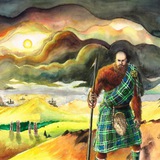
Illustration of Abaris, the Hyperborean.
“Neither by ship nor on foot would you find the marvellous road to the assembly of the Hyperboreans.
Never the Muse is absent from their ways:
lyres clash and flutes cry and everywhere maiden choruses whirling.
Neither disease nor bitter old age is mixed in their sacred blood;
far from labor and battle they live.”
– Pindar, Tenth Pythian Ode.
“Neither by ship nor on foot would you find the marvellous road to the assembly of the Hyperboreans.
Never the Muse is absent from their ways:
lyres clash and flutes cry and everywhere maiden choruses whirling.
Neither disease nor bitter old age is mixed in their sacred blood;
far from labor and battle they live.”
– Pindar, Tenth Pythian Ode.
Forwarded from Hyperborean Radio (Uncensored) (T.L.K.)
Marzanna is a Mother Goddess and Death goddess of the Polish people, she is often equated to Morena from the Eastern Slavs. In Polish folklore she is the Grim Reaper and bringer of plagues, having beautiful Emerald eyes and raven hair. Her hall in the underworld is a Mirror Palace and the intersection of the two rivers, through these mirrors she can help guide the souls of the dead through the realms, both to Nav a land of rest, or to visit those in the realm of the living. She does not rule Nav though at times she is considered a consort of Veles or Chernobog, though in other tales she was the consort or wife of a Sun god such as Yarillo or Dahzbog, when he was unfaithful she trapped him in her mirrors.-TLK
Helskór (“Hel-Shoes”)
In Norse tradition, helskór is footwear made to assist the deceased in their journey to Helheim, and the many challenges that lay ahead.
In their trek, they would have had to traverse a 2 mile wide heath that is closely packed with tall coarse grass and sharp thorny shrubs.
Once through the heath, the unjust in life would find themselves before a fast moving river filled with sharp, rustling weapons that belonged to men who died in battle.
The amount of wounding and pain they incurred was believed to correlate to the amount of misdeeds they committed while alive.
If a just, honorable person came before the river, they would be provided with two boards to stand on to float across.
“And when they had heaped up the howe, and were going to lay the body in it, Thorgrim the priest goes up to Gisli, and says, “’Tis the custom, brother-in-law, to bind the hellshoe on men, so that they may walk on them to Valhalla, and I will now do that by Vestein.”
—The story of Gisli the Outlaw
In Norse tradition, helskór is footwear made to assist the deceased in their journey to Helheim, and the many challenges that lay ahead.
In their trek, they would have had to traverse a 2 mile wide heath that is closely packed with tall coarse grass and sharp thorny shrubs.
Once through the heath, the unjust in life would find themselves before a fast moving river filled with sharp, rustling weapons that belonged to men who died in battle.
The amount of wounding and pain they incurred was believed to correlate to the amount of misdeeds they committed while alive.
If a just, honorable person came before the river, they would be provided with two boards to stand on to float across.
“And when they had heaped up the howe, and were going to lay the body in it, Thorgrim the priest goes up to Gisli, and says, “’Tis the custom, brother-in-law, to bind the hellshoe on men, so that they may walk on them to Valhalla, and I will now do that by Vestein.”
—The story of Gisli the Outlaw
The Abbots Bromley Horn Dance, Staffordshire, England.
This ritual dancing is first described in 1686, whereas six morris dancers carry antlers.
Accompanying them is a “woman”, an archer, a fool, and sometimes a hobby horse, frolicking along as each antler-bearer “menaces” the other.
I’m still looking into the origins of this peculiar dance, as I have an inkling that it may be linked to Cernunnos, or Silvanus.
Or it might just be a possibility that they wanted to have fun, celebrating a horned deity without purposefully doing so.
Looking more into it, so stay tuned. More to come.
This ritual dancing is first described in 1686, whereas six morris dancers carry antlers.
Accompanying them is a “woman”, an archer, a fool, and sometimes a hobby horse, frolicking along as each antler-bearer “menaces” the other.
I’m still looking into the origins of this peculiar dance, as I have an inkling that it may be linked to Cernunnos, or Silvanus.
Or it might just be a possibility that they wanted to have fun, celebrating a horned deity without purposefully doing so.
Looking more into it, so stay tuned. More to come.
Forwarded from Hyperborean Radio (Uncensored) (T.L.K.)
"Freya was far and away the most popular goddess in Sweden. While her veneration did spread outside of it, both her and Freyr were the focus of spiritual activities in the area. Representing kingship, magic, witchcraft, seers, fertility of the land and its people, and much much more. The two even after the Church began to move in are mentioned extensively in the folk customs. Indicating that the so called “Vanir” were the most prominent in Sweden and likely Scandinavia for the most part. However, most of our sources find their written origin not in the Scandinavian peninsula, but in Iceland. A land removed from the mainland of Europe, with a drastically changed societal structure, and landscape. Despite this the prominence of both Freyr and Freya remains in the area in myths and folk customs, albeit in the most famous source the Eddas. They are overshadowed by the Aesir gods, many of which have their likely origins from areas outside the countries of Norway and Sweden."
- Excerpt Freya, The Mother of Sweden
- Excerpt Freya, The Mother of Sweden