Forwarded from Hyperborean Radio (Uncensored) (T.L.K.)
In Paganism there are several spheres. Within our people there are three core ones The Masculine, the Feminine, and the child. These three intersect at family and community gatherings which can be seen symbolized in the Triquetra the European balance symbol. However, this is important for another reason and that is that the paganism of women and the paganism of men is distinct. Entire deities such as Dionysus had predominantly female followers as did other deities, The Morrigan had predominantly male followers despite her modern "goth goddess" status. The customs of each are also subdivided, certain things were only taught man to young man, or woman to young woman. Songs, customs, skills, stories, celebrations, things only a man OR a woman would know but not the other. This is important to know as we remember our old ways. I as a man am not going to do paganism the same way as a woman, and vice versa. Whether it is spinning songs or Hunting rituals. However as a whole it is still us.-TLK
Keeping it in the Family
Our gods are not yahweh figures that embrace all people regardless of their ethnic and cultural background.
While they do encompass some of the more compassionate qualities that we as Hyperboreans also display, they do not welcome all people, nor should they.
That’s what a tribe should do, viewing those outside the family with a skeptical eye, as history has shown us a very effective way to erase a people is to infiltrate from within.
When you seek to follow gods and cultural norms outside your own historical ties, then you further remove yourself from your heathen heritage and birthright.
Keep it close to home Hyperborean, your soul will resonate with the spirituality of your ancestors and gain the favor of familial gods.
Our gods are not yahweh figures that embrace all people regardless of their ethnic and cultural background.
While they do encompass some of the more compassionate qualities that we as Hyperboreans also display, they do not welcome all people, nor should they.
That’s what a tribe should do, viewing those outside the family with a skeptical eye, as history has shown us a very effective way to erase a people is to infiltrate from within.
When you seek to follow gods and cultural norms outside your own historical ties, then you further remove yourself from your heathen heritage and birthright.
Keep it close to home Hyperborean, your soul will resonate with the spirituality of your ancestors and gain the favor of familial gods.
Forwarded from Hyperborean Radio (Uncensored) (T.L.K.)
In European tradition, especially under the influence of Alchemy we have the 4 core elements of Water (Liquid), Earth (Solid), Fire (Energy), and Air (Gas). These 4 core elements are also symbolized by an assigned spirit these include Undine for Water, Gnome for Earth, Salamander for Fire, and Sylph for Air. Along with these 4 there is the fifth element known as Aether which has many varied qualities and interpretations, it is derived from the old god Aether who represented the upper air that the gods breathed. Though the concept has been brought forth by numerous people including Tesla. Personally similar to how the 4 core elements correspond to stages of matter, Aether could be seen as potential, spirit, or if you want to go mundane dark matter.-TLK
Forwarded from Celta Lusitani Celtiberi Folk
Navia, Nabia
Statue of Navia in Galicia
Navia River in Asturias
She is a nymph goddess with versatility around rivers, the abundant forests of the valleys, and the fallen. Similar to Artemis of the Greco-Roman religion.
The core of her cult seems to be found at Lusitanian territory in north-central Portugal but has also extended as far north as Galicia, Asturias and western Leon.
To honor Navia, warriors would offer their old swords and shields at riverbeds. Navia was paired with Jupiter by the Romans as what can be seen by epithets on inscriptions left behind in western Hispania. The water flows of her river were believed to represent a passage to the afterlife.
Statue of Navia in Galicia
Navia River in Asturias
She is a nymph goddess with versatility around rivers, the abundant forests of the valleys, and the fallen. Similar to Artemis of the Greco-Roman religion.
The core of her cult seems to be found at Lusitanian territory in north-central Portugal but has also extended as far north as Galicia, Asturias and western Leon.
To honor Navia, warriors would offer their old swords and shields at riverbeds. Navia was paired with Jupiter by the Romans as what can be seen by epithets on inscriptions left behind in western Hispania. The water flows of her river were believed to represent a passage to the afterlife.
Check out my friend https://t.me/AethelwulfArt on https://t.me/hyperboreanradio giving an account on his spiritual awakening.
Those of us that follow the old ways have a tale to tell of how we got there.
This is his.
Those of us that follow the old ways have a tale to tell of how we got there.
This is his.
Telegram
Art of Neale Rundgren
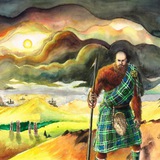
My name is Neale Rundgren and I am of Scandinavian & Rhodesian descent. I am a painter specialising in European cultures & folklore.
Forwarded from Art of Neale Rundgren
Thanks to Hyperborean Radio for inviting me on to their show last night. We had lots of fun talking about my spiritual awakening https://www.youtube.com/watch?v=qoBVpyMKNLU
YouTube
Aethelwulfs Song / W: Neale Rundgren
Hello to all those out there in the Wastelands of Modernity. Today we spoke to Aethelwulf learning the story and song of his life and his return to the old ways of his people, we spoke of fenrir, Jotnar, Norse paganism, Naturalistic Pantheism, South Africa…
Ojkanje, or "Cyrillic singing" could possibly have origins from wolf howls in the Baltic region. It has seemingly long-standing traditional ties to wolf cults in the area, and if done in a group setting, it has the same unity as the howling of a wolf pack. https://youtu.be/fjm9QXUVYLA
YouTube
Ojkanje singing
UNESCO: List of Intangible Cultural Heritage in Need of Urgent Safeguarding - 2010
URL: http://www.unesco.org/culture/ich/USL/00320
Description: Ojkanje two-part singing, found in the Croatian regions of the Dalmatian hinterland, is performed by two or…
URL: http://www.unesco.org/culture/ich/USL/00320
Description: Ojkanje two-part singing, found in the Croatian regions of the Dalmatian hinterland, is performed by two or…
All female Serbian ensemble with the same style. Beautiful. https://youtu.be/gjmTMWnvTBs
YouTube
Serbian Traditional ganga song from Hercegovina - Srpka tradicionalna pesma iz Hercegovine
Aktuelno: Prva Skola srpskog i balkanskog tradicionalnog pevanja Bojane Nikolic
Upis je u toku!
Kralja Milana 2 - Dom Vukove zeduzbine
info:
http://www.bojananikolic.rs/sajt/?p=21
info@bojananikolic.rs
www.bojananikolic.rs
____________________
''Necu…
Upis je u toku!
Kralja Milana 2 - Dom Vukove zeduzbine
info:
http://www.bojananikolic.rs/sajt/?p=21
info@bojananikolic.rs
www.bojananikolic.rs
____________________
''Necu…
❤1