Forwarded from Hyperborean Radio (Uncensored) (T.L.K.)
In short as a pagan I would indeed consider Friday the 13th a day of great luck as in October of 1307 one of our greatest enemies turned on itself destroying one of its arms of great destruction to our people and ancient ways out of greed, vanity, envy, pride and a wrath brought on by the lust for power to sate their gluttony and stoke their sloth. The church and Christian kings on this day exposed for all with eyes to see that they themselves are possessed by and guilty of all they claim to stand against. A great day indeed was Oct 13th 1307.
Where are you on your journey in the old ways?
Final Results
16%
Interested/curious
9%
Testing the water
24%
Just starting out
33%
Been Heathen for a while now
10%
I’ve been pagan all my life
9%
I am one with the gods
Surtr
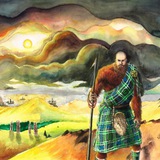
Surtr the fire giant, as is mentioned in the epic poem Völuspá, is the leader of the Ægir, the race of titans or giants (Jötunn) that will wage war against the Æsir, the Norse gods.
In the poem Vafþrúðnismál, the Jötunn Vafþrúðnir asks the question to Odin (disguised as "Gagnráðr") "what the plain is called where in battle Surt and the sweet gods will meet".
This is a nod to the twilight of the gods, and an end to an era, Ragnarök.
Odin says that the "ordained field" is Vígríðr, and it stretches "a hundred leagues" in every direction.
When Ragnarök takes place Sutr is fated to do battle with and slay the god Freyr only to be slain by him as well.
He (Surtr) arrives from Muspelheim, the domain of extreme heat and fire,
wielding his weapon of which is
a giant burning sword. With it the world is razed and afterwards
sinks into the ocean.
“Surtr moves from the south
with the scathe of branches:
there shines from his sword
the sun of Gods of the Slain.”
Surtr the fire giant, as is mentioned in the epic poem Völuspá, is the leader of the Ægir, the race of titans or giants (Jötunn) that will wage war against the Æsir, the Norse gods.
In the poem Vafþrúðnismál, the Jötunn Vafþrúðnir asks the question to Odin (disguised as "Gagnráðr") "what the plain is called where in battle Surt and the sweet gods will meet".
This is a nod to the twilight of the gods, and an end to an era, Ragnarök.
Odin says that the "ordained field" is Vígríðr, and it stretches "a hundred leagues" in every direction.
When Ragnarök takes place Sutr is fated to do battle with and slay the god Freyr only to be slain by him as well.
He (Surtr) arrives from Muspelheim, the domain of extreme heat and fire,
wielding his weapon of which is
a giant burning sword. With it the world is razed and afterwards
sinks into the ocean.
“Surtr moves from the south
with the scathe of branches:
there shines from his sword
the sun of Gods of the Slain.”
The mythical abode of the goddess Hulda in Thuringia.
The Hörselloch or Venus Cave is located on the Grober Hörselberg near Eisenach in Thuringia and is an interesting natural monument. Fascinating myths and legends entwine around the Venus Cave.
It was well known in prehistoric times that the Germanic goddess Hulda or possibly Frau Holle, has her home here.
It was later reinterpreted as Venus, which was consecrated there, and through the Christianization and the resulting distortion it is said to have seduced Christian knights there.
Richard Wagner took this myth as a template for his opera "Tannhauser" in 1845.
The Hörselloch or Venus Cave is located on the Grober Hörselberg near Eisenach in Thuringia and is an interesting natural monument. Fascinating myths and legends entwine around the Venus Cave.
It was well known in prehistoric times that the Germanic goddess Hulda or possibly Frau Holle, has her home here.
It was later reinterpreted as Venus, which was consecrated there, and through the Christianization and the resulting distortion it is said to have seduced Christian knights there.
Richard Wagner took this myth as a template for his opera "Tannhauser" in 1845.
Forwarded from THE OLD WAYS (Velesa37)
The custom of decorating the wayside shrines with colorful ribbons is an ancient Slavic practice predating the introduction of Christianity. Various locations in Poland. I know that in Russia during spring time it was an old tradition for the whole family to come visit the deceased loved one at his/her gravesite. The family would bring food and drink and eat and drink together with the dead a family member, and introduced to the dead family member all of the newly born children and tell of all the news in the family. This was part of the Slavic ancestor veneration tradition.
GABRIEL’S HOUNDS
In the company of the Wild Hunt, accompanying the gods and their entourage are a spectral pack of dogs known as Gabriel’s Hounds. Running or flying with reckless haste in the night sky of Northern Europe, these canines which are also known as Gabriel’s Rachets, are associated with stormy or bad weather.
In the company of the Wild Hunt, accompanying the gods and their entourage are a spectral pack of dogs known as Gabriel’s Hounds. Running or flying with reckless haste in the night sky of Northern Europe, these canines which are also known as Gabriel’s Rachets, are associated with stormy or bad weather.
SEVEN WHISTLERS
A Group of seven phantasmal birds who upon being spotted is feared by Sailors, fishermen and mining crews across Britain.
In 1862, locals in the Northumbrian village of Hartley proclaimed to have heard the seven whistlers the night before a pit disaster which claimed the lives of 204 miners.
Normally occurring at night, the Seven Whistlers ring out unearthly cries and are said to be an omen of death. According to some witnesses, there are actually six in the group and continually fly throughout the night in search of the seventh, and when they are reunited, the world will come to an end.
A Group of seven phantasmal birds who upon being spotted is feared by Sailors, fishermen and mining crews across Britain.
In 1862, locals in the Northumbrian village of Hartley proclaimed to have heard the seven whistlers the night before a pit disaster which claimed the lives of 204 miners.
Normally occurring at night, the Seven Whistlers ring out unearthly cries and are said to be an omen of death. According to some witnesses, there are actually six in the group and continually fly throughout the night in search of the seventh, and when they are reunited, the world will come to an end.
In one of the tales of Frau Holle, a widow has a lazy daughter, Pechmarie, and a hardworking stepdaughter, Goldmarie. When a spool falls into the well, Goldmarie jumps in and comes to the land of Frau Holle, where she shakes the beds so that it snows on earth.
When she wants to go home again, she is richly blessed with a shower of gold for her diligent work. The envious stepsister wants to do the same and also jumps into the well. But because she is unkind & lazy, Frau Holle showers her with tar.
When she wants to go home again, she is richly blessed with a shower of gold for her diligent work. The envious stepsister wants to do the same and also jumps into the well. But because she is unkind & lazy, Frau Holle showers her with tar.