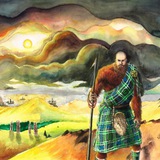
They laid him down upon his back,
and cudgell'd him full sore.
they hung him up before the storm,
and turn'd him o'er and o'er.
They filled up a darksome pit
with water to the brim,
they heav'd in John Barleycorn.
There, let him sink or swim!
They laid him upon the floor,
to work him farther woe;
and still, as signs of life appear'd,
they toss'd him to and fro.
They wasted o'er a scorching flame
the marrow of his bones;
but a miller us'd him worst of all,
for he crush'd him between two stones.
And they hae taen his very hero blood
and drank it round and round;
and still the more and more they drank,
their joy did more abound.
John Barleycorn was a hero bold,
of noble enterprise;
for if you do but taste his blood,
'twill make your courage rise.
'Twill make a man forget his woe;
'twill heighten all his joy;
'twill make the widow's heart to sing,
tho the tear were in her eye.
Then let us toast John Barleycorn,
each man a glass in hand;
and may his great posterity
ne'er fail in old Scotland!
and cudgell'd him full sore.
they hung him up before the storm,
and turn'd him o'er and o'er.
They filled up a darksome pit
with water to the brim,
they heav'd in John Barleycorn.
There, let him sink or swim!
They laid him upon the floor,
to work him farther woe;
and still, as signs of life appear'd,
they toss'd him to and fro.
They wasted o'er a scorching flame
the marrow of his bones;
but a miller us'd him worst of all,
for he crush'd him between two stones.
And they hae taen his very hero blood
and drank it round and round;
and still the more and more they drank,
their joy did more abound.
John Barleycorn was a hero bold,
of noble enterprise;
for if you do but taste his blood,
'twill make your courage rise.
'Twill make a man forget his woe;
'twill heighten all his joy;
'twill make the widow's heart to sing,
tho the tear were in her eye.
Then let us toast John Barleycorn,
each man a glass in hand;
and may his great posterity
ne'er fail in old Scotland!
Forwarded from Hyperborean Radio (Uncensored) (T.L.K.)
The concept of submitting to fate or submitting to god(s) will is not something that allows us to aspire to greatness, the idea that we have no will nor choice, but are mere puppets of some celestial game is a symptom of Christianity, "it's all a part of gods plan" you were born and someday you will die, heroes do not submit to fate they do as they wish and as they view as right. You have agency, you have a choice, the only true destiny any of us have is to die, we can be great or we can be a pointless bit of animate flesh. Which do you want to be? The Choice is not Yahwehs, or fates, or destiny's it is yours. No Excuses, now who and what do you want to be?
This media is not supported in your browser
VIEW IN TELEGRAM
300! Thanks for the subs, lads and lasses. Cheers!
🔥1
Forwarded from THE OLD WAYS (Velesa37)
"Dvorovoi” by Oleg Yahnin.
The Dvorovoi (Russian: Дворово́й) is a Slavic spirit of the courtyard. It was associated with a farmstead's grounds, cattle shed, and stable. A dvorovoi was considered more dangerous than a domovoi as it could pose a threat to livestock, particularly animals with white fur. ...
The Dvorovoi (Russian: Дворово́й) is a Slavic spirit of the courtyard. It was associated with a farmstead's grounds, cattle shed, and stable. A dvorovoi was considered more dangerous than a domovoi as it could pose a threat to livestock, particularly animals with white fur. ...
Wooden idols found in Fischerinsel, Berlin (11th-12th century), Gorbunovo (c. 400 years BC) & Pohjankuru (c. 3000 years BC).
Christian vandalism to pagan idols and sacred sites is nothing new. They are not the only guilty ones in this, as abrahamic faiths across the board despise the truly beautiful.
They seek to eradicate “pagan” aesthetics, or anything that doesn’t propel the universalistic war engine.
Sometimes merely covering them up with saints and “holy” men, but more commonly defacing the sacred.
The most heinous of sins against non-abrahamic faiths is by absorbing aspects of them, and claiming their history, culture and spiritual values as their own.
If heathens were truly not feared, then why do abrahamists go to these measures?
“Religion of Love” is a false advertisement.
They seek to eradicate “pagan” aesthetics, or anything that doesn’t propel the universalistic war engine.
Sometimes merely covering them up with saints and “holy” men, but more commonly defacing the sacred.
The most heinous of sins against non-abrahamic faiths is by absorbing aspects of them, and claiming their history, culture and spiritual values as their own.
If heathens were truly not feared, then why do abrahamists go to these measures?
“Religion of Love” is a false advertisement.
The Hawthorn (Crataegus oxyacantha)is a flowering plant that is native to Europe which has a history and lore all of its own.
It is incredible to find clues that are strewn about European lore with traditions and practices that carry on, even to this day!
In ancient Greece, Athenian brides
used the hawthorn blossoms to
decorate the wedding party and
they themselves carried large
boughs of it to the altar of Hymen, a
Greek god of marriage, feasts,
song and possibly childbirth.
Hawthorn was also believed to
keep evil spirits from crossing
the threshold of the home.
Even its leaves were put
Into cradles of newborn babes for protection from malicious spirits.
It is incredible to find clues that are strewn about European lore with traditions and practices that carry on, even to this day!
In ancient Greece, Athenian brides
used the hawthorn blossoms to
decorate the wedding party and
they themselves carried large
boughs of it to the altar of Hymen, a
Greek god of marriage, feasts,
song and possibly childbirth.
Hawthorn was also believed to
keep evil spirits from crossing
the threshold of the home.
Even its leaves were put
Into cradles of newborn babes for protection from malicious spirits.
In the Mabinogion, the giant king Yspaddaden Penkawr
means “Giant Hawthorn” and he is
associated by this name with the
Hawthorn plant.
Olwen, his daughter, leaves white
flowering trefoils behind in her graceful steps, which more than likely are Hawthorn flowers.
In Teutonic lore, hawthorn is thought to have symbolized death and was used in funeral pyres.
Even in modern springtime festivals in the British Isles, large Hawthorn boughs are cut and placed outside the home.
They were called May Bushes and decorated with wildflowers. Although it was proper to decorate outside
with hawthorn blossoms, bringing them into the home is believed to bring illness and misfortune (death).
means “Giant Hawthorn” and he is
associated by this name with the
Hawthorn plant.
Olwen, his daughter, leaves white
flowering trefoils behind in her graceful steps, which more than likely are Hawthorn flowers.
In Teutonic lore, hawthorn is thought to have symbolized death and was used in funeral pyres.
Even in modern springtime festivals in the British Isles, large Hawthorn boughs are cut and placed outside the home.
They were called May Bushes and decorated with wildflowers. Although it was proper to decorate outside
with hawthorn blossoms, bringing them into the home is believed to bring illness and misfortune (death).
The faint smell of rotting meat
that strangely permeates from
the plant may have contributed
to the belief of bringing misfortune into the home.
The May Pole is traditionally made of
hawthorn or decorated with hawthorn flowers and
The phrase “by Oak, Ash and Thorn” referred to either Hawthorn
or BlackThorn.
This is an exciting discovery for me,
as I am constantly enamored
with the prevalence and saturation
of the pagan symbolism, lore, and tradition that is hidden under our noses.
that strangely permeates from
the plant may have contributed
to the belief of bringing misfortune into the home.
The May Pole is traditionally made of
hawthorn or decorated with hawthorn flowers and
The phrase “by Oak, Ash and Thorn” referred to either Hawthorn
or BlackThorn.
This is an exciting discovery for me,
as I am constantly enamored
with the prevalence and saturation
of the pagan symbolism, lore, and tradition that is hidden under our noses.