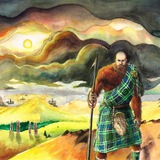
“In the northern English region of Yorkshire, travelers at night sometimes heard the sound of clanking chains and saw a strange looming figure called Jack-in-Irons.
Jack said nothing, threatening or otherwise, but his presence was nonetheless said to be quite frightening.”
`Encyclopedia of Celtic Mythology and Folklore’
-P. Monaghan
Jack said nothing, threatening or otherwise, but his presence was nonetheless said to be quite frightening.”
`Encyclopedia of Celtic Mythology and Folklore’
-P. Monaghan
🔥8❤3
Folklore is quite literally ancestral and racial memory passed down from one generation to the next.
Mythology serves the same purpose, but at its core it tends to have a much larger scale than folklore.
Because of this wide encompassing nature, and it’s genesis being one that is slow and arises from the subconscious, Myths have a tendency to be more easily found than folklore due to their being more widespread.
This is a specific reason why I hold folklore more near and dear than the more popular held mythological stories and legends (even though our myths are no less important).
The stories of the folk (folklore) have no real agenda other than the passing of a tribe’s customs and beliefs to the next generation.
The stories, beliefs, customs, and traditions of a people that are gifted to family and kin keep cultural identity flourishing and vibrant, and this is where folklore can be found both alive and well.
Mythology serves the same purpose, but at its core it tends to have a much larger scale than folklore.
Because of this wide encompassing nature, and it’s genesis being one that is slow and arises from the subconscious, Myths have a tendency to be more easily found than folklore due to their being more widespread.
This is a specific reason why I hold folklore more near and dear than the more popular held mythological stories and legends (even though our myths are no less important).
The stories of the folk (folklore) have no real agenda other than the passing of a tribe’s customs and beliefs to the next generation.
The stories, beliefs, customs, and traditions of a people that are gifted to family and kin keep cultural identity flourishing and vibrant, and this is where folklore can be found both alive and well.
👍9
Folklore is just as important as the mythology of a people because of it’s living on through the folk and retelling, much like myth yet on a smaller scale.
What is overlooked is that myths often arise from folklore, but because of their almost similar nature, myth and folklore often overlap one another.
Nevertheless, it is not really the realism of myths and folk tales that makes them important but the invaluable lessons or message they impart to the tribe.
The myth, although decidedly handy to educate one about gods, spirits and heroes in a grandiose scale, almost to the point of being out of reach… folklore brings those same gods, heroes and spirits into the home or around the fire to warm themselves and share a tale or two.
Folklore’s importance is that it shows that the ancestors and gods have a personal interaction and interest in their extended family… us.
What is overlooked is that myths often arise from folklore, but because of their almost similar nature, myth and folklore often overlap one another.
Nevertheless, it is not really the realism of myths and folk tales that makes them important but the invaluable lessons or message they impart to the tribe.
The myth, although decidedly handy to educate one about gods, spirits and heroes in a grandiose scale, almost to the point of being out of reach… folklore brings those same gods, heroes and spirits into the home or around the fire to warm themselves and share a tale or two.
Folklore’s importance is that it shows that the ancestors and gods have a personal interaction and interest in their extended family… us.
❤5👍2
The primal wilderness Is our refuge and safe haven, because her character matches our own.
Most other tribes fear the wild because she does not accept them as her children.
They are foreigners to her primal awe and are recognized as such by Mother Nature’s citizens.
Hyperboreans, on the other hand, feel a certain kinship and familiarity that borders on, if not outright elicits, nostalgia that one gets when coming home to a familiar place.
We are a people of forests, mountain, tundra, and it would do us well to get back to those environments to heal.
Does the bear share his territory with the jackal? No.
Now look to civilization and ask the same question.
Get to the wilderness Hyperborean.
She is waiting.
Most other tribes fear the wild because she does not accept them as her children.
They are foreigners to her primal awe and are recognized as such by Mother Nature’s citizens.
Hyperboreans, on the other hand, feel a certain kinship and familiarity that borders on, if not outright elicits, nostalgia that one gets when coming home to a familiar place.
We are a people of forests, mountain, tundra, and it would do us well to get back to those environments to heal.
Does the bear share his territory with the jackal? No.
Now look to civilization and ask the same question.
Get to the wilderness Hyperborean.
She is waiting.
🔥22👍7❤3🤬1