Forwarded from Art of Neale Rundgren
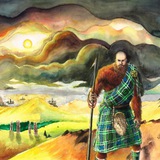
Álfheim:
We hear so much about the realms/worlds of Norse folklore due in part of the fact they’re the cornerstone of the culture and heritage of the Nordic people, but we still seem to neglect some of the realms in favour of those which we deem more important or perceptible. So let’s talk about the realm of the Light Elves, Álfheim (which came in second on the polls).
Álfheim can be translated as “The Homeland of the Elves”, who are thought to be a race of demigods (though it is possible the elves are semi-ascended ancestors) within a lush and ethereal world, but any pre-Christian information regarding this particular realm is quite thin on the ground. It’s possible that most knowledge pertaining to the many spellbinding stories of the realms were told orally from one generation to the next and therefore lost to time. However, from what we know, according to some of the sagas as well as surviving records, the elves were described as luminous, beautiful and dazzling - even more so than the sun – giving us the impression that the realm in which they lived is a sublime and wondrous place. Needless to say, the elves inspired the customs and/or practices of music and art. The realm is located next to Miðgarðr and is ruled by the Vanir god, Freyr.
Although the relationship between the elves and the Vanir is somewhat unclear and abstruse, it is possible Freyr did blend in well with the elves due to his exceptional qualities and association with peace, fertility, rain and sunshine.
It is believed Álfheim is loosely based on a particular region between two rivers, Gota and Glom, situated between Sweden and Norway, because the people living there are thought to be fairer than the rest of the Scandinavian people, though this is claim is disputable.
Nevertheless, elves have played an instrumental role throughout European literature, often portrayed as light yet agile; beautiful and immortal, but seemingly susceptible to corruption under extreme circumstances. This is quite evident in Tolkien’s Silmarillion – including The Hobbit and The Lord of the Rings: an unparalleled and uncontested work of literature which brought to light the once forgotten lore of Europe.
I’d also like to bring to light to an equally fascinating story called The Fairy Queen of Elphame, the Elf-Hame – or the elfin queen of faerie – whose name was invoked often during the Scottish Witch Trials. I’m not well-versed in this particular story, but you can watch a video on YT called The Fairy Queen Of Elphame to learn more about the enigmatic queen.
There are some notable elves – such as Dain and Weyland. Dain is one of the lords of Álfheim, who received his own set of runes at the same time Odin acquired the secrets of the runes, as well as Dvalin and Asvid, both dwarf and jötunns respectively, receiving their runes, giving the impression this could be the basis of Tolkien’s tale in which Sauron bestowed upon the races of Middle-Earth their rings of power. Weyland, a remarkable smith of outstanding skill of the Anglo-Saxon and Scandinavian people, according to some legends, is the lord of the elves.
There is also Tomte: The House-Elf of Sweden, I guess the Swedish equivalent of the Irish Leprechaun, though the former is often associated with home and farm, whereas the latter is associated with the field and forest. The Tomte is a fable creature, or the guardian of small things; friend of household pets and the cattle in the stable. He would normally ask for a bowl of pudding on Christmas Eve. Although Tomte’s origins are indeed pre-Christian Norse paganism, he has become an incorporated icon of the Swedish tradition, Lucia.
Elves to me are the quintessential portrayal of the Nordic people; fierce yet forgiving, but can be a force to be reckoned with when confronted by the malice of the world, lurking within the shadows beyond our borders.
We hear so much about the realms/worlds of Norse folklore due in part of the fact they’re the cornerstone of the culture and heritage of the Nordic people, but we still seem to neglect some of the realms in favour of those which we deem more important or perceptible. So let’s talk about the realm of the Light Elves, Álfheim (which came in second on the polls).
Álfheim can be translated as “The Homeland of the Elves”, who are thought to be a race of demigods (though it is possible the elves are semi-ascended ancestors) within a lush and ethereal world, but any pre-Christian information regarding this particular realm is quite thin on the ground. It’s possible that most knowledge pertaining to the many spellbinding stories of the realms were told orally from one generation to the next and therefore lost to time. However, from what we know, according to some of the sagas as well as surviving records, the elves were described as luminous, beautiful and dazzling - even more so than the sun – giving us the impression that the realm in which they lived is a sublime and wondrous place. Needless to say, the elves inspired the customs and/or practices of music and art. The realm is located next to Miðgarðr and is ruled by the Vanir god, Freyr.
Although the relationship between the elves and the Vanir is somewhat unclear and abstruse, it is possible Freyr did blend in well with the elves due to his exceptional qualities and association with peace, fertility, rain and sunshine.
It is believed Álfheim is loosely based on a particular region between two rivers, Gota and Glom, situated between Sweden and Norway, because the people living there are thought to be fairer than the rest of the Scandinavian people, though this is claim is disputable.
Nevertheless, elves have played an instrumental role throughout European literature, often portrayed as light yet agile; beautiful and immortal, but seemingly susceptible to corruption under extreme circumstances. This is quite evident in Tolkien’s Silmarillion – including The Hobbit and The Lord of the Rings: an unparalleled and uncontested work of literature which brought to light the once forgotten lore of Europe.
I’d also like to bring to light to an equally fascinating story called The Fairy Queen of Elphame, the Elf-Hame – or the elfin queen of faerie – whose name was invoked often during the Scottish Witch Trials. I’m not well-versed in this particular story, but you can watch a video on YT called The Fairy Queen Of Elphame to learn more about the enigmatic queen.
There are some notable elves – such as Dain and Weyland. Dain is one of the lords of Álfheim, who received his own set of runes at the same time Odin acquired the secrets of the runes, as well as Dvalin and Asvid, both dwarf and jötunns respectively, receiving their runes, giving the impression this could be the basis of Tolkien’s tale in which Sauron bestowed upon the races of Middle-Earth their rings of power. Weyland, a remarkable smith of outstanding skill of the Anglo-Saxon and Scandinavian people, according to some legends, is the lord of the elves.
There is also Tomte: The House-Elf of Sweden, I guess the Swedish equivalent of the Irish Leprechaun, though the former is often associated with home and farm, whereas the latter is associated with the field and forest. The Tomte is a fable creature, or the guardian of small things; friend of household pets and the cattle in the stable. He would normally ask for a bowl of pudding on Christmas Eve. Although Tomte’s origins are indeed pre-Christian Norse paganism, he has become an incorporated icon of the Swedish tradition, Lucia.
Elves to me are the quintessential portrayal of the Nordic people; fierce yet forgiving, but can be a force to be reckoned with when confronted by the malice of the world, lurking within the shadows beyond our borders.
👍1
Brigid, Imbolc and approaching the gods
February 1st marks the halfway point between winter solstice and the spring equinox. A time when forest creatures that hibernate are in a deep slumber, dreaming of renewal of life in the spring.
It is also a traditional holiday from the British Isles that is pre-Christian in origin, Imbolc.
The word “Imbolc” comes from the Old Irish word meaning “ewe’s milk” or “in the belly.”
Celebrations were underway to celebrate and honor the Celtic goddess Brigid, and it continues to this day as vibrant as ever.
Brigid is is to be celebrated on this day and is one of the most venerated deities in the Irish pagan pantheon. Her name means exalted one, while her most ancient Gaelic name, Breo-Saighead, means fiery power or fiery arrow.
As the daughter of the good god, Daghda, of the Tuatha Dé Danann (people of the Goddess Danu) she was and is the patroness of healing arts, fertility, poetry, music, prophecy, agriculture, and smithcraft.
February 1st marks the halfway point between winter solstice and the spring equinox. A time when forest creatures that hibernate are in a deep slumber, dreaming of renewal of life in the spring.
It is also a traditional holiday from the British Isles that is pre-Christian in origin, Imbolc.
The word “Imbolc” comes from the Old Irish word meaning “ewe’s milk” or “in the belly.”
Celebrations were underway to celebrate and honor the Celtic goddess Brigid, and it continues to this day as vibrant as ever.
Brigid is is to be celebrated on this day and is one of the most venerated deities in the Irish pagan pantheon. Her name means exalted one, while her most ancient Gaelic name, Breo-Saighead, means fiery power or fiery arrow.
As the daughter of the good god, Daghda, of the Tuatha Dé Danann (people of the Goddess Danu) she was and is the patroness of healing arts, fertility, poetry, music, prophecy, agriculture, and smithcraft.
Her importance in Celtic culture and history, puts her front and center to the festival of Imbolc. A few occurrences of this celebration involves the lighting of fires, purification of well water and the ushering in of the new year (Spring).
When you are as new to pre-Christian beliefs and way of life as I am, it can be a breath of fresh air to come across a deity that is approachable, and maternal. This is especially heartfelt for me as my own mother is not long for this world.
When you are as new to pre-Christian beliefs and way of life as I am, it can be a breath of fresh air to come across a deity that is approachable, and maternal. This is especially heartfelt for me as my own mother is not long for this world.
One good practice when not knowing how to approach a god or goddess is to simply… write them a note. The fine folks at HeimdallR’s Home put this notion forward and explained that it is very simple to do.
Take a sheet of paper and a pen/pencil and write a letter to the deity you have an interest in. It may seem silly, or childlike, but if you are not familiar with approaching Brigid or any other deity for that matter, just write a note to them.
It can be as simple as “Hey (insert name), I don’t really know you but you are the god/goddess of my ancestors and I would really like to get to know you…”
Take a sheet of paper and a pen/pencil and write a letter to the deity you have an interest in. It may seem silly, or childlike, but if you are not familiar with approaching Brigid or any other deity for that matter, just write a note to them.
It can be as simple as “Hey (insert name), I don’t really know you but you are the god/goddess of my ancestors and I would really like to get to know you…”
The letter can be kept and filed away so you can look back on your journey with the gods, or you can burn it, knowing that they already know what your intentions for the letter were.
This is good practice for bringing the gods into your life and getting to know them better. After all, they are our extended family and what better way to begin the year with getting to know your kin.
One does not need to have a flashy ceremony, sacrifice animals or invoking with fancy words to get to know Brigid or another god for that matter.
You only have to be sincere.
This is good practice for bringing the gods into your life and getting to know them better. After all, they are our extended family and what better way to begin the year with getting to know your kin.
One does not need to have a flashy ceremony, sacrifice animals or invoking with fancy words to get to know Brigid or another god for that matter.
You only have to be sincere.
Forwarded from Stam van de Vos🦊, hekserij en heidendom van de Lage Landen
A very cool map with lots of European tribes😎. Just click on the name of the tribe of your choice if you want to learn about them. https://www.historyfiles.co.uk/FeaturesEurope/Barbarian_Map52BC_max.htm?fbclid=IwAR1BUuwpI7iudcE0vz9n0ghB9Z3EOSxT2FLPJsqWoGCtH9-RHW7EnDaRwt4
www.historyfiles.co.uk
Map of Europe's Tribes (Maximum Size)
A map of Europe's tribes around 52 BC
If you want to see the nautical side of our history, jump over to: https://t.me/GeeDunkNautica
Telegram
GeeDunk Nautica
Exploring the mysteries of European and American sea traditions, deities and superstitions.
Connecting the diaspora to our past. Unearthing life at sea for the Hyperborean people of the world.
Connecting the diaspora to our past. Unearthing life at sea for the Hyperborean people of the world.
👍2
BC Neanderthal Mindset pinned «If you want to see the nautical side of our history, jump over to: https://t.me/GeeDunkNautica»
Forwarded from Old and New European Art and Aesthetics
Apollo Revealing his Divinity to the Shepherdess Isse (1750). Francois Boucher (French, 1703-1770).
Forwarded from Old and New European Art and Aesthetics
This media is not supported in your browser
VIEW IN TELEGRAM
The Carnyx is a wind instrument of the Iron Age Celts, used between c. 200 BC and c. AD 200. Thought to be played, several in unison, before a battle, to intimidate the enemy.
The Cave of Pazin & the Giant
In Southern Istria (Croatia), as the story goes, lived a massive giant. He was as big as an enormous mountain and his name was Ban Dragonja.
Unlike many giants in stories of the past, Ban Dragonja was gentle and more than happy to help the tiny humans who lived near him.
They came to him, asking for his help by ploughing the land to develop rivers, thereby irrigating the soil. He proceeded to plow from a lake to the ocean and named the trench Dragonja, then tilled another one, naming it Mirna, after his eloquent wife.
In Southern Istria (Croatia), as the story goes, lived a massive giant. He was as big as an enormous mountain and his name was Ban Dragonja.
Unlike many giants in stories of the past, Ban Dragonja was gentle and more than happy to help the tiny humans who lived near him.
They came to him, asking for his help by ploughing the land to develop rivers, thereby irrigating the soil. He proceeded to plow from a lake to the ocean and named the trench Dragonja, then tilled another one, naming it Mirna, after his eloquent wife.
While plowing a third trench in the most demanding part of the area, near the city walls, the commander started to criticize him on how shallow the dig was.
The industrious giant was offended by this and abandoned his work as a result.
Since his work was left unfinished, the water level rose from the river and began to flood the Pazin valley. The local populace panicked when they realized this and begged him to come back to save them from drowning, which he did.
His solution to the problem? He stomped his enormous foot down beside the castle, and created the underground Pazin cave, which swallowed up all of the flooding waters. It still runs through the cave, which you can still tour today.
The industrious giant was offended by this and abandoned his work as a result.
Since his work was left unfinished, the water level rose from the river and began to flood the Pazin valley. The local populace panicked when they realized this and begged him to come back to save them from drowning, which he did.
His solution to the problem? He stomped his enormous foot down beside the castle, and created the underground Pazin cave, which swallowed up all of the flooding waters. It still runs through the cave, which you can still tour today.
Here is a neat video of ziplining inside Pazin cave, and a cool overhead shot at the beginning of the video.https://youtu.be/aPr8PxNa1Jg
YouTube
Pazinska jama - Pazin cave
Pazinska jama - Pazin cave
Video by: Mladen Paulinic
Video by: Mladen Paulinic
True to yourself
It has taken me this long to post about Scandanavian culture because I think we have a “Viking” pop fad going on in the world today that is troublesome to say the least.
Nothing is wrong with being proud of your heritage, and I might be stepping on toes here, but I recommend focusing on your own people.
When I say your people, I mean YOUR people. The actual ones whose history YOU are linked to and are descended from.
It has taken me this long to post about Scandanavian culture because I think we have a “Viking” pop fad going on in the world today that is troublesome to say the least.
Nothing is wrong with being proud of your heritage, and I might be stepping on toes here, but I recommend focusing on your own people.
When I say your people, I mean YOUR people. The actual ones whose history YOU are linked to and are descended from.
Whether you are Irish, German, Russian, Spanish, Italian, Polish, etc… you are intrinsically tied to your people by blood. This is something to be proud of and not to be taken lightly.
I believe it comes natural as you find out more about who you are, who your family is, and where they come from.
Your people’s stories, folklore, myths, beliefs, customs, etc.. allow you to discover your true cultural interests, inclinations and ties when it pertains to spirituality and culture.
From this, you have a compass on self discovery that you would have never thought possible.
I believe it comes natural as you find out more about who you are, who your family is, and where they come from.
Your people’s stories, folklore, myths, beliefs, customs, etc.. allow you to discover your true cultural interests, inclinations and ties when it pertains to spirituality and culture.
From this, you have a compass on self discovery that you would have never thought possible.
To merely say, “I am a Viking” is a fallacy and a delusion. You most certainly are not. The Viking age has been over for quite some time now.
People today need to stop LARPing and find their actual roots.
Not to say that re-enactments are not entertaining but it should honor the past and this is not meant to offend real Scandinavians or their kin.
This current fad will pass, and another one will take its place because such is the way of pop culture. Focus on your own people and don’t waste time obsessing over pretending to be something that you are not.
People today need to stop LARPing and find their actual roots.
Not to say that re-enactments are not entertaining but it should honor the past and this is not meant to offend real Scandinavians or their kin.
This current fad will pass, and another one will take its place because such is the way of pop culture. Focus on your own people and don’t waste time obsessing over pretending to be something that you are not.
Instead study the story of your own folk and tribe. There is a place for appreciating other Hyperborean cultures and the mark they have made on the world, but unless you are of Scandinavian lineage, please stop appropriating another culture that is not yours.
Scandinavia has its own rich history, culture and people.
Let them own it. It is theirs to be proud of.
Scandinavia has its own rich history, culture and people.
Let them own it. It is theirs to be proud of.