
Let's talk about so important topic as GDPR🤓
👉The General Data Protection Regulation (GDPR) is the toughest privacy and security law in the world.
The purpose of GDPR is to provide clarity and consistency for the protection of personal information.
What you need to know about GDPR
📎 GDPR may be an EU mandate, but it also impacts every country
📎 GDPR requirements are applied to all kinds of personal data
📎 GDPR compliance requires to respects basic rights regarding personal data and data privacy
📎 You have to designate a representative in the EU
📎 There are hefty penalties for non-compliance with GDPR
📎 GDPR requires you to switch from an "opt-out" approach of data collection and data processing to an "opt-in" approach.
📎 GDPR compliance requires companies to clearly define their data privacy policies and make them easily accessible
📎 GDPR requirements set time limits for breach notifications
📎 GDPR requirements give data subjects the right to ask for their personal information
📎 According to GDPR requirements it may be necessary to hire a data protection officer
📎 Cloud-based storage is not free from following GDPR
📎 Human right are paramount, even at the expense of the user experience
What types of privacy data does the GDPR protect?
🔺Basic identity information such as name, address and ID numbers
🔺Web data such as location, IP address, cookie data and RFID tags
🔺Health and genetic data
🔺Biometric data
🔺Racial or ethnic data
🔺Political opinions
🔺Sexual orientation
In the next episode we will continue this topic.
Stay tuned⭐️
👉The General Data Protection Regulation (GDPR) is the toughest privacy and security law in the world.
The purpose of GDPR is to provide clarity and consistency for the protection of personal information.
What you need to know about GDPR
📎 GDPR may be an EU mandate, but it also impacts every country
📎 GDPR requirements are applied to all kinds of personal data
📎 GDPR compliance requires to respects basic rights regarding personal data and data privacy
📎 You have to designate a representative in the EU
📎 There are hefty penalties for non-compliance with GDPR
📎 GDPR requires you to switch from an "opt-out" approach of data collection and data processing to an "opt-in" approach.
📎 GDPR compliance requires companies to clearly define their data privacy policies and make them easily accessible
📎 GDPR requirements set time limits for breach notifications
📎 GDPR requirements give data subjects the right to ask for their personal information
📎 According to GDPR requirements it may be necessary to hire a data protection officer
📎 Cloud-based storage is not free from following GDPR
📎 Human right are paramount, even at the expense of the user experience
What types of privacy data does the GDPR protect?
🔺Basic identity information such as name, address and ID numbers
🔺Web data such as location, IP address, cookie data and RFID tags
🔺Health and genetic data
🔺Biometric data
🔺Racial or ethnic data
🔺Political opinions
🔺Sexual orientation
In the next episode we will continue this topic.
Stay tuned⭐️

❤11
Let's continue talks about as GDPR🤓
Which companies does the GDPR affect?
Any company that stores or processes personal information about EU citizens within and outside the EU. Specific criteria for companies required to comply are:
➖A presence in an EU country.
➖No presence in the EU, but it processes personal data of European residents.
➖More than 250 employees.
➖Fewer than 250 employees but its data-processing impacts the rights and freedoms of data subjects, is not occasional, or includes certain types of sensitive personal data.
Checklist
📌Be aware of the data you are collecting
📌Appoint a DPO (Data Protection Officer) to oversee the data protection strategy
📌Create a GDPR diary (Date Register) to record how an organization is practicing GDPR
📌Assess data collection requirements
📌Immediately report data breaches
📌Be clear about data collection motives
📌Verify the age of all users consenting to data processing
📌Include a double opt-in for all new email list sign-ups
📌Keep your Privacy Policy updated
📌Regularly assess all third-party risks
Which companies does the GDPR affect?
Any company that stores or processes personal information about EU citizens within and outside the EU. Specific criteria for companies required to comply are:
➖A presence in an EU country.
➖No presence in the EU, but it processes personal data of European residents.
➖More than 250 employees.
➖Fewer than 250 employees but its data-processing impacts the rights and freedoms of data subjects, is not occasional, or includes certain types of sensitive personal data.
Checklist
📌Be aware of the data you are collecting
📌Appoint a DPO (Data Protection Officer) to oversee the data protection strategy
📌Create a GDPR diary (Date Register) to record how an organization is practicing GDPR
📌Assess data collection requirements
📌Immediately report data breaches
📌Be clear about data collection motives
📌Verify the age of all users consenting to data processing
📌Include a double opt-in for all new email list sign-ups
📌Keep your Privacy Policy updated
📌Regularly assess all third-party risks

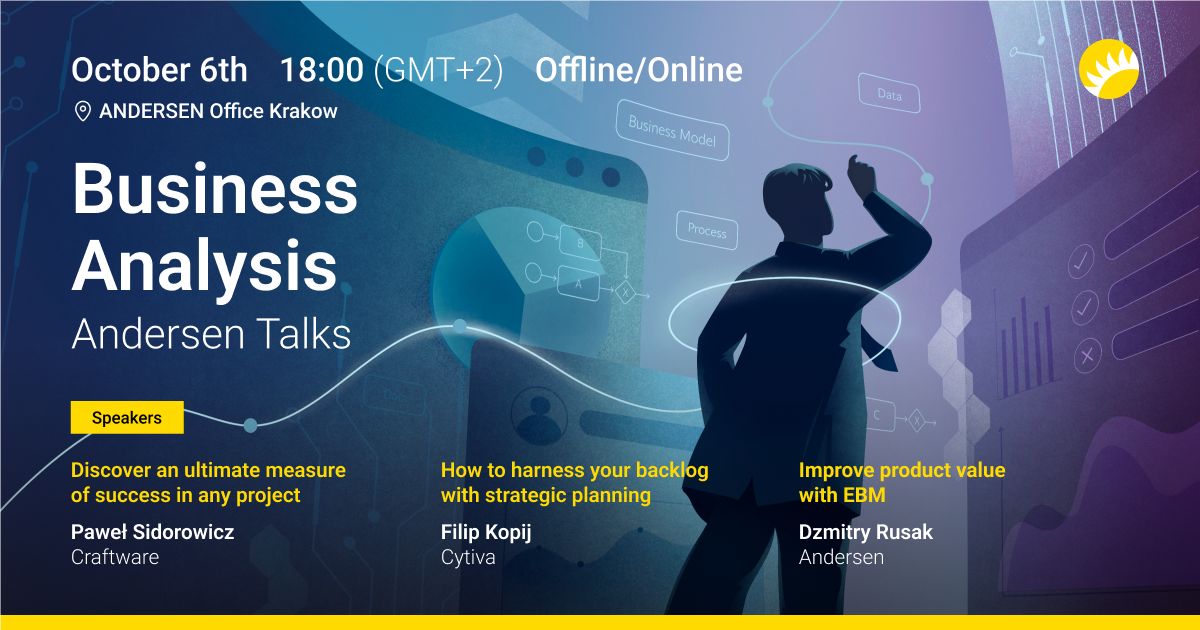
Are you a Business Analyst? Let’s talk about EBM, strategic planning, and glasses of beer as a measure of project success!
We’d like to invite you to Andersen's meetup in Krakow, where Senior Business Analysts and industry segment managers, who collected the best practices from their work in three comprehensive reports, will share their experiences with you. Along with valuable information, we guarantee subtle networking, pizza, and just a company of good people.
Are you in Krakow? Offline registration: https://lnkd.in/dRcfX_qz
Online registration: https://lnkd.in/dirDhbHp
And below is some more information about our speakers and their presentations!
1. Dzmitry Rusak (Business Analyst and Product Owner at Andersen)
Topic: Improve Product Value with EBM.
What is EBM (Evidence-Based Management)? EBM value within a project. EBM metrics. Feature prioritization based on EBM.
2. Paweł Sidorowicz (Team Lead and Business Analyst at Craftware)
Topic: "Do You Want to Grab Some Beer after Work?" as an Ultimate Measure of Success in Any Project.
You can use any framework, notation, or library, but if you don't build and sustain strong business relationships with stakeholders, you will never achieve success.
3. Filip Kopij (Business Analyst and Product Owner at Cytiva)
Topic: How to Harness Your Backlog Using Strategic Planning
How to prioritize a growing backlog? How to apply strategic planning to agile work? How to make sure you and your team follow the organization's strategic goals? I'll answer these and other questions during the session.
Seems useful, right? And it really is! Register using the link above and set a reminder in your calendar! See you!
We’d like to invite you to Andersen's meetup in Krakow, where Senior Business Analysts and industry segment managers, who collected the best practices from their work in three comprehensive reports, will share their experiences with you. Along with valuable information, we guarantee subtle networking, pizza, and just a company of good people.
Are you in Krakow? Offline registration: https://lnkd.in/dRcfX_qz
Online registration: https://lnkd.in/dirDhbHp
And below is some more information about our speakers and their presentations!
1. Dzmitry Rusak (Business Analyst and Product Owner at Andersen)
Topic: Improve Product Value with EBM.
What is EBM (Evidence-Based Management)? EBM value within a project. EBM metrics. Feature prioritization based on EBM.
2. Paweł Sidorowicz (Team Lead and Business Analyst at Craftware)
Topic: "Do You Want to Grab Some Beer after Work?" as an Ultimate Measure of Success in Any Project.
You can use any framework, notation, or library, but if you don't build and sustain strong business relationships with stakeholders, you will never achieve success.
3. Filip Kopij (Business Analyst and Product Owner at Cytiva)
Topic: How to Harness Your Backlog Using Strategic Planning
How to prioritize a growing backlog? How to apply strategic planning to agile work? How to make sure you and your team follow the organization's strategic goals? I'll answer these and other questions during the session.
Seems useful, right? And it really is! Register using the link above and set a reminder in your calendar! See you!
👍3
Let’s imagine that you have come up with an excellent business idea for a brand new product. You realize that the idea is more like your own hypothesis than a proven fact. That’s why you start asking yourself crucial questions shaping the future of a successful product: “Is there a real market need for the product?” “Who is the target audience?” “What are the key functionalities?” In addition, you want to have the ability to improve the product iteration by iteration. Here comes the concept of a minimum viable product, or MVP, which is of great help to business owners.
What the benefits of MVP development are?
MVP is a version of a product that has just enough features so that it can be tested by the first customers who provide feedback for future changes. What exact benefits does MVP offer a business?
📎Finding a market fit
MVP gives a company an opportunity to check in real life if there is any good demand for their future product. There is no sense in putting tons of effort into creating something that presents no interest at all.
📎Defining essential functionality
Every product sovles some problem that users have. Hence, your project goals and the needs of its target audience define what key features it must include to bring the most value to your business.
📎Raising investment
MVP software development doesn’t take long, however, the product perfectly reflects your project goals, contains main product features, and can be used to collect user feedback. Thus, startup leaders use them to present their ideas to investors and get the funding for their projects.
📎Optimizing resources
When you build an MVP, you focus all efforts on the features that users really need, and can calculate in detail their cost and time to develop. Therefore, it’s stongly recommended to go for an MVP to minimize product expenses and time to market.
In the next episode we will continue this topic.
Stay tuned⭐️
What the benefits of MVP development are?
MVP is a version of a product that has just enough features so that it can be tested by the first customers who provide feedback for future changes. What exact benefits does MVP offer a business?
📎Finding a market fit
MVP gives a company an opportunity to check in real life if there is any good demand for their future product. There is no sense in putting tons of effort into creating something that presents no interest at all.
📎Defining essential functionality
Every product sovles some problem that users have. Hence, your project goals and the needs of its target audience define what key features it must include to bring the most value to your business.
📎Raising investment
MVP software development doesn’t take long, however, the product perfectly reflects your project goals, contains main product features, and can be used to collect user feedback. Thus, startup leaders use them to present their ideas to investors and get the funding for their projects.
📎Optimizing resources
When you build an MVP, you focus all efforts on the features that users really need, and can calculate in detail their cost and time to develop. Therefore, it’s stongly recommended to go for an MVP to minimize product expenses and time to market.
In the next episode we will continue this topic.
Stay tuned⭐️

👍5
Kindly remind about some fascinating event⭐️
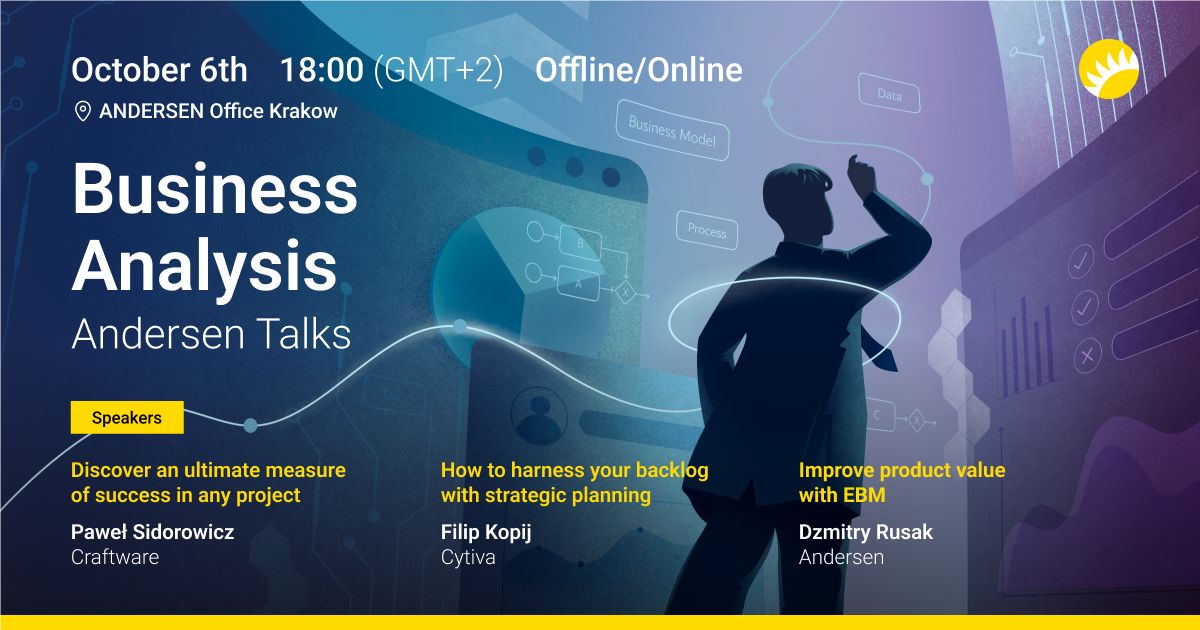
Are you a Business Analyst? Let’s talk about EBM, strategic planning, and glasses of beer as a measure of project success!
We’d like to invite you to Andersen's meetup in Krakow, where Senior Business Analysts and industry segment managers, who collected the best practices from their work in three comprehensive reports, will share their experiences with you. Along with valuable information, we guarantee subtle networking, pizza, and just a company of good people.
Are you in Krakow? Offline registration: https://lnkd.in/dRcfX_qz
Online registration: https://lnkd.in/dirDhbHp
And below is some more information about our speakers and their presentations!
1. Dzmitry Rusak (Business Analyst and Product Owner at Andersen)
Topic: Improve Product Value with EBM.
What is EBM (Evidence-Based Management)? EBM value within a project. EBM metrics. Feature prioritization based on EBM.
2. Paweł Sidorowicz (Team Lead and Business Analyst at Craftware)
Topic: "Do You Want to Grab Some Beer after Work?" as an Ultimate Measure of Success in Any Project.
You can use any framework, notation, or library, but if you don't build and sustain strong business relationships with stakeholders, you will never achieve success.
3. Filip Kopij (Business Analyst and Product Owner at Cytiva)
Topic: How to Harness Your Backlog Using Strategic Planning
How to prioritize a growing backlog? How to apply strategic planning to agile work? How to make sure you and your team follow the organization's strategic goals? I'll answer these and other questions during the session.
Seems useful, right? And it really is! Register using the link above and set a reminder in your calendar! See you!
Are you a Business Analyst? Let’s talk about EBM, strategic planning, and glasses of beer as a measure of project success!
We’d like to invite you to Andersen's meetup in Krakow, where Senior Business Analysts and industry segment managers, who collected the best practices from their work in three comprehensive reports, will share their experiences with you. Along with valuable information, we guarantee subtle networking, pizza, and just a company of good people.
Are you in Krakow? Offline registration: https://lnkd.in/dRcfX_qz
Online registration: https://lnkd.in/dirDhbHp
And below is some more information about our speakers and their presentations!
1. Dzmitry Rusak (Business Analyst and Product Owner at Andersen)
Topic: Improve Product Value with EBM.
What is EBM (Evidence-Based Management)? EBM value within a project. EBM metrics. Feature prioritization based on EBM.
2. Paweł Sidorowicz (Team Lead and Business Analyst at Craftware)
Topic: "Do You Want to Grab Some Beer after Work?" as an Ultimate Measure of Success in Any Project.
You can use any framework, notation, or library, but if you don't build and sustain strong business relationships with stakeholders, you will never achieve success.
3. Filip Kopij (Business Analyst and Product Owner at Cytiva)
Topic: How to Harness Your Backlog Using Strategic Planning
How to prioritize a growing backlog? How to apply strategic planning to agile work? How to make sure you and your team follow the organization's strategic goals? I'll answer these and other questions during the session.
Seems useful, right? And it really is! Register using the link above and set a reminder in your calendar! See you!
Let's continue topic MVP⭐️
What the challenges of MVP development are
Having taken into account the benefits that MVP offers companies, let's take a look at the challenges that they face while developing it.
Poor market research
How can you be sure that the target audience will find your product useful? In-depth market research conducted by professional Business Analysts prior to the MVP development process and also after it’s completed and you receive user feedback will help. Insufficient research, in turn, will result in vague functionality, inabitily to define what software has already been introduced to the market by your competitors, who your target audience is, what functionality is needed to meet their needs, and how to adjust your solution so that it would be a success. Thus, inadequate market research will ultimately result in the product failure.
Inexperienced development team
Sometimes companies opt for hiring low-skilled teams to build an MVP which might seem like a cost-effective options. Subsequently, they start looking for a top-notch team to finalize the development and release the final version of software. This leads to a situation when the product quality is tremendously affected entailing negative user feedback. Lack of experience, proper planning, and control over the development process creates chaos on a project. Thus, when you hire any team member, verify that they have a proven experience in MVP software development.
Superfluity of features
It is strongly recommended to avoid adding extra features, that don’t cover basic user needs, to an MVP. When you’re trying to add as many nice-to-have features to your product as possible, the development will cost you more and take substantially more time. Any additional features that aren’t critical for software proper functioning and solving the main problem of users can be implemented later when upgrading your soltuon.
Strive for perfection
When it comes to MVP development, startups spend more time than needed to create a perfect solution continuosly improving its features. However, users don’t need this perfection if the feature doesn’t have any value for them. MVP isn’t meant to be perfect, its aim is to provide a business with insights to develop the final product.
Inappropriate time for the launch
It is of paramount importance to launch an MVP at the right moment since first impressions last. If the launch is too early, when the core features aren’t ready yet, users will be disappointed and will cease turning to your app. If the launch is too late, when the competitors’ products are already on the market, attracting user attention to your software will be challenging. The solution to this problem is to start establishing contacts with your potential users prior to the product launch to keep them updated.
What the challenges of MVP development are
Having taken into account the benefits that MVP offers companies, let's take a look at the challenges that they face while developing it.
Poor market research
How can you be sure that the target audience will find your product useful? In-depth market research conducted by professional Business Analysts prior to the MVP development process and also after it’s completed and you receive user feedback will help. Insufficient research, in turn, will result in vague functionality, inabitily to define what software has already been introduced to the market by your competitors, who your target audience is, what functionality is needed to meet their needs, and how to adjust your solution so that it would be a success. Thus, inadequate market research will ultimately result in the product failure.
Inexperienced development team
Sometimes companies opt for hiring low-skilled teams to build an MVP which might seem like a cost-effective options. Subsequently, they start looking for a top-notch team to finalize the development and release the final version of software. This leads to a situation when the product quality is tremendously affected entailing negative user feedback. Lack of experience, proper planning, and control over the development process creates chaos on a project. Thus, when you hire any team member, verify that they have a proven experience in MVP software development.
Superfluity of features
It is strongly recommended to avoid adding extra features, that don’t cover basic user needs, to an MVP. When you’re trying to add as many nice-to-have features to your product as possible, the development will cost you more and take substantially more time. Any additional features that aren’t critical for software proper functioning and solving the main problem of users can be implemented later when upgrading your soltuon.
Strive for perfection
When it comes to MVP development, startups spend more time than needed to create a perfect solution continuosly improving its features. However, users don’t need this perfection if the feature doesn’t have any value for them. MVP isn’t meant to be perfect, its aim is to provide a business with insights to develop the final product.
Inappropriate time for the launch
It is of paramount importance to launch an MVP at the right moment since first impressions last. If the launch is too early, when the core features aren’t ready yet, users will be disappointed and will cease turning to your app. If the launch is too late, when the competitors’ products are already on the market, attracting user attention to your software will be challenging. The solution to this problem is to start establishing contacts with your potential users prior to the product launch to keep them updated.

👍4
Documenting Software Requirements: How to Do It Right?
Global digitalization is leading to a drastic increase in the number of software companies offering their services. However, statistically, 17% of IT projects fail, which leads to irreparable consequences for businesses, 7% of projects exceed their deadlines, and nearly half of them overrun their budget.
Analyzing business requirements increases the chances of finishing the project on time by 75% and allows business owners to save up to half of the project’s budget.
Three reasons why you should document the requirements
Below are the most important reasons why analyzing business requirements and carefully documenting them during Project Discovery is crucial for a project.
Better project traceability
Thanks to the documents created by a Business Analyst, the team and stakeholders are on the same page regarding the developmental and testing processes. Everybody who is involved in the project knows exactly what needs to be done and what the project goals, scope, challenges, functional and non-functional requirements, and budget are.
The information both on specific tasks and on the general direction of work is always available. This allows the customer to stay up to date with the development process and even direct it. More importantly, structuring the requirements and storing them in one place make the project’s details clear to stakeholders, and therefore, the resulting product will meet their expectations to the fullest extent.
Efficient troubleshooting
Scope creep refers to the expansion of a project’s functionality that is beyond control. As a result, the development can substantially exceed the planned budget and timelines. This issue arises when the customers come up with many different ideas that haven’t been analyzed and prioritized by a dedicated specialist. This issue is found in about half of all projects, which means that only half of them are implemented on budget and within the timelines.
Meanwhile, carefully prepared business analysis documentation guarantees that, if your large-scale project expands, that can be easily controlled, and the developmental process won’t turn into a disaster due to multiple changes and gold plating.
Consistency of requirements
Keeping all the Business Analyst’s documents in one place ensures that the requirements can be restored even in case of data loss or data leakage. Such issues can occur when a team member leaves the project, the requirements become outdated, or if different sources contain contradictory information.
When the requirements are carefully documented, you as the customer can be sure that every idea, insight, and suggestion that was made is taken into account, analyzed, structured, documented, and updated by the team of experts.
In the next episode we will know what artifacts in software engineering are and how they help you reduce project costs⭐️
#Discovery
Global digitalization is leading to a drastic increase in the number of software companies offering their services. However, statistically, 17% of IT projects fail, which leads to irreparable consequences for businesses, 7% of projects exceed their deadlines, and nearly half of them overrun their budget.
Analyzing business requirements increases the chances of finishing the project on time by 75% and allows business owners to save up to half of the project’s budget.
Three reasons why you should document the requirements
Below are the most important reasons why analyzing business requirements and carefully documenting them during Project Discovery is crucial for a project.
Better project traceability
Thanks to the documents created by a Business Analyst, the team and stakeholders are on the same page regarding the developmental and testing processes. Everybody who is involved in the project knows exactly what needs to be done and what the project goals, scope, challenges, functional and non-functional requirements, and budget are.
The information both on specific tasks and on the general direction of work is always available. This allows the customer to stay up to date with the development process and even direct it. More importantly, structuring the requirements and storing them in one place make the project’s details clear to stakeholders, and therefore, the resulting product will meet their expectations to the fullest extent.
Efficient troubleshooting
Scope creep refers to the expansion of a project’s functionality that is beyond control. As a result, the development can substantially exceed the planned budget and timelines. This issue arises when the customers come up with many different ideas that haven’t been analyzed and prioritized by a dedicated specialist. This issue is found in about half of all projects, which means that only half of them are implemented on budget and within the timelines.
Meanwhile, carefully prepared business analysis documentation guarantees that, if your large-scale project expands, that can be easily controlled, and the developmental process won’t turn into a disaster due to multiple changes and gold plating.
Consistency of requirements
Keeping all the Business Analyst’s documents in one place ensures that the requirements can be restored even in case of data loss or data leakage. Such issues can occur when a team member leaves the project, the requirements become outdated, or if different sources contain contradictory information.
When the requirements are carefully documented, you as the customer can be sure that every idea, insight, and suggestion that was made is taken into account, analyzed, structured, documented, and updated by the team of experts.
In the next episode we will know what artifacts in software engineering are and how they help you reduce project costs⭐️
#Discovery
👍9
What artifacts in software engineering are and how they help you reduce project costs
Artifacts are items created in the course of project development that don’t pertain to the product itself but help the team work on it. Business Analysts are responsible for the preparation of the following software engineering artifacts.
Meeting agenda
Description. Agenda is an artifact prepared before every meeting of the shareholders with the team and the meetings of the team members with each other. The goal of this artifact is to outline the key features of the forthcoming meeting. These meetings are conducted in order to elicit and specify the requirements, discuss important issues, and agree on a single vision for the product.
The meeting agenda includes the following information:
📎general information about the meeting, i.e. its topic, time, location, and duration
📎the number of participants and their positions
📎issues to be discussed
📎expected results
📎additional materials, e.g. preparatory documents
Value. The agenda is extremely helpful in terms of making the meetings more productive as everybody knows the discussion plan and prepares for the event in advance. This artifact in software engineering saves the shareholders’ time allowing them to concentrate on the most important issues, meaning that more time will be spent on delivering value to the project.
Average preparation time: from thirty minutes to an hour.
A follow-up email
Description. This document summarizes the results of a meeting. It’s usually prepared in the format of an email which is compiled and sent to all the meeting participants after the meeting. Its purpose is to record the negotiation results and establish contact between everybody who was in the meeting.
Value. The follow-up email provides a clear vision of the development, including a recap of agreed items, proposed solutions, and received feedback. For the customer, it is a proven way to ensure that their position was rightly understood and the designed features will meet their expectations.
Average preparation time: from thirty minutes to an hour.
In the next episode we will continue looking through the artifacts in software. Stay tuned ⭐️
#Discovery
Artifacts are items created in the course of project development that don’t pertain to the product itself but help the team work on it. Business Analysts are responsible for the preparation of the following software engineering artifacts.
Meeting agenda
Description. Agenda is an artifact prepared before every meeting of the shareholders with the team and the meetings of the team members with each other. The goal of this artifact is to outline the key features of the forthcoming meeting. These meetings are conducted in order to elicit and specify the requirements, discuss important issues, and agree on a single vision for the product.
The meeting agenda includes the following information:
📎general information about the meeting, i.e. its topic, time, location, and duration
📎the number of participants and their positions
📎issues to be discussed
📎expected results
📎additional materials, e.g. preparatory documents
Value. The agenda is extremely helpful in terms of making the meetings more productive as everybody knows the discussion plan and prepares for the event in advance. This artifact in software engineering saves the shareholders’ time allowing them to concentrate on the most important issues, meaning that more time will be spent on delivering value to the project.
Average preparation time: from thirty minutes to an hour.
A follow-up email
Description. This document summarizes the results of a meeting. It’s usually prepared in the format of an email which is compiled and sent to all the meeting participants after the meeting. Its purpose is to record the negotiation results and establish contact between everybody who was in the meeting.
Value. The follow-up email provides a clear vision of the development, including a recap of agreed items, proposed solutions, and received feedback. For the customer, it is a proven way to ensure that their position was rightly understood and the designed features will meet their expectations.
Average preparation time: from thirty minutes to an hour.
In the next episode we will continue looking through the artifacts in software. Stay tuned ⭐️
#Discovery
👍9
Let's continue to discuss BA/SA artifacts in software engineering 🤓
🔶Vision & Scope document
Description. Different types of documents from a Business Analyst are required depending on the project’s specific needs. Each of the following documents covers a particular area of the project/product and has a different scope.
The Vision & Scope document consists of the following two parts:
🔸The vision part is a high-level description of a solution that needs to be delivered. This concept identifies current issues and the ways to solve them, business opportunities, and concomitant risks, and includes the metrics that will help you successfully reach your goals.
🔸The scope part specifies the amount of work to be done in order to achieve the goals. It lists project deliverables in the form of features developed in each release, basic assumptions, dependencies, the industry rules, and other limitations imposed on software.
Value. The Vision & Scope document helps all the stakeholders have the same vision of the project goals and a clear understanding of what needs to be done to achieve the needed outcomes. It allows the project participants to avoid misunderstandings early in the software development life cycle that could otherwise result in a costly and time-consuming rework.
Average preparation time: from two to four weeks.
🔶Software Requirements Specification
Description. This extensive Business Analyst’s artifact contains detailed product information, including the methodologies that will be applied, the technology stack, functional and non-functional requirements, etc.
Value. SRS serves as a detailed plan for custom software development containing all the necessary information about the product’s functionality, features, and limitations. It helps both the customer and the IT vendor be on the same page regarding these important issues. The document contains precise requirements assessment and precedes the architecture and design stage. Such thorough planning allows the customer to avoid a costly rework and obtain accurate information as to the development cost, timelines, and risks.
Average preparation time: from four to eight weeks.
🔶User stories, user story maps, and use cases
Description. A user story describes a software feature from a user's perspective and serves as a basis for collecting and documenting user requirements. It describes user types, needs, and expectations so that the developers can deliver a user-oriented product that brings value to end-users.
User stories are normally visualized in the form of user story maps. The latter allows the team to prioritize user stories and match them with the corresponding functionality.
A use case is a written description of a sequence of simple steps which the users take to perform the necessary actions. It outlines the system's behavior from a user’s point of view.
Value. All of the aforementioned software engineering artifacts allow Business Analysts to implement a user-driven approach to software design and ensure that the developed product satisfies the needs of end-users, thus, increasing the product’s popularity in the market.
Average preparation time: a user story/a use case — less than a day, a user story map — up to five days.
🔶Vision & Scope document
Description. Different types of documents from a Business Analyst are required depending on the project’s specific needs. Each of the following documents covers a particular area of the project/product and has a different scope.
The Vision & Scope document consists of the following two parts:
🔸The vision part is a high-level description of a solution that needs to be delivered. This concept identifies current issues and the ways to solve them, business opportunities, and concomitant risks, and includes the metrics that will help you successfully reach your goals.
🔸The scope part specifies the amount of work to be done in order to achieve the goals. It lists project deliverables in the form of features developed in each release, basic assumptions, dependencies, the industry rules, and other limitations imposed on software.
Value. The Vision & Scope document helps all the stakeholders have the same vision of the project goals and a clear understanding of what needs to be done to achieve the needed outcomes. It allows the project participants to avoid misunderstandings early in the software development life cycle that could otherwise result in a costly and time-consuming rework.
Average preparation time: from two to four weeks.
🔶Software Requirements Specification
Description. This extensive Business Analyst’s artifact contains detailed product information, including the methodologies that will be applied, the technology stack, functional and non-functional requirements, etc.
Value. SRS serves as a detailed plan for custom software development containing all the necessary information about the product’s functionality, features, and limitations. It helps both the customer and the IT vendor be on the same page regarding these important issues. The document contains precise requirements assessment and precedes the architecture and design stage. Such thorough planning allows the customer to avoid a costly rework and obtain accurate information as to the development cost, timelines, and risks.
Average preparation time: from four to eight weeks.
🔶User stories, user story maps, and use cases
Description. A user story describes a software feature from a user's perspective and serves as a basis for collecting and documenting user requirements. It describes user types, needs, and expectations so that the developers can deliver a user-oriented product that brings value to end-users.
User stories are normally visualized in the form of user story maps. The latter allows the team to prioritize user stories and match them with the corresponding functionality.
A use case is a written description of a sequence of simple steps which the users take to perform the necessary actions. It outlines the system's behavior from a user’s point of view.
Value. All of the aforementioned software engineering artifacts allow Business Analysts to implement a user-driven approach to software design and ensure that the developed product satisfies the needs of end-users, thus, increasing the product’s popularity in the market.
Average preparation time: a user story/a use case — less than a day, a user story map — up to five days.
🔥3👍2
☝️It has been said that a picture is worth a thousand words. For people, it is much easier to comprehend abstract information by looking at it, visualizing it in their mind, and thus, seeing the whole picture.
According to Statista, the value of the global data visualization market is projected to reach $7.76 billion in 2023, growing by about 9% yearly. This fact alone proves data visualization tools are an effective means for providing better perception and cognition of information.
Three reasons why you should visualize the requirements
A rule of thumb states that the more complicated software architecture is, the more detailed and structured the visualization of every part of the system should be. Functional requirements in business analysis that are presented graphically communicate some types of information more efficiently than text. For example, it’s easier to describe a system’s data flow with diagrams and the interface details with wireframes and prototypes, rather than writing dozens of text documents for this purpose.
Below are several benefits that proper visualization of requirements brings to a project:
🔶A holistic view of the system’s functionality
Indivisible software requirements contained in a Business Analyst’s documents that describe the system’s design, the testing process, and work management are called atomic requirements. Along with the undeniable benefits that well-documented requirements bring to a project they have a serious drawback. Namely, they prevent shareholders from embracing the system as a whole and understanding the designed business logic and software functionality clearly. All that customers see is a broad to-do list with no idea how everything is going to be implemented.
The requirements visualized by a Business Analyst allow customers to see the scale and complexity of a product and its functionality. This is extremely important for accurate estimation of budget and timelines. Additionally, the product’s graphic representation marks the first step in transforming rough requirements into a well-designed solution with a detailed plan for its implementation.
🔶Requirements verification
By visualizing requirements, Business Analysts are able to identify errors, missing requirements, and lacking coverage of the designed functionality with use cases.
There always exists a strong temptation to start the development process right after the requirements are elicited and documented. However, in the early stages of a project lifecycle, the concept that is being designed is full of flaws and inaccuracies due to the lack of user and customer feedback. In addition, the development team might not understand the product goals clearly.
The aim of visualizing the Business Analyst’s functional requirements is to construct a completed piece of business/user flow with all possible scenarios involved. This helps a Business Analyst identify unaccounted aspects of the functionality, ensure logical consistency of the designed model and the exhaustive nature of the documentation where all the requirements and use cases are described.
🔶Quick feedback from stakeholders
According to the Agile approach toward custom software development, the customer and the development team need to interact closely so that efficient cooperation can be ensured and a valuable product can thus be delivered. Agile projects necessitate constant communication between the project members, frequent demo meetings, elicitation of valuable insights, and gathering user feedback.
Visualized documents created by a Business Analyst are easily reviewed by the customer who can give feedback quickly. Thus, the product is updated according to new guidelines. As a result, projects develop in a flexible manner, new solutions and approaches are implemented, and shareholders can even be involved in the designing process which adds to the collaboration.
⭐️In the next episode we will find out what artifacts in software development do Business Analysts create by means of visualization
According to Statista, the value of the global data visualization market is projected to reach $7.76 billion in 2023, growing by about 9% yearly. This fact alone proves data visualization tools are an effective means for providing better perception and cognition of information.
Three reasons why you should visualize the requirements
A rule of thumb states that the more complicated software architecture is, the more detailed and structured the visualization of every part of the system should be. Functional requirements in business analysis that are presented graphically communicate some types of information more efficiently than text. For example, it’s easier to describe a system’s data flow with diagrams and the interface details with wireframes and prototypes, rather than writing dozens of text documents for this purpose.
Below are several benefits that proper visualization of requirements brings to a project:
🔶A holistic view of the system’s functionality
Indivisible software requirements contained in a Business Analyst’s documents that describe the system’s design, the testing process, and work management are called atomic requirements. Along with the undeniable benefits that well-documented requirements bring to a project they have a serious drawback. Namely, they prevent shareholders from embracing the system as a whole and understanding the designed business logic and software functionality clearly. All that customers see is a broad to-do list with no idea how everything is going to be implemented.
The requirements visualized by a Business Analyst allow customers to see the scale and complexity of a product and its functionality. This is extremely important for accurate estimation of budget and timelines. Additionally, the product’s graphic representation marks the first step in transforming rough requirements into a well-designed solution with a detailed plan for its implementation.
🔶Requirements verification
By visualizing requirements, Business Analysts are able to identify errors, missing requirements, and lacking coverage of the designed functionality with use cases.
There always exists a strong temptation to start the development process right after the requirements are elicited and documented. However, in the early stages of a project lifecycle, the concept that is being designed is full of flaws and inaccuracies due to the lack of user and customer feedback. In addition, the development team might not understand the product goals clearly.
The aim of visualizing the Business Analyst’s functional requirements is to construct a completed piece of business/user flow with all possible scenarios involved. This helps a Business Analyst identify unaccounted aspects of the functionality, ensure logical consistency of the designed model and the exhaustive nature of the documentation where all the requirements and use cases are described.
🔶Quick feedback from stakeholders
According to the Agile approach toward custom software development, the customer and the development team need to interact closely so that efficient cooperation can be ensured and a valuable product can thus be delivered. Agile projects necessitate constant communication between the project members, frequent demo meetings, elicitation of valuable insights, and gathering user feedback.
Visualized documents created by a Business Analyst are easily reviewed by the customer who can give feedback quickly. Thus, the product is updated according to new guidelines. As a result, projects develop in a flexible manner, new solutions and approaches are implemented, and shareholders can even be involved in the designing process which adds to the collaboration.
⭐️In the next episode we will find out what artifacts in software development do Business Analysts create by means of visualization

👍4
What artifacts in software development do Business Analysts create by means of visualization?
Generally, there are five groups of software engineering artifacts provided by a Business Analyst that help companies reduce project costs. They are the following:
🔶 Diagrams
A diagram is a schematic representation of particular processes in a system. Diagrams vary depending on:
🔸their level of abstraction: high-level vs. detailed diagrams
🔸language or notation used for modeling: diagrams are either based on the Unified Modeling Language (UML) or on Business Process Model and Notation (BPMN)
🔸the types of system representation: structural, behavioral, and interaction diagrams.
The most popular diagrams include but are not limited to:
📎 Activity diagrams modeling business workflows as a list of actions and their consequences
📎 Entity-relationship diagrams illustrating the interaction of different entities, e.g. objects, concepts, and people, with each other within a system
📎 Use case diagrams illustrating possible interactions of a user with a system
📎 Class diagrams describing the system’s structure by showing its classes, their attributes, operations, and relationships between objects
📎 Statechart diagrams describing transitions between the states of an entity when a specific event happens
📎 Sequence diagrams showing process interactions arranged in time sequence
📎 End-to-end diagrams describing the entire business process with all possible alternative scenarios and being used for high-level modeling or when onboarding new members of a dedicated software development team
📎 BPMN diagrams describing processes by means of a frequently used language, which helps project participants avoid communication gaps.
Value. Each diagram has its purpose helping Business Analysts conceptualize the requirements at the necessary level of abstraction and identify where information is missing.
Average preparation time: from one to three days.
⭐️In the next episode we will continue discussing what artifacts in software development do Business Analysts create by means of visualization
Generally, there are five groups of software engineering artifacts provided by a Business Analyst that help companies reduce project costs. They are the following:
🔶 Diagrams
A diagram is a schematic representation of particular processes in a system. Diagrams vary depending on:
🔸their level of abstraction: high-level vs. detailed diagrams
🔸language or notation used for modeling: diagrams are either based on the Unified Modeling Language (UML) or on Business Process Model and Notation (BPMN)
🔸the types of system representation: structural, behavioral, and interaction diagrams.
The most popular diagrams include but are not limited to:
📎 Activity diagrams modeling business workflows as a list of actions and their consequences
📎 Entity-relationship diagrams illustrating the interaction of different entities, e.g. objects, concepts, and people, with each other within a system
📎 Use case diagrams illustrating possible interactions of a user with a system
📎 Class diagrams describing the system’s structure by showing its classes, their attributes, operations, and relationships between objects
📎 Statechart diagrams describing transitions between the states of an entity when a specific event happens
📎 Sequence diagrams showing process interactions arranged in time sequence
📎 End-to-end diagrams describing the entire business process with all possible alternative scenarios and being used for high-level modeling or when onboarding new members of a dedicated software development team
📎 BPMN diagrams describing processes by means of a frequently used language, which helps project participants avoid communication gaps.
Value. Each diagram has its purpose helping Business Analysts conceptualize the requirements at the necessary level of abstraction and identify where information is missing.
Average preparation time: from one to three days.
⭐️In the next episode we will continue discussing what artifacts in software development do Business Analysts create by means of visualization

👍1
Let's continue topic what artifacts in software development do Business Analysts create by means of visualization
🔶 Analysis models
An analysis model is an efficient tool developed to show all the aspects of a problem and determine the best way to meet a specific set of user needs. It consists of the most important concepts, dimensions, and indicators used to characterize a research area. This artifact provides a Business Analyst with a template of issues and insights to pay attention to when analyzing a specific requirement.
The most popular analysis models include but are not limited to:
📎 A product roadmap outlining the product’s development, features, and evolution
📎 The business analysis approach describing the approach toward the planning of activities in business analysis and the ways of achieving desired outcomes
📎 The SWOT analysis model evaluating the merits and flaws of a business and identifying opportunities and threats
📎 The PESTLE analysis model evaluating different groups of factors, their possible impact on the product, duration of effect, type of impact, i.e. negative or positive, and level of importance
📎 Requirements prioritization models, e.g. Kano model and Pareto chart, helping Business Analysts deconstruct and prioritize requirements by specific metrics and based on dedicated criteria
📎 A persona describing common interests, needs, behavioral patterns, and expectations of a particular group of end-users who interact with the product in a similar way
📎 Benchmarking charts, graphs, and dashboards visualizing the results of market analysis and comparison of the designed product with the alternatives offered by competitors in an intuitive format convenient for the customer
📎 A conceptual data model structurizing the data related to business processes and performance indicators.
Value. Analysis models allow project participants to conceptualize information about the designed product and extract valuable insights using helpful templates. These documents prepared by a Business Analyst help those involved in the project identify product needs, opportunities for growth, and problem areas that require careful attention.
Average preparation time: from one to three days.
⭐️In the next episode we will continue discussing what artifacts in software development do Business Analysts create by means of visualization
🔶 Analysis models
An analysis model is an efficient tool developed to show all the aspects of a problem and determine the best way to meet a specific set of user needs. It consists of the most important concepts, dimensions, and indicators used to characterize a research area. This artifact provides a Business Analyst with a template of issues and insights to pay attention to when analyzing a specific requirement.
The most popular analysis models include but are not limited to:
📎 A product roadmap outlining the product’s development, features, and evolution
📎 The business analysis approach describing the approach toward the planning of activities in business analysis and the ways of achieving desired outcomes
📎 The SWOT analysis model evaluating the merits and flaws of a business and identifying opportunities and threats
📎 The PESTLE analysis model evaluating different groups of factors, their possible impact on the product, duration of effect, type of impact, i.e. negative or positive, and level of importance
📎 Requirements prioritization models, e.g. Kano model and Pareto chart, helping Business Analysts deconstruct and prioritize requirements by specific metrics and based on dedicated criteria
📎 A persona describing common interests, needs, behavioral patterns, and expectations of a particular group of end-users who interact with the product in a similar way
📎 Benchmarking charts, graphs, and dashboards visualizing the results of market analysis and comparison of the designed product with the alternatives offered by competitors in an intuitive format convenient for the customer
📎 A conceptual data model structurizing the data related to business processes and performance indicators.
Value. Analysis models allow project participants to conceptualize information about the designed product and extract valuable insights using helpful templates. These documents prepared by a Business Analyst help those involved in the project identify product needs, opportunities for growth, and problem areas that require careful attention.
Average preparation time: from one to three days.
⭐️In the next episode we will continue discussing what artifacts in software development do Business Analysts create by means of visualization

👍4
Let's continue topic what artifacts in software development do Business Analysts create by means of visualization
🔶Matrices
The most popular types of matrices include but are not limited to:
🔸 The requirements traceability matrix links product requirements in different stages of their existence, from the time when they were identified up to the time when they are fulfilled. The matrix ensures that the documented requirements will be delivered as requested by stakeholders. It shows the requirements coverage in terms of the number of test cases and their execution statuses.
🔸 The RACI matrix illustrates the goal of a task and the actions required from each involved person to complete it, helping to define the areas of responsibility and assign team members to perform the work.
Value. Matrices allow the team to analyze changes in the requirements and make informed decisions regarding product development. In addition, they ensure efficient communication between team members and with shareholders as everybody is informed about their areas of responsibility and shares a common vision of threats and opportunities related to the project.
Average preparation time: up to two days.
⭐️In the next episode we will continue discussing what artifacts in software development do Business Analysts create by means of visualization
🔶Matrices
The most popular types of matrices include but are not limited to:
🔸 The requirements traceability matrix links product requirements in different stages of their existence, from the time when they were identified up to the time when they are fulfilled. The matrix ensures that the documented requirements will be delivered as requested by stakeholders. It shows the requirements coverage in terms of the number of test cases and their execution statuses.
🔸 The RACI matrix illustrates the goal of a task and the actions required from each involved person to complete it, helping to define the areas of responsibility and assign team members to perform the work.
Value. Matrices allow the team to analyze changes in the requirements and make informed decisions regarding product development. In addition, they ensure efficient communication between team members and with shareholders as everybody is informed about their areas of responsibility and shares a common vision of threats and opportunities related to the project.
Average preparation time: up to two days.
⭐️In the next episode we will continue discussing what artifacts in software development do Business Analysts create by means of visualization

👍3
Let's continue topic what artifacts in software development do Business Analysts create by means of visualization
🔶Wireframes and mock-ups
🔸A wireframe is a schematic representation of a designed software structure. It is a blueprint of the interface that focuses on the prioritization of content, functionalities available, space allocation, and intended behaviors.
🔸A mock-up is a high-fidelity render of the design that showcases what the finished product will look like. Mock-ups are more detailed than wireframes and require more time to create.
Value. The above artifacts in software development help programmers and designers think through the software structure and interface and efficiently communicate with each other when working on web solutions or mobile apps. These documents created by a Business Analyst before the product’s visual design is finalized and the code is written will save you from costly rework.
Average preparation time: from several days to a week.
🔶Prototypes
A prototype is an elementary working model of a product or information system usually built for demonstration purposes. It serves as a basis for future software development. Prototyping allows Business Analysts to research new alternatives to the existing design and test it to finalize the product’s functionality prior to its development.
Value. Prototypes help the project participants grasp the project’s concept and exchange ideas with the customer. They also ensure valuable feedback from the customer and end-users even before the code is written. Thus, the solution’s design can be modified in a timely manner to achieve the best possible results.
Average preparation time: from several days to a week.
☝️Summary
The visual artifacts prepared by Business Analysts bring substantial value to both the customer and the development team. Graphical representations of the Business Analyst’s documents ensure that the product development runs smoothly and help customers avoid costly and time-consuming rework.
🔶Wireframes and mock-ups
🔸A wireframe is a schematic representation of a designed software structure. It is a blueprint of the interface that focuses on the prioritization of content, functionalities available, space allocation, and intended behaviors.
🔸A mock-up is a high-fidelity render of the design that showcases what the finished product will look like. Mock-ups are more detailed than wireframes and require more time to create.
Value. The above artifacts in software development help programmers and designers think through the software structure and interface and efficiently communicate with each other when working on web solutions or mobile apps. These documents created by a Business Analyst before the product’s visual design is finalized and the code is written will save you from costly rework.
Average preparation time: from several days to a week.
🔶Prototypes
A prototype is an elementary working model of a product or information system usually built for demonstration purposes. It serves as a basis for future software development. Prototyping allows Business Analysts to research new alternatives to the existing design and test it to finalize the product’s functionality prior to its development.
Value. Prototypes help the project participants grasp the project’s concept and exchange ideas with the customer. They also ensure valuable feedback from the customer and end-users even before the code is written. Thus, the solution’s design can be modified in a timely manner to achieve the best possible results.
Average preparation time: from several days to a week.
☝️Summary
The visual artifacts prepared by Business Analysts bring substantial value to both the customer and the development team. Graphical representations of the Business Analyst’s documents ensure that the product development runs smoothly and help customers avoid costly and time-consuming rework.

❤1