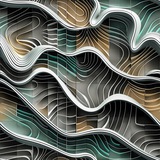
And the third work from Ekaterina Zakablutskaya. Also LORA, but for SDXL (download here). This model is focused on generating terraced buildings. In the presentation that I attach below, it is interesting to read about the experiments with #revit . Overall the model is very cool with the materials and vegetation. It's probably one of the most realistic architectural SDXL LORA I've seen. Here are some images that I generated with it.
Ekaterina Zakablutskaya_Final_LORA training.pdf
6.8 MB
The PDF with the presentation is in Russian, but most of the stuff is clear from the images, I guess.
🔥3
And of course, those who managed to complete the task received certificates. The assignment was not simple and was time-consuming, just like the course itself.
❤3
Let's talk about ip-adapter for flux. what you need to know about it:
- first, it is not as accurate as the similar approach for sdxl;
- second, you need even more graphics memory than just for flux, but there is a nuance, which I will tell you next post today;
- third, ip-adapter for flux can't be combined with control net (or I haven't found how to do it in a good way. formally mistoline cn works with xlabs sampler but results are incredibly bad in my tests), nevertheless control net doesn't work well with the architecture tasks yet, so it's not a big loss.
#comfyui
- first, it is not as accurate as the similar approach for sdxl;
- second, you need even more graphics memory than just for flux, but there is a nuance, which I will tell you next post today;
- third, ip-adapter for flux can't be combined with control net (or I haven't found how to do it in a good way. formally mistoline cn works with xlabs sampler but results are incredibly bad in my tests), nevertheless control net doesn't work well with the architecture tasks yet, so it's not a big loss.
#comfyui
👍1
about accuracy, this is an example of the original image (left) and the result (right). you can see that the style is completely different, here, rather, we are talking about the fact that the features of the object from the original image are transferred, not the style. In the ip-adapter node we have almost no settings, except for strength, unlike SDXL, where there are many parameters. nevertheless, the result is interesting and the approach itself can be used for form finding. and you can also add LORA, I did so in the example that I shared above. I used my own LORA.
To save memory it makes sense to download and use GGUF Flux models. on the ip-adapter page they recommend this one specifically: flux1-dev-Q4_0.gguf, there are also other recommendations for running on weak machines (and for Flux almost anything is a weak machine).
GitHub
GitHub - city96/ComfyUI-GGUF: GGUF Quantization support for native ComfyUI models
GGUF Quantization support for native ComfyUI models - city96/ComfyUI-GGUF
Today is the last day to register for our December webinar at a discounted price https://designmorphine.com/education/cellular-diffusions-v1-0
DesignMorphine - Cellular Diffusions V1.0
Cellular Diffusions V1.0
Ai Diffusion Voxels
posted another one of my LORA on civitai.
https://civitai.com/models/776612?modelVersionId=868589
#comfyui #ai
https://civitai.com/models/776612?modelVersionId=868589
#comfyui #ai
❤14👍2🔥1